


Big numbers are comforting. When a market crosses 13.43 million securities accounts and adds roughly 1.56 million more in just six months, the instinctive reaction is simple: more people are coming in, so opportunities must be getting easier to find.VSDCTuổi Trẻ
That is exactly where many first-time investors misread the signal. Account growth measures how mainstream the market is becoming. It does not measure how easy the market has become to make money in. A bigger crowd can still be chasing a narrow set of winners, leaving a lot of portfolios behind even while the headline numbers look healthy.
What the account surge does prove
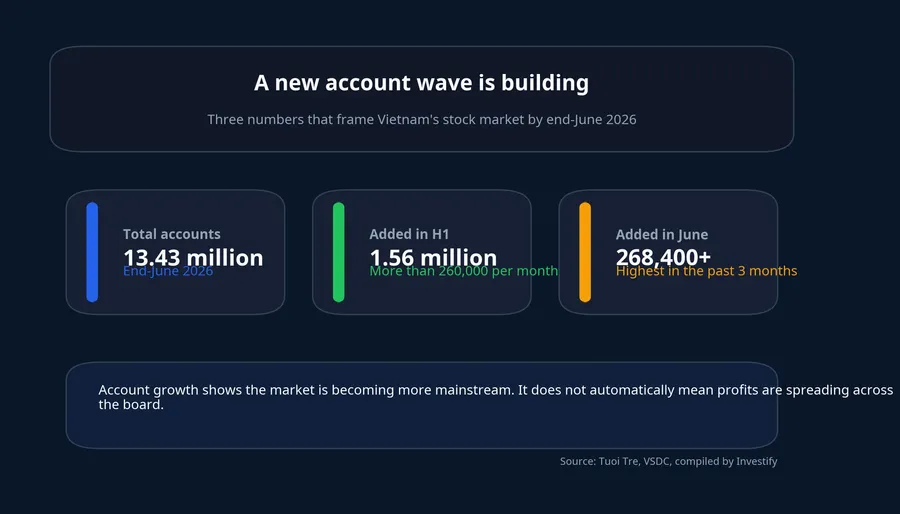
By the end of June 2026, Vietnam's stock market had 13,430,517 trading accounts. Domestic individual investors alone accounted for 13,358,399 of them.VSDC That is a meaningful long-term signal. It says equities are becoming more familiar to ordinary households rather than remaining a niche product for a relatively small investor base.
The pace matters too. Tuổi Trẻ reported that the market added roughly 1.56 million accounts in the first half of 2026, including more than 268,400 in June alone, the strongest monthly increase in the past three months.Tuổi Trẻ Public interest is clearly still expanding. New investors are not stepping back.
But the account count leaves out the harder questions. It does not tell you how many of those accounts are funded, how much money actually entered the market, or whether that money is spreading across sectors instead of piling into a small cluster of leaders. Those missing details are exactly what determine whether beginners are entering a generous market or a selective one.
That distinction matters. If you treat a rising account count as a direct buy signal, you are turning a popularity metric into a profitability metric. The data does not support that leap.
A higher index is not the same as broader opportunity
The obvious pushback is that VN-Index is still above year-end levels, so surely the market cannot be that difficult. The index does tell an important part of the story, but not all of it.
VN-Index rose from 1,784.49 on December 31, 2025 to 1,860.01 on June 30, 2026, a gain of about 4.23%. After the July 7 session, it was still at 1,848.25, up roughly 3.57% from year-end.
That shows the market's overall structure has held up. It does not prove that gains have been easy to capture at the portfolio level. An index can rise because a relatively small group of large-cap names does most of the lifting, while many smaller or less favored stocks lag behind.
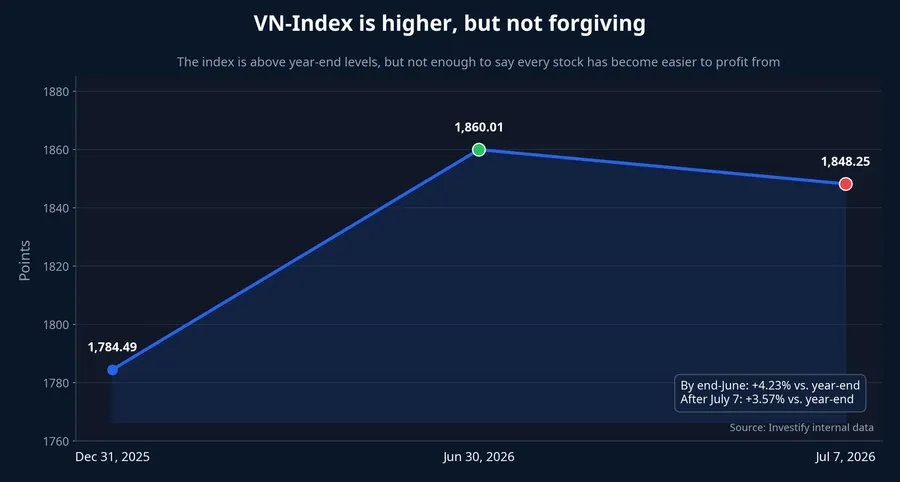
This is one of the most common beginner traps. People see the index rise and assume their own odds of success rise with it. In practice, the index is a stadium view. Your return depends on where you are standing inside that stadium. If capital is concentrated in a few leaders, the market can look healthier than the average small investor experience actually feels.
Breadth is the more useful test
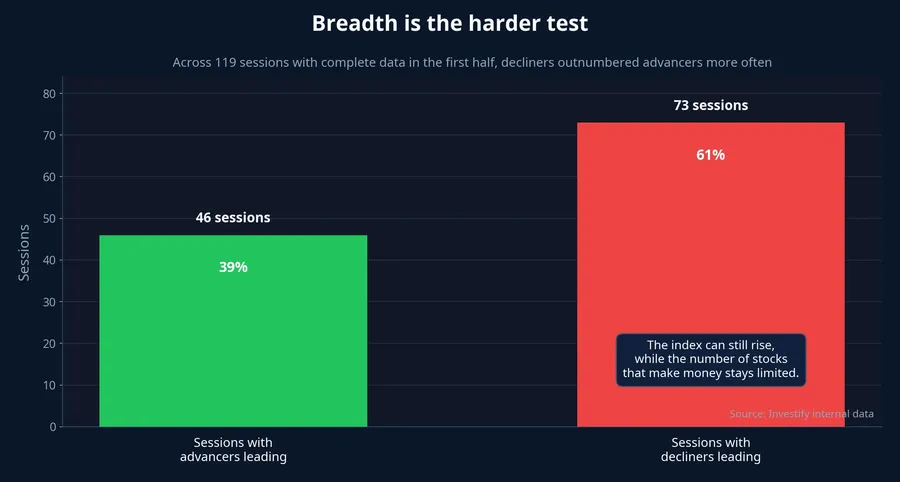
If you want to know whether opportunity is spreading, breadth is a better place to look. Across 119 VN-Index sessions with complete breadth data from the start of the year through the end of June, there were only 46 sessions in which advancers outnumbered decliners. In 73 sessions, decliners were more numerous. On average, each session saw about 139 stocks rise and 167 fall. June itself had 8 positive breadth sessions and 14 negative ones.
That matters because it translates more directly into what investors feel in their accounts. The index may still be above year-end levels, yet most sessions in the first half of 2026 leaned toward more losers than winners. That is a classic sign of a selective market rather than an easy one.
The July 7 session reinforced the same point. VN-Index gained 4.75 points, or 0.26%, with 173 advancers against 152 decliners. Breadth was better that day, but total market trading value was only a little above VND 18,000 billion.VietnamPlus One green session after a wobble is helpful. It is not enough to confirm that fresh money is lifting the market in a broad, durable way.
This is why breadth often says more about real opportunity than the headline index level. If advancers still fail to dominate over multiple sessions, beginners are entering a market with more participants but not necessarily more forgiving odds.
Foreign flows still complicate the backdrop
Another piece of the puzzle is foreign capital. A compiled figure cited by Báo Mới showed net foreign selling of more than VND 80,377 billion in the first six months of 2026.Báo Mới That does not mean domestic retail money cannot drive rallies. The first half of the year showed that it can.
But it does suggest the market's liquidity base is not yet fully aligned. A market driven mainly by domestic flows can still go up, yet it often comes with sharper differentiation. The money tends to crowd into favored sectors and heavyweight names, while the rest of the board struggles to keep pace.
That is another reason the account boom should not be mistaken for an easy-money phase. Beginners are not just dealing with volatility. They are dealing with a market that is asking tougher questions about where money belongs.
Three things beginners should watch instead
Instead of asking how many people have opened new accounts, beginners should ask three more practical questions. First, is breadth improving in a sustained way, with advancers clearly beating decliners over several sessions. Second, is liquidity strengthening on more than just a brief rebound. Third, is leadership broadening across sectors, or is the index still leaning on a narrow set of large-cap stocks.

Those questions matter because they separate public excitement from real market quality. A headline about 1.56 million new accounts can easily trigger the thought that other newcomers must already be making money. But if breadth remains weak, liquidity is uneven, and leadership stays narrow, then the market is only getting more crowded, not necessarily easier.
In other words, the account count is a picture of attention. Breadth, liquidity, and participation across sectors are a picture of opportunity. The two can move together over time, but they do not always move together in the same moment.
Conclusion: a broader market base, but still a selective tape
The clearest reading from the current data is straightforward. Vietnam's account boom is constructive for the long-term development of the equity market, but it is not evidence that the market has become easier for beginners to win in. The near-term backdrop still looks selective, with breadth weaker than the index alone suggests and money flow not yet spreading evenly across the board.
That does not mean beginners should stay away. It means they should read the market in more than one layer. The most useful signals to watch over the next two weeks are whether breadth improves consistently, whether liquidity can hold at a higher base after rebound sessions, and whether leadership expands beyond the usual heavyweight names.