


Decree 260/2026/ND-CP took effect on July 1, yet the market did not respond with a broad-based rush into every stock linked to technology.Báo Chính phủ That does not make the policy any less important. It simply reminds investors that incentives do not automatically become revenue, and revenue does not automatically become profit. The decree only lowers costs at specific points in the chain such as research, testing, intellectual-property protection, product certification, and borrowing costs. A company without an eligible project or a credible route to commercialization will still struggle to turn that support into earnings.
The core thesis is straightforward: Decree 260 is a meaningful policy tailwind for Vietnam’s technology ecosystem, but in the stock market it will work selectively. The companies most likely to benefit first are those that already have R&D capacity, real projects, and a clear ability to translate lower financing and development costs into contracts, revenue, and healthier margins. Everyone else is still trading more on narrative than on proof.
What Decree 260 actually supports
The most important feature of Decree 260 is not that it “supports technology” in a vague sense. It is that the support is targeted at clearly defined stages. For high-technology research and development, the State can cover up to 100% of the budget for tasks commissioned or funded through relevant funds. Companies can also receive loan-interest support equal to 70% of the contractual lending rate, capped at 8% a year for up to 5 years.Báo Chính phủ
For strategic technology, the support goes further: loan-interest support can equal 100% of the contractual interest rate, capped at 10% a year, also for a maximum of 5 years. The package also includes support for testing, certification, intellectual-property filings, and commercialization.Báo Chính phủ In plain terms, the government is cutting some of the most expensive cost lines in innovation. It is not guaranteeing demand for every listed company associated with the theme.
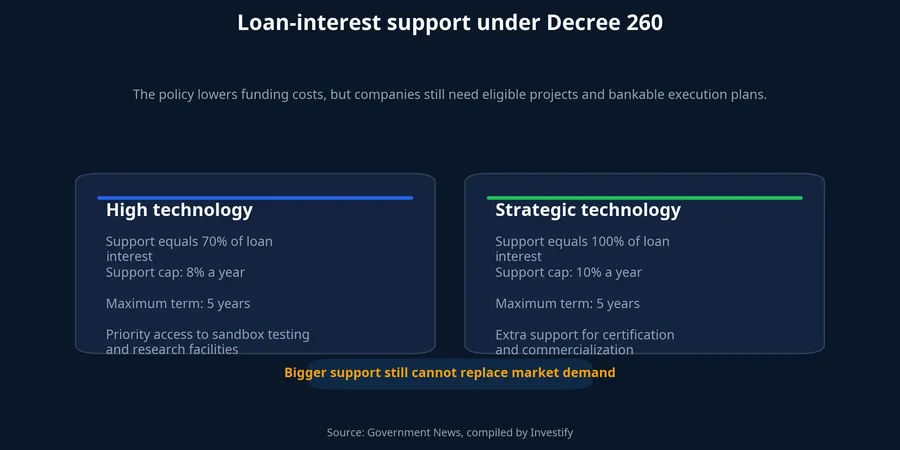
That distinction matters, especially for newer investors. Cheaper funding only creates an advantage when a company already has a reason to borrow and a credible way to turn that capital into production capacity, services, or products that customers will actually buy. Without projects, interest-rate support means very little. With projects that drag on, run over budget, or fail to secure customers, the incentives may soften the pain but they do not change the quality of the business.
A stronger policy signal also means a tighter filter
The bigger picture shows that the government is not relying on a single decree. In the broader package of policies taking effect from July, it has also set a goal of forming at least 10 large-scale strategic technology companies by 2030 to develop digital infrastructure, digital data, digital talent, strategic technologies, and cybersecurity.Báo Chính phủ At the implementation layer, the Ministry of Science and Technology has also issued a catalogue of 3,030 standards covering 30 strategic-product groups.Báo Chính phủ
Those figures matter because they show policy moving from broad direction into execution infrastructure. But that also means a stricter filter for listed companies. The market will not stop at labels such as “AI,” “semiconductors,” or “digital infrastructure.” It will ask for harder evidence on technical capability, invested assets, project progress, and the ability to preserve returns.

That is also why investors should not bundle every related company into one trade. The economic effect of Decree 260 on a software company, a data-center operator, an equipment manufacturer, or a diversified conglomerate is not the same. The earliest beneficiaries are usually the companies already positioned at the exact stage that the policy supports, not the ones telling the biggest story.
Stock prices are already reflecting that selectivity
The first market response after the decree took effect was cautious. On July 3, FPT closed down 0.28%, CMG fell 0.18%, and VIC was flat. That is not evidence that investors rejected the policy. It is evidence that the market was not willing to reprice every familiar technology-linked name in one move.
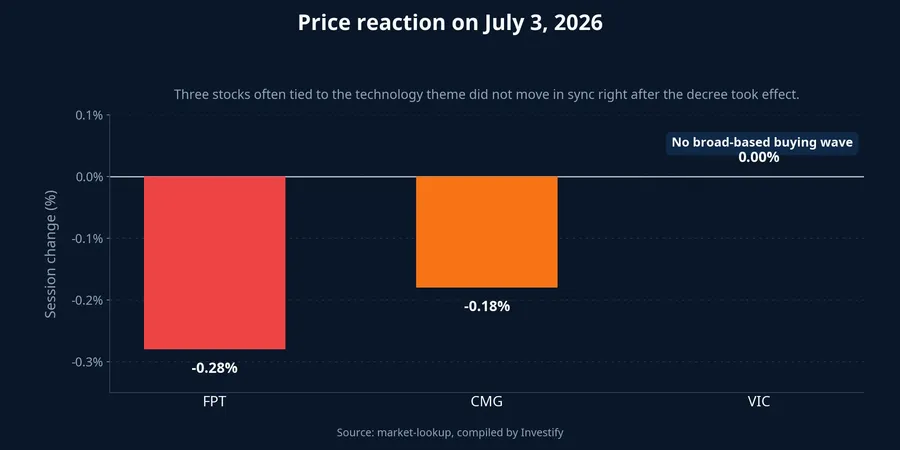
Look more closely and that reaction makes sense. One session is nowhere near enough to price the long-term earnings impact of a policy shift, but it is enough to show that institutional money still wants confirmation. That confirmation does not come from a slogan about “benefiting from the decree.” It comes from new contracts, deliberate increases in R&D spending, infrastructure going into operation, or technology revenue growing faster than the rest of the business.
It is also important not to overstate causality. If a stock rises in the coming weeks, investors should not assume that the full move came from Decree 260. Capital can also react to second-quarter earnings, valuation resets, or company-specific news.
What investors should check before buying the story
For stock analysis, the cleanest approach is to work from policy down to company reports. First, identify which cost line the policy actually affects: funding, tax, testing, certification, or commercialization. Then compare that with the company’s position in the value chain. If the business does not need much debt, interest support is unlikely to be the main catalyst.
The next checkpoint is whether the project is real. Has the company disclosed research centers, computing infrastructure, testing capacity, or actual customer contracts. Do capital expenditures, fixed assets, and R&D costs reflect a genuine investment cycle. For companies already trading on ambitious technology narratives, that evidence matters even more.
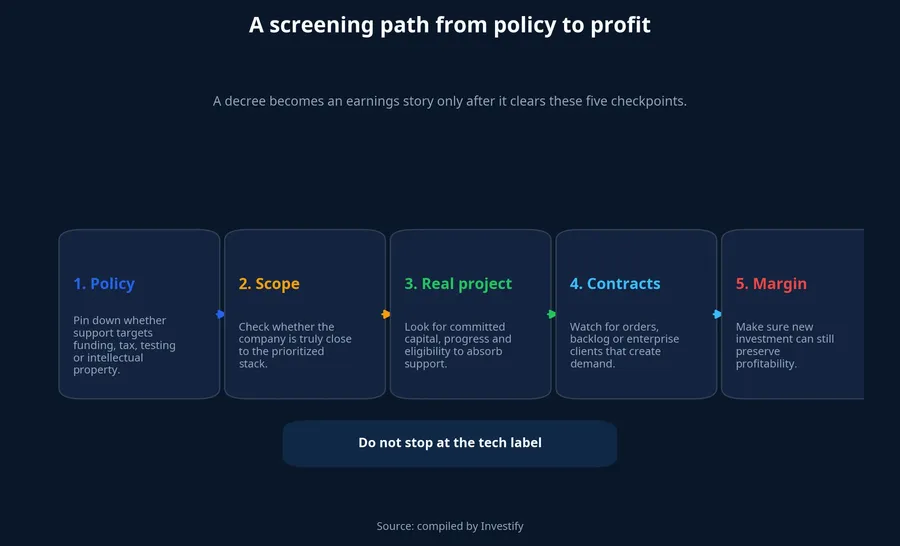
Finally, there is the margin question. A company may sharply increase investment in data infrastructure, research centers, or engineering talent, while profit still lags for the next 2 to 4 quarters. If costs run ahead of revenue for too long, the stock can still come under pressure even when the long-term technology narrative sounds compelling.
Conclusion: policy can open the road, but earnings still need proof
Decree 260 deserves close attention because it shows Vietnam moving faster to support research, testing, and commercialization in priority technology fields.Báo Chính phủ Combined with the goal of forming at least 10 large-scale strategic technology companies by 2030 and the newly issued set of 3,030 standards, this is clearly more than a symbolic campaign.Báo Chính phủBáo Chính phủ
But for stocks, the conclusion is not “buy the whole technology group.” A better conclusion is that the policy is setting up a deeper round of differentiation. Companies with real projects, real demand, and the ability to protect margins while expanding investment have a credible chance to turn incentives into earnings. Everyone else will still have to pass the market’s familiar test: where the money is going, where the orders are coming from, and whether profit is actually starting to move.