


News that Vietnam has concluded FTA negotiations with EFTA can trigger a familiar market reflex: a new trade deal must mean a broad rally for exporters. For newer investors, that is exactly where the pause should come in. Closing negotiations is a positive policy milestone, but the path from that headline to revenue, earnings, and eventually stock prices is much longer.VietnamPlus
The first thing to keep straight is that EFTA is not “Europe” in the broad sense. The bloc includes Switzerland, Norway, Iceland, and Liechtenstein: wealthy, high-standard markets, but still a much smaller trade destination for Vietnam than the US, China, or the European Union. In plain terms, this is a meaningful new door, but not one large enough to pull every export stock through at the same speed.VietnamPlus
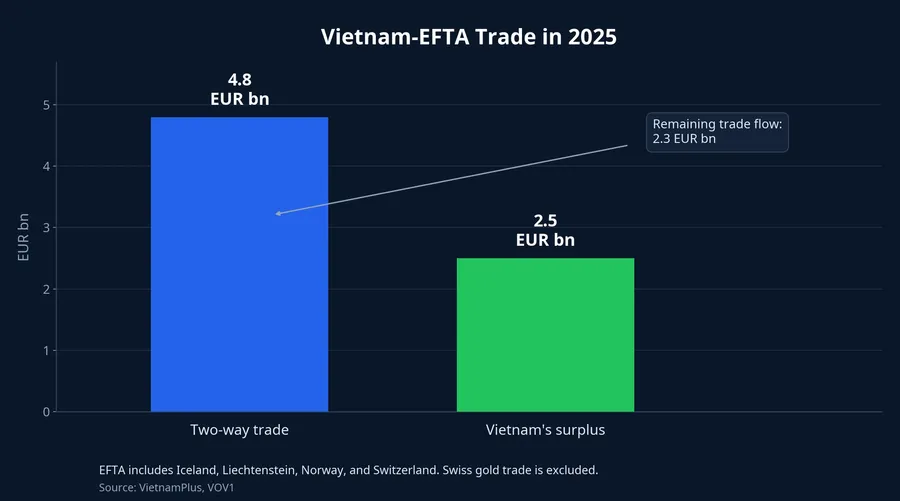
The base numbers reinforce that point. In 2025, two-way Vietnam-EFTA trade reached EUR 4.8 billion, with Vietnam running a surplus of about EUR 2.5 billion; those figures exclude Swiss gold trade. That is a meaningful increase over a 10-year period, but it is still a niche export market compared with Vietnam’s biggest end-demand engines today.VOV1VietnamPlus
So how should investors screen for real beneficiaries? The cleanest framework is a three-filter approach. First, does the company operate in product groups EFTA already imports heavily from Vietnam? Second, does it have the customers, markets, and supply-chain setup needed to turn tariff preferences into actual orders? Third, where exactly is the deal in the legal process, and how far is it from becoming economically effective?
Filter one: does the company sell into the right product groups?
According to reports published this week, Vietnam’s main exports to EFTA include electrical machinery, footwear, garments, and mechanical equipment. That matters because it separates sectors that are close to the trade story from sectors that merely sound related. On that test alone, garments and footwear sit closer to the opportunity set than most other listed themes, because they already have real export exposure to EFTA rather than abstract headline exposure.VOV1VietnamPlus
Even inside that closer group, though, the benefits will not be evenly distributed. A large garment manufacturer is not automatically in a better position than a mid-sized peer if most of its orders still go to the US or Japan. Tariff preferences are only the entry ticket. A company still needs the customers, the sourcing base, and the ability to meet technical requirements in the target market before that ticket becomes money.
That is where newer investors often blur sector logic with company logic. Two apparel names may sit in the same industry bucket, but the company still dependent on non-qualifying inputs, still weak on traceability, or still lacking commercial relationships in Switzerland, Norway, or nearby channels will not move at the same pace as a company that already has those pieces in place.
Filter two: are the market access and supply-chain conditions already there?
EFTA is a wealthy bloc with high standards, which means the story does not end with tariffs. VietnamPlus reported that the agreement spans rules of origin, technical barriers, sanitary and phytosanitary standards, investment, government procurement, and sustainable development. For investors, that is more important than any punchy headline, because a favorable tariff only matters if the company can actually qualify for it.VietnamPlus
Put simply, being an exporter is not enough. If a company sells the right product but still lacks reliable quality control, enough control over inputs, or familiarity with European customer standards, the benefits will arrive later than the market initially expects. That is why a layered reading is more useful than treating “export stocks” as a single trade.
Electronics is a good example. It is a major product group in bilateral trade, but Vietnam’s large-scale electronics export capacity sits heavily in the FDI sector. That means any stock-market benefit is more likely to show up through service providers, logistics operators, infrastructure names, or support links in the supply chain than through a clean, direct listed-equity theme. The benefit is real, but it is a second-order benefit.
Which sectors are closest, and which ones still need proof?
Once those first two filters are applied, the picture sharpens quickly. Garments, footwear, and parts of the supplier base look closest to the opportunity. Those are the areas worth watching first, not because they are automatic winners, but because they are where investors can most usefully test which companies already have customers, origin-rule readiness, and the operational base to turn preferences into real orders.
Ports, logistics, and industrial parks are more indirect. They only benefit in a meaningful way if cargo volumes rise, tenants expand investment, or new capital flows show up clearly enough to feed into throughput and earnings. If trade grows slowly, or if incremental volume simply moves through existing routes, the earnings effect could be much thinner than the early market narrative suggests.
This is where newer investors need to separate “could benefit” from “will soon report higher profit.” Those are not the same statement. A trade agreement can make Vietnam more attractive to manufacturers, but decisions on port usage, warehouse demand, or industrial land leasing still depend on rent, power, labor, legal procedures, and project timing. The FTA is a plus factor in the file, not a signed commercial order next quarter.
Filter three: negotiations are over, but the deal is not yet in force
This is the most important point if the goal is to avoid paying too early for a story. According to VietnamPlus, Vietnam-EFTA FTA talks were restarted on September 8, 2025, in Geneva and went through five rounds before reaching the July 2, 2026 negotiation-close milestone. But the end of negotiations is not the same thing as entry into force. From here, the process still has to move through signing, ratification, and implementation.VietnamPlus
For retail investors, the easiest analogy is a large contract: agreeing on terms is not the same as booking revenue. Companies still need time to win customers, negotiate pricing, adjust supply chains, complete compliance work, and convert policy commitments into actual commercial orders. That is why any short-term price reaction is usually a reaction to expectations first, while the hard numbers come later.

The article’s thesis is straightforward: the Vietnam-EFTA FTA is a positive step for trade integration, but it is not a reason to rerate every export stock at once. The names worth watching first are the companies that sell into product groups EFTA already buys from Vietnam, have markets close enough to matter, and can qualify for the preferences once the agreement takes effect. Indirect beneficiaries such as logistics and industrial parks remain relevant, but they still need evidence from volume, investment, and order trends before the case becomes compelling.
What matters in practice is not guessing which sector might pop first for a few sessions. It is identifying which businesses can turn a policy opening into operating cash flow. The most important signals to track over the coming months are the signing and ratification timeline, new-order updates in the export sectors closest to the story, and early evidence of rising throughput in logistics and industrial infrastructure.