

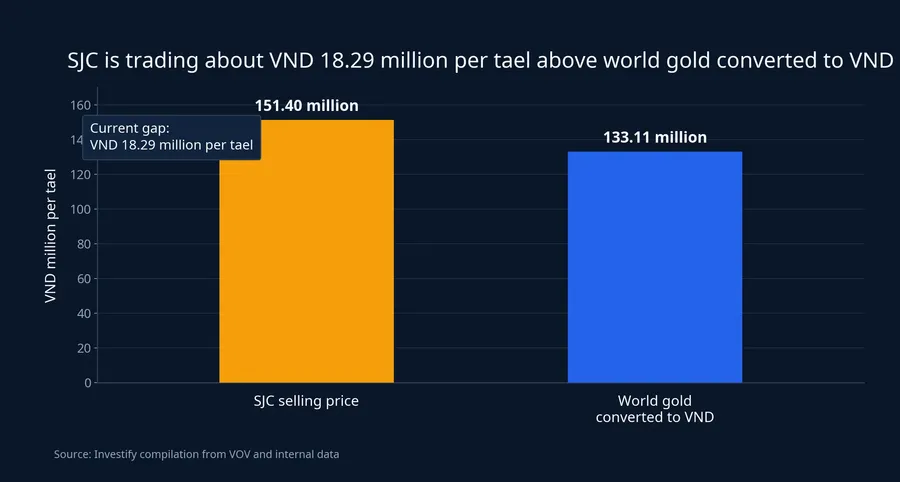
A world gold price of around USD 4,175.03 per ounce does not answer the question retail buyers actually care about: is gold in Vietnam cheap or expensive right now? On the morning of July 4, SJC gold bars were quoted at VND 151.4 million per tael, while world gold converted into Vietnamese dong was only about VND 133.11 million. That VND 18.29 million gap is exactly where many first-time investors start reading the market the wrong way.VOV
The cleaner way to read this market is to stop treating local gold as a direct mirror of the international chart. In practice, Vietnamese buyers pay for four stacked price layers: world gold, the USD/VND exchange rate, the domestic premium attached to SJC bars, and the gap between the shop's bid and ask prices.
Layer one: World gold sets the base
The first layer is international gold. It is still the biggest directional input. If world gold falls sharply over several sessions, local prices in Vietnam will struggle to hold up forever. If global gold rallies quickly, domestic prices almost always feel that pull, even if the speed and magnitude are not identical.
In the latest move, world gold rose from USD 4,007.72 per ounce on June 30 to USD 4,170.51 on July 3, a gain of about 4.06% in just a few sessions. VietnamNet also noted that world gold remained close to the USD 4,200 per ounce area on July 4, which means the international backdrop was still supportive at that point.VietnamNet
But that is only the foundation. Vietnamese buyers do not transact in USD per ounce, and they do not receive gold in ounce units. The global chart still has to pass through several conversions before it becomes the number displayed at a local jewelry counter.
Layer two: The exchange rate decides how world gold enters local wallets
Even if world gold does not move, the amount a Vietnamese buyer pays can still change with the exchange rate. VOV converted world gold using Vietcombank's July 4 exchange rate of VND 26,463 per dollar. On that basis, world gold worked out to roughly VND 133.11 million per tael.VOV
That may sound like a technical detail, but it is one of the most common blind spots for new investors. If the global gold price stays flat while the dollar strengthens against the Vietnamese dong, the converted local value of gold still rises. If the dollar cools, part of the global rally can disappear once it is translated into local currency.
Layer three: The domestic SJC premium tells a separate market story
Even after the currency conversion, there is still a large gap between international gold and the quoted SJC selling price. On the morning of July 4, that premium was about VND 18.29 million per tael.VOV This is not a line-item fee on the receipt. It is the extra domestic price the market is placing on SJC bars relative to world gold converted into VND.
This is also where many retail readers swing into one of two simplistic interpretations. One side assumes that a large premium automatically means local gold is irrationally expensive. The other treats SJC's branding and market position as enough reason to ignore the premium entirely. Neither reading is good enough. The domestic premium can widen or narrow depending on real supply and demand, investor psychology, and how easy it is to trade actual bars in the market.
For SJC bars, the legal structure still matters. Decree 232/2025/ND-CP, issued by the government on August 26, 2025 and effective from October 10, 2025, ended the state's exclusive monopoly on gold bar production and shifted the market to a licensing regime. Under that framework, a business needs charter capital of at least VND 1,000 billion to be considered for a gold bar production license, while a commercial bank needs at least VND 50,000 billion in charter capital and still requires approval from the State Bank of Vietnam.Báo Chính phủ
The key point is that legal opening does not mean new supply immediately floods the market. Turning a regulatory change into real bars available for sale still takes time, organization, and approval. That is why the SJC premium does not reflect gold prices alone. It also reflects the structure of Vietnam's gold bar market.
Layer four: The buy-sell spread is the loss you can see immediately
If the first three layers explain why the listed price is high, the fourth layer is where retail risk becomes visible. On the morning of July 4, the spread between SJC's buying and selling prices stood at VND 3 million per tael.VOV That means a buyer is already materially underwater if they need to sell back immediately.
Put simply, a rise in world gold is helpful, but it is not the same thing as profit. For a local buyer to make money in practice, the shop's buyback price has to rise enough to overcome that spread before anything else counts as a gain. If global gold only edges higher, or if the domestic premium narrows, the move on the international chart may never fully reach the investor's pocket.
Gold bars and gold rings are not telling the same story
Not every form of gold in Vietnam carries the same premium structure. On July 4, VOV reported SJC gold rings in a range of VND 148.3 million to VND 151.3 million per tael, while Investify's internal data showed an SJC ring selling price of VND 149.8 million on the same day. Even within the same brand, gold rings and gold bars can move differently.VOV
Over the last 10 sessions, SJC bars still traded above SJC rings, with an end-period gap of VND 1.6 million per tael in Investify data. That is a useful reminder for beginners: "the local gold price" is not one number.
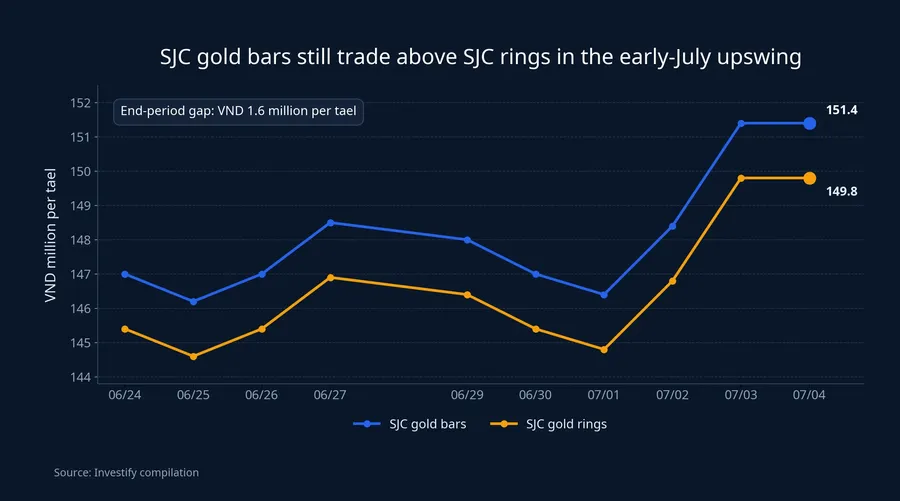
The week ending on July 4 also showed how differently these price layers can interact. VietnamNet reported that SJC gold bars rose VND 4.4 million per tael from the previous weekend.VietnamNet But that gain did not come from world gold alone. It was also shaped by exchange-rate effects, local holding sentiment, and an elevated domestic premium.
A practical framework for first-time investors
If this entire article had to be reduced to a checklist, it would be four questions. First, where is world gold heading? Second, is the USD/VND exchange rate amplifying or softening that move? Third, is the SJC premium to converted world gold widening or narrowing? Fourth, how wide is the shop's bid-ask spread right now?
The core thesis is straightforward: Vietnamese gold buyers should not make a decision from a single international chart. The real profit and loss experience depends on what form of gold they are buying, how much domestic premium they are paying, and how much spread they will have to absorb if they need to exit. As long as those local frictions stay high, a global rally in gold is not enough to make every domestic purchase comfortable.
The most useful signals to watch over the next few sessions are tied to those same four layers: the next direction in world gold after the early-July rally, movements in bank USD/VND rates, the premium between SJC and converted world prices, and the width of the bid-ask spread at local counters. When all four move in the buyer's favor, local prices can climb very quickly. But if even one layer turns, the sense of safety created by "world gold is still high" can fade just as quickly.