


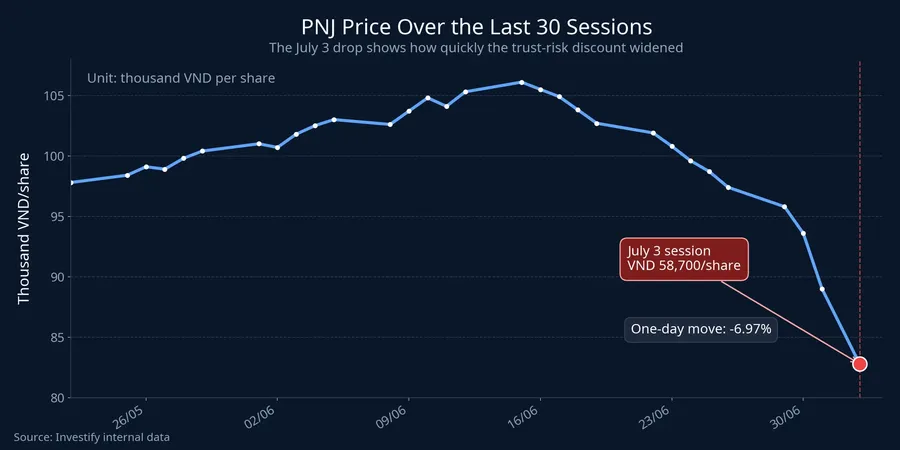
PNJ's sharp drop on the morning of July 3 was not just a stock reacting to a legal headline at a bad moment. What got repriced immediately was trust: trust in certification papers, in traceability, and in how quickly the company can ring-fence brand risk once a controversy reaches the verification stage.
Market data showed PNJ at VND 58,700 per share, down 6.97% from the previous session, with 941,000 shares traded and a market capitalization of roughly VND 20 trillion. At the same time, the VN-Index stood at 1,860.47 points, down only 0.32%. That gap matters. It suggests the move was not simply a weak tape dragging everything lower, but a company-specific response to the P-Lab story.
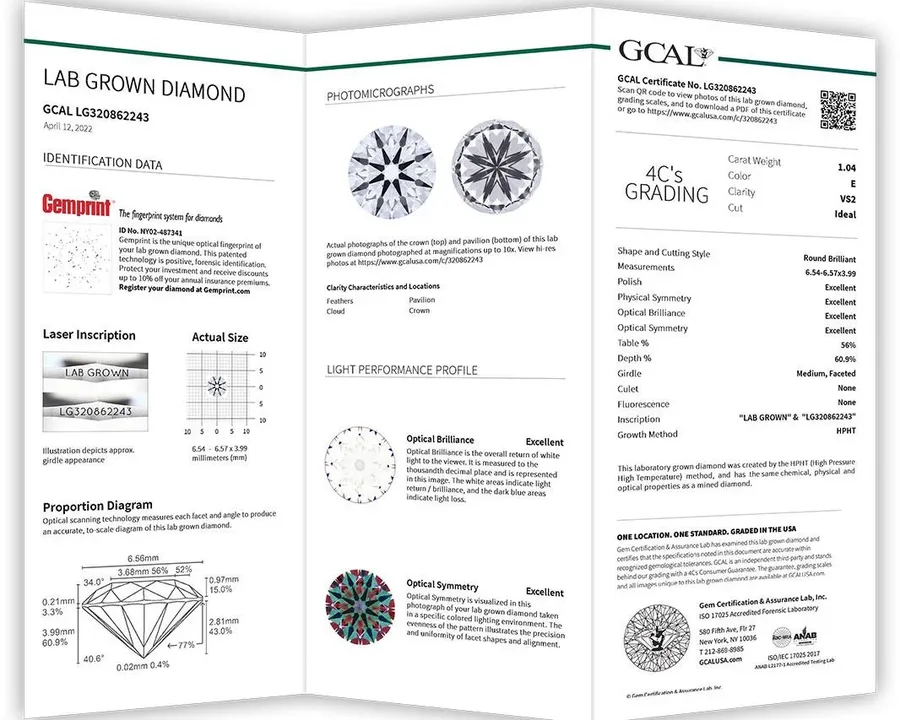
The confirmed part of the story is fairly clear. PNJ said the diamonds it distributes are tested under standard procedures, remain traceable, and still meet quality requirements.VietnamBiz Along the same line, P-Lab said the matter falls under the legal responsibility of Dang Ngoc Thao, former Director of PNJ Inspection One Member Co., Ltd. (P-Lab), and that the company is ready to cooperate whenever competent authorities request it.VietnamNet
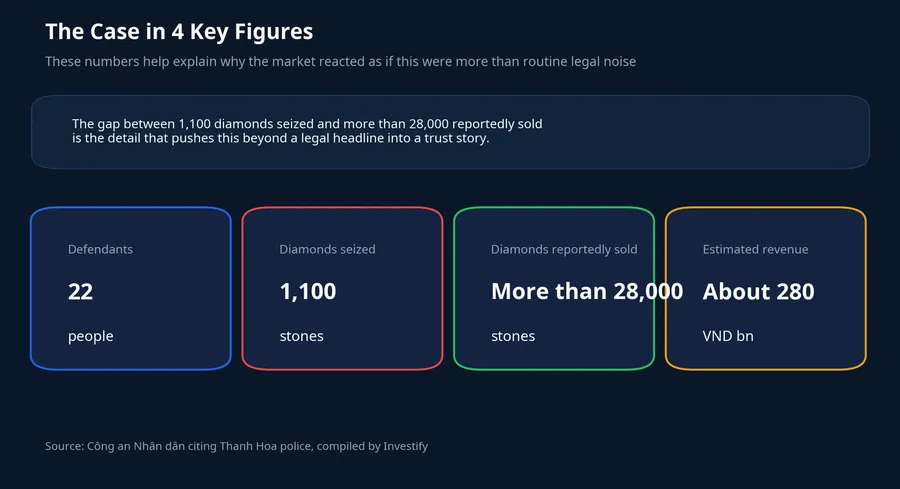
But markets do not trade only on what a company says. They also trade on what a case implies. Công an Nhân dân, citing Thanh Hoa police, reported that investigators had charged 22 defendants and seized 1,100 diamonds in the case announced on July 2.CAND The same report said the smuggling ring had allegedly made 141 transport trips from 2024 until detection, bringing more than 28,000 diamonds from Hong Kong into Vietnam, with estimated revenue of about VND 280 billion.CAND
For new investors, this is exactly where the reading can go wrong. One track is the legal process, which still has to run through formal investigation and judicial procedure before any broader conclusion can be drawn. The other track is stock-price behavior, which always moves faster because it reflects expectations, sentiment, and the risk premium investors want right now. The two tracks are related, but they do not move at the same speed.
Put differently, the stock does not need to wait for authorities to decide whether the wider system has a problem before reacting. It only needs a credible risk that the controversy could touch the brand's trust layer. For a jewelry retailer, that layer is more sensitive than a weak quarter. A disappointing earnings print can be measured through margins, same-store sales, or inventory. Damage to trust is harder to quantify, which is exactly why markets often demand a steeper discount.
That does not mean there is already enough evidence to call this a long-term franchise problem for PNJ. The real issue right now is the possible transmission of distrust, not a completed verdict on the parent brand. If investors skip that distinction, they usually fall into one of two bad habits: treating the sell-off as proof of systemic collapse, or treating it as a simple bargain because the share price is suddenly cheaper by a few percentage points.
Both readings are premature. The bearish case becomes stronger only if later disclosures show a wider scope of impact, structural holes in the certification process, or an inability to provide independent verification that can restore confidence. The more constructive case improves if PNJ quickly clarifies the affected product scope, how it will handle customers who bought items certified by P-Lab, and what additional review procedures are being introduced across both certification and traceability. For now, the market is still waiting for evidence either way.
It is also worth acknowledging an alternative explanation so the analysis does not overreach. Part of the opening sell-off may have been amplified by stop-loss orders, margin management, or the instinctive urge to cut exposure when a familiar retail name hits limit down. But those technical factors explain why the decline accelerated, not what triggered it. The trigger still appears to be the P-Lab-linked information and the fear that certification questions could raise the long-term cost of protecting PNJ's brand.
What the tape never says out loud, but investors need to understand, is that markets usually punish trust risk more aggressively than ordinary operating risk. An operating mistake can sometimes be fixed with time and money. In high-value jewelry, buyers are paying not only for the stone itself, but for the confidence that the paperwork is credible, the product can be traced, and the company can stand behind the sale if a dispute emerges. That is why even a narrow controversy around the certification step can widen the equity risk premium so quickly.
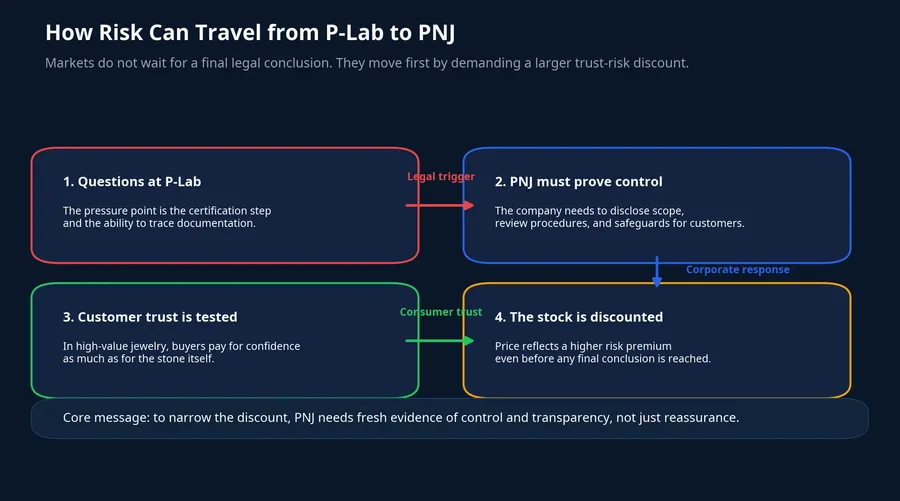
If you view PNJ as a listed company rather than just a red ticker on the screen, the key question over the next few sessions is not how many percentage points the stock has already fallen. It is what kind of evidence the market gets next. A statement defending product quality is necessary, but it is not enough by itself to compress the discount immediately. Investors will want specifics: how any independent review is being run, whether the scope looks narrow or broad, how customer remediation works, and whether the certification setup changes after the shock.
Post-drop trading behavior will matter as well. If the stock stays under pressure while turnover remains heavy and no clear balance zone appears, the market is still charging a higher premium for unanswered questions. If liquidity stays active but the price begins to stabilize, that would suggest buyers are starting to believe the risk can be contained and are moving from emotional selling to more selective repricing.
For first-time investors, the lesson here is not that you must react faster than the market. The lesson is to separate three layers of information. The first is the legal story, which answers what is being investigated and what stage the process has reached. The second is the corporate response, which answers how the company is defending itself. The third is price and liquidity behavior, which answers whether the market accepts that defense. Mixing up those three layers is one of the easiest ways for new investors to either panic too early or bottom-fish too early.
PNJ remains a major company in Vietnam's jewelry retail market. But that status is exactly why anything touching certification quality and customer trust is judged against a higher standard. The limit-down move on the morning of July 3 should therefore be read as a repricing of trust risk, not as a final verdict on the company's long-term health.Người Đưa Tin What can change that picture in the near term is not a generic reassurance, but concrete evidence that the risk around P-Lab can be contained, verified, and prevented from turning into a broader crack in the PNJ brand.