


More than USD 1 trillion flowing into US-listed ETFs in the first half of 2026 sounds like a simple signal: global investors are willing to take on more risk. That reading is only half right. ETFs are no longer just passive wrappers for buying “the market.” They have become one of the clearest ways to see which stories investors actually want to fund.MarketWatch
In practical terms, ETF inflows do not all mean the same thing. Money going into a broad index fund, a technology ETF, an emerging-market ETF or a leveraged ETF carries very different information. The useful question is not whether “ETF money is rising,” but which part of the growth narrative that money is choosing to back.
What a record inflow really says
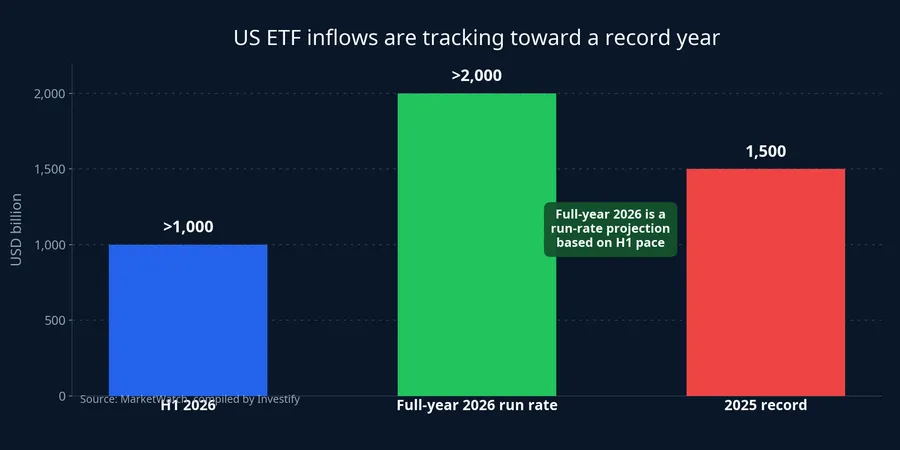
Start with scale. MarketWatch reported that US-listed ETFs pulled in more than USD 1 trillion in the first half of 2026 alone, putting the industry on a pace to exceed USD 2 trillion for the full year if that run rate holds. That would move well past the USD 1.5 trillion record set in 2025, with total US ETF assets already standing at roughly USD 15.6 trillion.MarketWatch
For newer investors, the important part is not the word “record.” It is the role ETFs now play as a giant capital pipeline. Once money moves through a pipe that large, each branch matters. It shows where investors see relative safety, where they see growth, and where they are willing to accept more volatility in exchange for higher upside.
That is why ETFs should not be read as a one-direction indicator. Large fund inflows do not mean every stock inside a basket is equally attractive, and they do not mean every asset class is benefiting at the same time. Often the money is flowing into a narrow set of exposures while much of the market is barely being touched.
The US is still the core, but technology is the axis
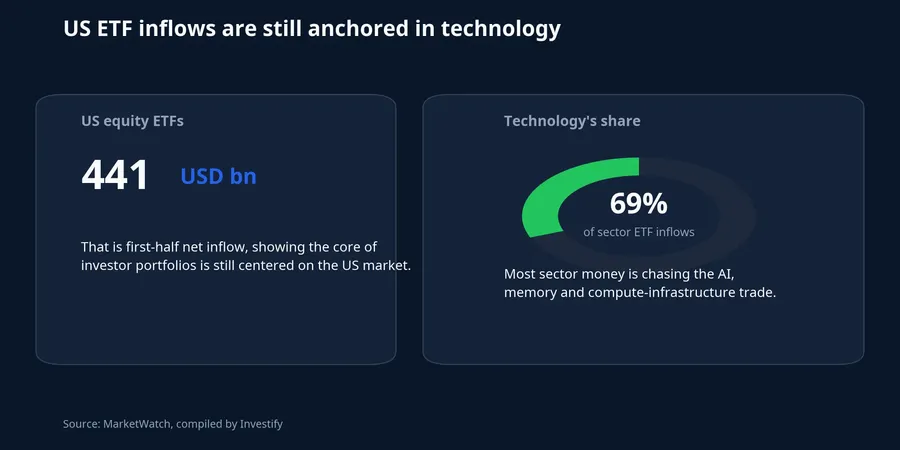
The first layer of the flow map is straightforward: US equities remain the core allocation. ETFs focused on US stocks attracted about USD 441 billion in the first half of 2026. But that core is not neutral. Roughly 69% of sector ETF inflows are going into technology.MarketWatch
That matters because “money is buying the US” can sound broader than it really is. In practice, a large share of that money is buying America through artificial intelligence, compute infrastructure, memory and the companies seen as direct beneficiaries of the next technology cycle.
So a rising headline index does not automatically mean opportunity is broadening at the same pace. If most of the money is leaning into the same growth axis, the market can still look strong on the surface while valuation risk becomes concentrated in a handful of groups. That is why reading ETF flows properly requires a second step after “the US”: which sectors are attracting the money, and how crowded are those trades becoming.
DRAM is an extreme example of money choosing a specific story
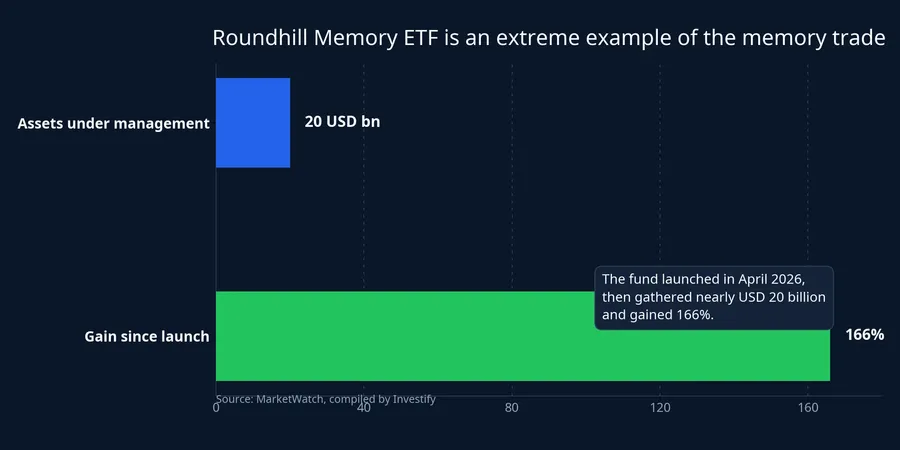
MarketWatch highlighted one especially vivid example: the Roundhill Memory ETF, ticker DRAM. The fund launched only in April 2026, yet it had already gathered nearly USD 20 billion and gained 166%, riding exposure to companies linked to AI memory demand such as Micron, Samsung and SK Hynix.MarketWatch
A fund that new pulling in capital that quickly tells you investors are not just looking for growth in the abstract. They want trades that are narrow enough, clear enough and easy enough to express as a thesis. The market is not buying “technology” as one undifferentiated block. It is breaking the sector into smaller links and paying up for the ones believed to be closest to the profit pool.
That still does not justify a neat one-cause explanation. DRAM’s surge clearly signals how hot the memory trade has become, but it would be too tidy to say AI alone explains the whole move. Semiconductor valuations, momentum positioning and performance-chasing flows may all be contributing. What the evidence supports most clearly is this: global investors are willing to pay aggressively for narrow themes when those themes sit at the center of the current growth narrative.
Emerging markets are not being left behind
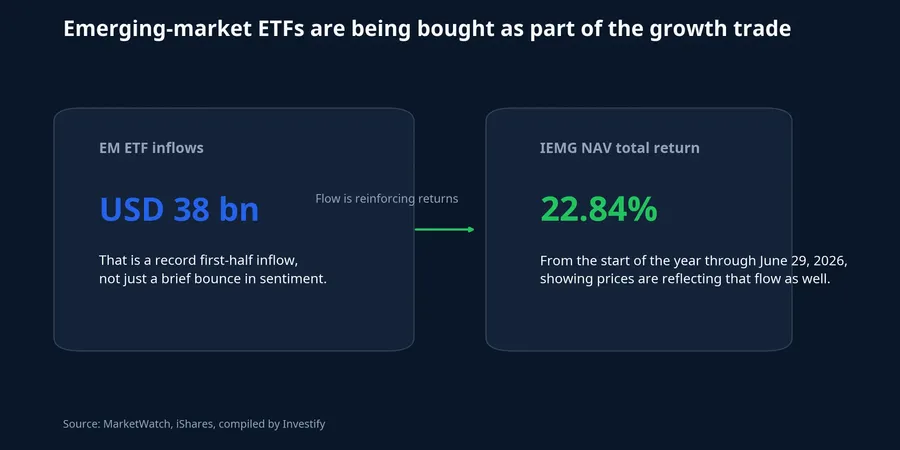
If you look only at the capital going into the US, it is easy to conclude that global money has simply rotated back to one dominant center. The second layer of the flow map says otherwise. Emerging-market ETFs drew a record USD 38 billion in the first half of 2026, while the iShares Core MSCI Emerging Markets ETF posted a 22.84% NAV total return from the start of the year through June 29, 2026.MarketWatchiShares
That point matters because today’s risk-on mood is not confined to Wall Street. Some of that capital is expanding into markets seen as part of the same growth chain, especially Asian production and technology hubs. On the same logic, the iShares MSCI South Korea ETF delivered a 102.88% NAV total return from the start of the year through June 29, 2026, underscoring how prominently South Korea sits in the semiconductor and memory story.iShares
Even here, it is worth resisting a single-driver narrative. Emerging-market flows may reflect growth expectations, relatively cheaper valuations, a softer dollar backdrop or the role of non-US semiconductor supply chains. The current evidence is not strong enough to assign exact weights to those drivers. It is strong enough to show that investors no longer see emerging markets as a simple peripheral allocation.
Leveraged ETFs suggest a higher tolerance for volatility
Another detail newer investors should not miss is that MarketWatch counted 222 leveraged ETF launches since the start of 2026.MarketWatch That is a very different signal from the classic story of ETFs as passive diversification tools. Leveraged ETFs are designed to amplify short-term moves, so growth in that product set tells you part of the market wants to increase the size of its bet, not just maintain exposure.
That changes how investors in Vietnam and elsewhere should read global headlines. When risk appetite rises, the first effect is often not that every asset climbs together. The more revealing effect is that money becomes willing to move into instruments with more sensitivity to trend. A market that looks healthy on the surface can therefore carry bigger swings inside its leadership groups, because some buyers are not just holding positions; they are trying to magnify them.
What Vietnamese F0 investors should take away
The practical takeaway is not to rush into a US ETF or hunt for the next DRAM-like product. The better lesson is to treat fund flows as a map of market psychology and capital priority. When a fund starts attracting heavy money, ask three things: is it buying the broad market or a narrow theme, is that money positioning for a longer holding period or a short-term swing, and is the theme spreading into related links or staying concentrated in one pocket.
That framework is just as useful back in Vietnam. A fund attracting subscriptions does not mean every stock in its basket is attractive. An index rising does not mean most investors are making money at the same time. The opposite can also happen: a narrow group gets the bulk of the flow, pushes the index higher and leaves much of the market behind.
The cleanest conclusion from the current data is that global risk appetite is strengthening, but in a selective way. Money is still using the US as the core, technology as the axis, expanding into emerging markets when they fit the same growth chain, and even leaning into leveraged ETFs to scale up the bet. The next signal worth watching is whether that capital starts spreading beyond the technology axis, because that will say more than any headline record about how durable this rally really is.