


The morning session on June 30 was exactly the kind of tape that can fool newer investors. Look at the headline line and you see VN-Index still up. Stop there, and it becomes easy to assume the market was broadly healthy. That was not what the structure of the session actually said.
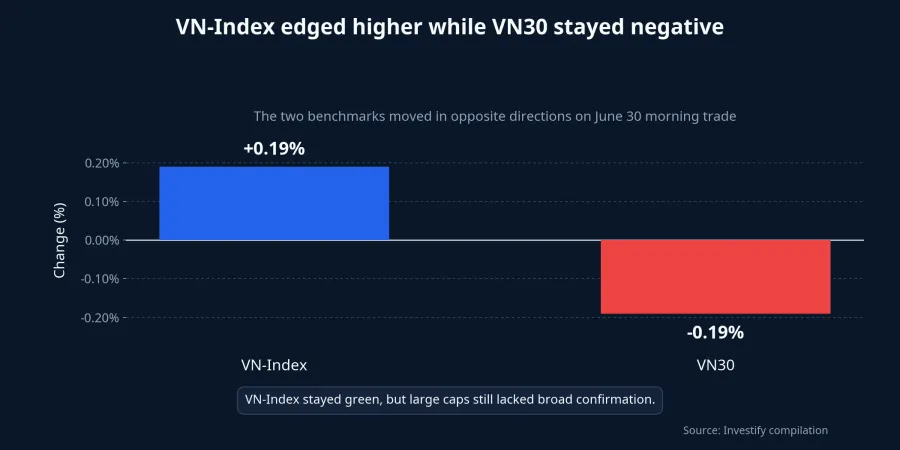
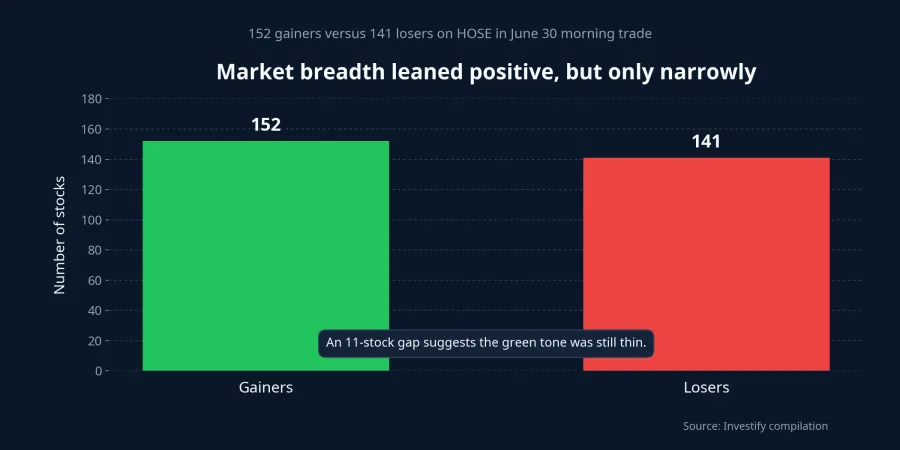
By the lunch break, VN-Index stood at 1,858.52 points, up 3.55 points, or 0.19%. Market breadth showed 152 gainers and 141 losers. At the same time, VN30 was at 2,000.41 points, down 3.88 points, also 0.19%. That contrast alone mattered. When the headline benchmark is green but the large-cap basket is still red, the message is not “everything is fine.” The message is that the market is split beneath the surface.
That is the core idea of this piece. June 30 morning trade was not a clean “strong market versus weak market” call. It was a lesson in structure. Which groups were actually holding the index up, and which ones had not returned yet?
A green benchmark is not the same as a green portfolio
The simplest way to read the session is this: VN-Index is a top-level snapshot, while a portfolio is lived reality. Those two things do not always move together. Because the benchmark is market-cap weighted, a handful of large stocks can rise modestly and still keep the index in positive territory.
That helps explain why the screen could look calm on June 30 morning even while many investors still felt the tape was hard to trust. VN30 was down 0.19% while VN-Index was up 0.19%. In practice, that meant support existed, but it was not coming from full agreement across the large-cap complex.
Breadth was positive, but only barely
The 152-to-141 breadth split sounds constructive on first read. Look closer, and it is still only a narrow edge. It does not describe a euphoric tape, and it certainly does not prove that buyers were pushing broadly across the board. In plain English, buying interest was present, but it was not dominant.
This is one of the easiest things for new investors to miss in live trading. Many see the index in positive territory and assume the odds of intraday gains have widened across the market. In reality, with only an 11-stock gap between gainers and losers, the outcome still depends heavily on where your portfolio is positioned.
VNFIN added to that reading. The financial index rose 0.03%, with 25 gainers and 13 losers. That said there was support inside financials, but support was still measured rather than aggressive.
Banks were doing the heavy lifting
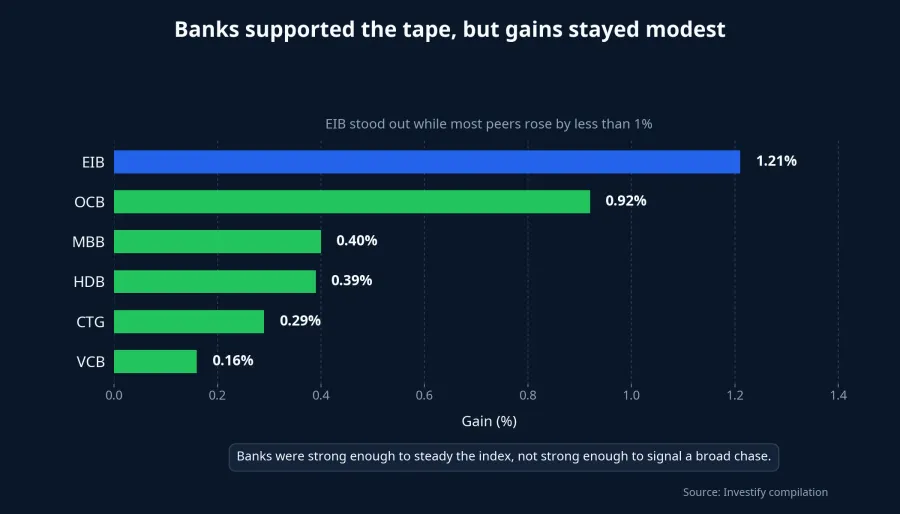
If one group deserves most of the credit for keeping the market steady, it is banks. MBB rose 0.40%, HDB gained 0.39%, EIB climbed 1.21%, CTG added 0.29%, VCB advanced 0.16%, and OCB rose 0.92%. This was not a breakout move, but it was exactly the kind of support a divided market needs: moderate gains in large, index-relevant names that can keep the benchmark from slipping further.
That matters to portfolios in a very practical way. Bank stocks carry large weights, so even small gains can materially support VN-Index. There are sessions when the board does not look dramatic, yet the benchmark is still being lifted by heavyweights.
The nuance is that gains inside banks were still uneven. EIB and OCB stood out more, while most of the group rose by less than 0.50%. That makes banks a stabilizer, not yet a locomotive. The group was strong enough to keep the tape from weakening sharply, but not strong enough to say money was chasing stocks in one broad wave.
Property was no longer falling all at once, but it was not healthy either
The most misleading part of the session sat in property stocks. If you looked only at June 30 morning data, you would not see a sector in outright collapse. VNREAL rose 0.41% to 3,214.90 points, with 22 gainers and 12 losers. VIC was up 0.92%, PDR rose 0.68%, while VHM slipped 0.47%. NVL and KDH were unchanged. Clearly, this was no longer a session where the whole group was being sold indiscriminately.
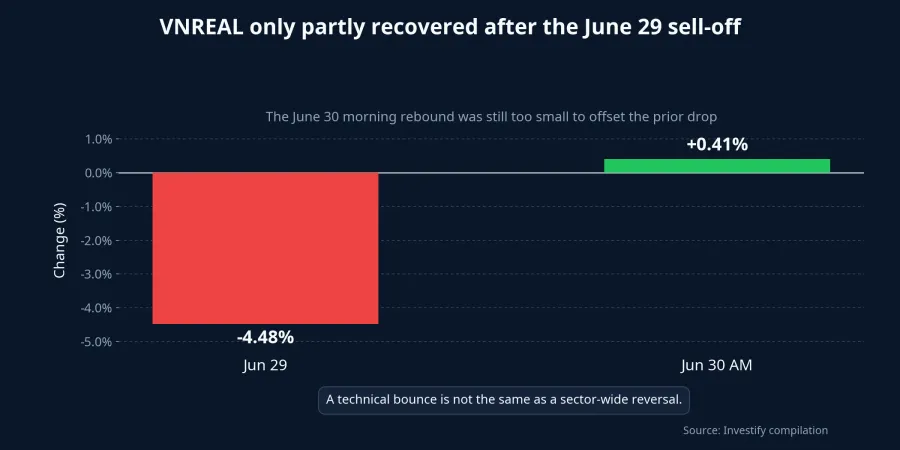
But it would be too fast to conclude that the risk had already passed. The sharper selling pressure belonged to the previous session. On June 29, Nhân Dân reported that real estate shares were under heavy selling pressure as VN-Index dropped nearly 17 points, with major names such as VIC and VHM also caught in the decline.Nhân Dân Internal data show VNREAL fell 4.48% that day, which means the 0.41% rebound on June 30 morning was still small when set against the drop that came immediately before it.
That is where newer investors need to separate “stopped falling” from “turned strong again.” After a sharp sell-off, a sector can easily stage a technical bounce in the next session. The bounce matters because it eases stress and improves tone, but it does not yet prove that money has returned to the whole group.
What to watch in the afternoon session
The first signal remains breadth. If the number of gainers expands clearly beyond the 152 seen in the morning and the gap over losers widens, the green index print becomes easier to trust. If VN-Index stays positive while losers begin to outnumber gainers, then leadership is still narrow and the headline print is doing too much of the storytelling.
The second signal is VN30. In the morning, the basket was still down 0.19%. If it turns positive in the afternoon, the quality of the broader move improves meaningfully because large caps stop contradicting the benchmark. If VN30 remains red or stuck near flat, the market is still in a holding pattern rather than a genuine acceleration phase.
The third signal is property. VNREAL was up 0.41% after a 4.48% decline in the prior session, so the afternoon should be read as a test of rebound quality. If the group can hold green and broaden participation, the market becomes less fragile. If the bounce fades or reverses, the pressure from the June 29 sell-off will still be hanging over sentiment.
The conclusion from June 30 morning is straightforward. VN-Index was green, but that was only the surface. Underneath, banks were doing the stabilizing, breadth was positive by only a thin margin, VN30 had not confirmed, and property was still just bouncing technically after a heavy sell-off. For newer investors, the useful lesson is to ask the right questions: where is the support, how wide is participation, and which group truly confirms strength by the close.