


Dow Jones breaking above 52,000 is the kind of headline that can lift sentiment instantly. For many newer investors, a record close sounds like a simple message: risk appetite is back, Wall Street is strong again, and other markets may open with a lighter tone. That reading is only half right.
The real takeaway is not the excitement around a round number. It is the reminder that different indexes tell different stories, and the Dow is especially easy to misread if you stop at the headline. The 52,000 mark is real, but its meaning only becomes clear when you look at how the index is built and what changed when Alphabet entered the Dow.

What the 52,000 milestone actually says
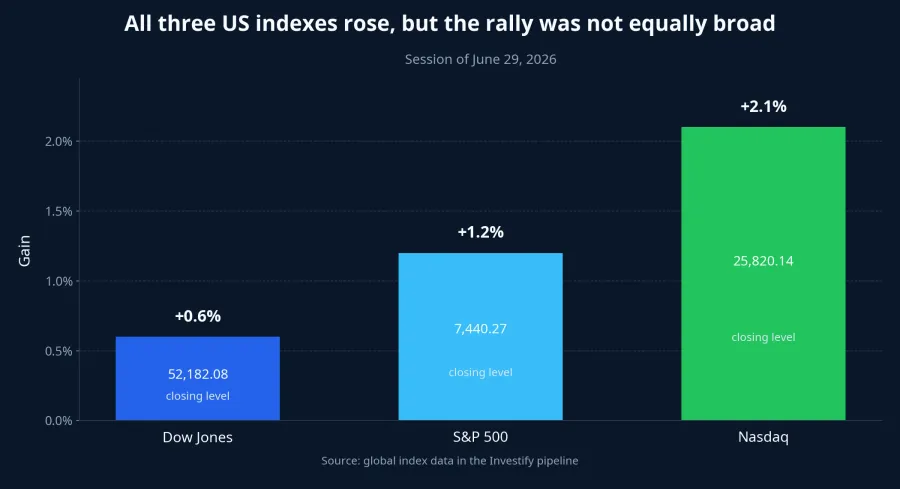
The latest US session was genuinely positive. The Dow closed at 52,182.08, up 0.6%. The S&P 500 ended at 7,440.27, up 1.2%, while the Nasdaq finished at 25,820.14, up 2.1%.
At first glance, that looks like a clean risk-on session. All three major benchmarks rose, and the Dow set a fresh record. But if you stop there and conclude that the entire US market is broadly healthy, you miss the key point: these indexes are not built to measure the same thing in the same way.
The Dow has enormous symbolic value because it is old, familiar, and media-friendly. Symbolism, however, is not the same as breadth. For newer investors, that is the distinction worth keeping: a record in one index does not automatically mean the bulk of the market is moving with the same strength.
Why the Dow is different from the S&P 500
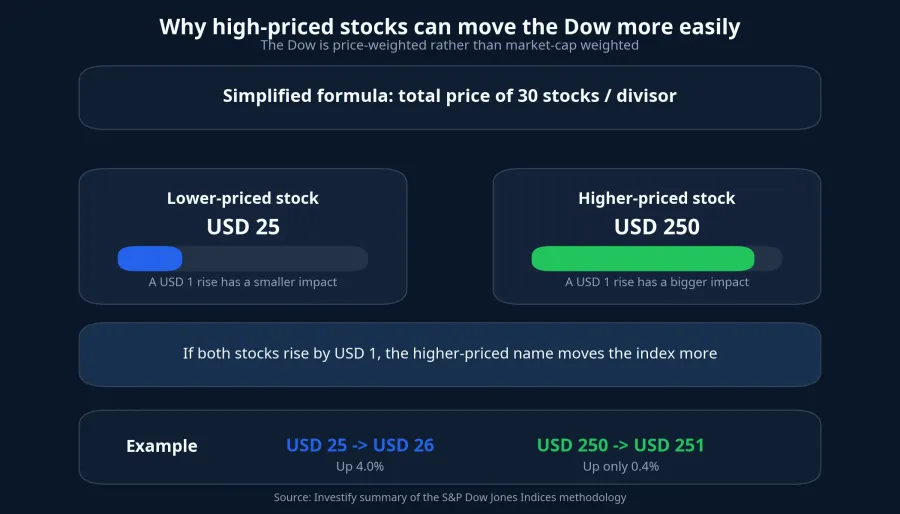
In simple terms, the S&P 500 is designed to reflect market weight more broadly, while the Dow Jones Industrial Average is price-weighted. It contains 30 stocks, and a higher-priced stock has more influence on the index when it moves by the same dollar amount as a lower-priced stock. That may sound technical, but it matters for anyone trying to read the signal correctly. If two stocks each rise by USD 1, the one trading at the higher absolute price exerts a bigger pull on the Dow. In other words, the Dow is sensitive to the price structure of its components, not just to the economic size of the companies inside it.
That is why the Dow does not answer the question many newer investors assume it answers. It does not say, "most of the US market is moving evenly higher." What it says is that a basket of 30 large companies, weighted by price, was strong enough to push the index to a new high.
Alphabet changed the way this record should be read
The story becomes clearer once you put the milestone in context. On June 23, 2026, S&P Dow Jones Indices announced that Alphabet would replace Verizon in the Dow Jones Industrial Average, effective before the market opened on June 29, 2026.S&P DJI
The same release said Verizon accounted for only about 0.5 percentage points of the Dow because of its lower stock price, while adding Alphabet increases the index's exposure to digital advertising, cloud infrastructure, artificial intelligence, hardware, autonomous driving, health technology, and digital media.S&P DJI That is not a cosmetic reshuffle. The Dow is still the Dow, but its basket now leans further toward technology and digital services.
There is also an important technical limit on how far that explanation should go. It would be wrong to say Alphabet mechanically shoved the Dow above 52,000. S&P Dow Jones Indices said the divisor would be adjusted when the component change took effect, specifically to avoid an artificial jump caused purely by the reshuffle.S&P DJI
So the better reading is this: 52,000 is still a meaningful psychological milestone, but it arrived on top of a different structure. Once Alphabet came in and Verizon went out, the same Dow level began to reflect a somewhat different mix of industries. Investors who ignore that shift can easily confuse a symbolic high with evidence of a uniformly strong market.
What newer Vietnamese investors should take from it
This matters to your portfolio not because a Dow record is a buy signal by itself. It matters because of how you filter market signals. When the Dow gains 0.6% but the Nasdaq rises 2.1%, the better question is not "the US market is green, so everything must be fine." The better question is "which groups are generating that strength?"
If the upside is concentrated in technology and other heavy hitters, the right takeaway is that sentiment is improving, not necessarily that breadth has become broad-based. For newer investors, that is a crucial step from reading headlines to reading market structure. A good headline tells you where attention is going; a sound decision starts with knowing what the headline leaves out.
The same discipline applies in Vietnam. The VN-Index previously closed at 1,854.97. If local stocks open stronger on the back of US sentiment, the next things to watch are liquidity, market breadth, the role of banks, brokers and technology names, and the behavior of foreign investors.
That is because the US market usually reaches Vietnam through sentiment first and real money flow second. A more optimistic opening can make the tape feel lighter, but it cannot replace domestic evidence. If local trading still revolves around a narrow set of large caps, an early gain is more likely to be a mood lift than a confirmed trend shift.
The number to remember is not 52,000
For newer investors, the lasting lesson here is not the exact milestone itself. The more useful lesson is that not all indexes should be read the same way. The Dow is powerful as a symbol, but the real health of the US market still needs confirmation from the S&P 500, the Nasdaq, and above all from whether buying is spreading beyond the biggest names.
The cleanest conclusion from the available evidence is that the Dow's move above 52,000 is real and important, but it is better read as a symbolic high reached by an index that now leans further toward technology. It is not yet enough to say all of Wall Street is healthy in a balanced way. The next signals worth watching are the breadth of the US rally, the extent of technology leadership, and how Vietnam trades once the initial burst of optimism fades.