
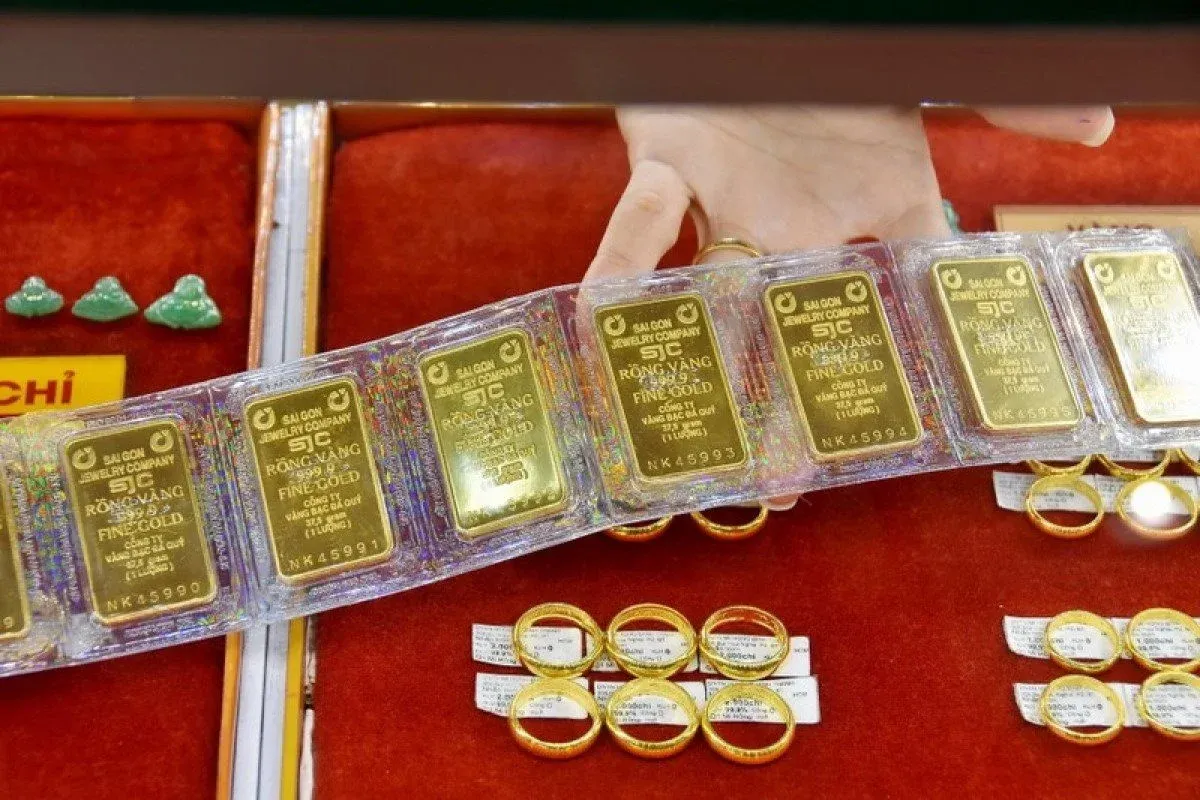

Starting July 1, gold-bar investors in Vietnam will need a different profit calculation. The buyback price at a gold shop still matters, but it is no longer the whole answer. Realized proceeds will also depend on whether the transaction falls into the taxable bucket, whether the investor can document cost basis, and whether the payment trail is clean enough to stand up to tighter scrutiny.Nhân Dân
That does not mean every gold sale after July 1 will automatically lose 0.1%, or that investors need to rush for the exit before the rule takes effect. The more accurate reading is that gold-bar trading is moving into a more transparent compliance framework, where invoices and payment records are becoming part of the economics of the trade. For first-time investors, that is the key shift because it affects cash actually kept after the sale, not just the headline quoted on the price board.

What changes on July 1
Per Nhân Dân, Vietnam's 2025 Personal Income Tax Law adds income from gold-bar transfers to taxable income from July 1, 2026.Nhân Dân The same report says that for non-resident individuals, personal income tax on gold transfers is calculated as transfer value multiplied by a 0.1% tax rate.Nhân Dân
The more important point for local retail investors is not the 0.1% figure itself. The law also leaves it to the government to specify the taxable value threshold for gold bars, the timing of collection, and how the rate may be adjusted under the broader roadmap for managing the gold market.Nhân Dân In plain English, the legal perimeter has been set, but the operational details still need guidance before investors know when a trade will be withheld, who performs the deduction, and what paperwork will qualify.
That is where many retail holders are likely to misread the story. A simple headline saying gold bars are now taxable can trigger a reflex to sell quickly before July 1. That reaction is too blunt. What is changing first is the compliance architecture, while transaction-level implementation still depends on follow-up guidance. The most rational move today is not to panic-sell, but to audit the paper trail behind each bar already sitting in the drawer or safe.
Why the invoice has become part of the asset
In a strong gold market, many investors remember only one thing: roughly what they paid. That memory-based method may have been enough for informal decision-making in the past, but it becomes fragile in a market that now expects more complete documentation. VietnamNet reports that gold and jewelry businesses are required to issue an electronic invoice for each sale, with the invoice created when ownership or usage rights are transferred to the buyer.VietnamNet
For an individual investor, the invoice matters on two levels. First, it helps establish cost basis: what price was paid, on which day, at which seller, and for what quantity. Second, it lowers the risk of disputes when the asset is sold back into a system where transaction data is increasingly standardized across gold dealers, banks, and regulators.
Put simply, an invoice does not create return, but it protects return. An investor who bought near the top and sells into a rebound is already sensitive to every million dong of margin left in the trade. If documentation is weak, that narrow profit can be eroded further by processing friction, requests for supplemental paperwork, or an unfavorable position when details are checked. In that sense, paperwork is starting to behave less like an accessory and more like part of the asset itself.
The payment trail matters too
Documentation does not stop with the invoice. VietnamNet says Decree 232/2025 requires gold transactions worth VND 20 million or more per day for a customer to be routed through the customer's payment account and the gold dealer's bank account.VietnamNet That may sound procedural, but it is the mechanism that lets authorities tie transaction value to the actual buyer, seller, and payment timestamp.
For investors holding gold bars now, the practical change is significant. In the past, the focus was often on finding the shop willing to pay a few hundred thousand dong more per tael. Price comparison still matters, but it now sits next to a second question: does this transaction leave behind a clean documentary trail. A slightly better posted bid may not be the better outcome if the payment process makes it harder to prove origin or cost basis later.
From a retail-investing perspective, liquidity in gold bars is no longer just about whether the asset can be sold. Clean liquidity means selling quickly, receiving funds clearly, avoiding disputes, and keeping the transaction easy to verify. That is the gap between a sale that looks complete on a price board and one that is genuinely complete in cash-flow and compliance terms.
What the latest prices are saying
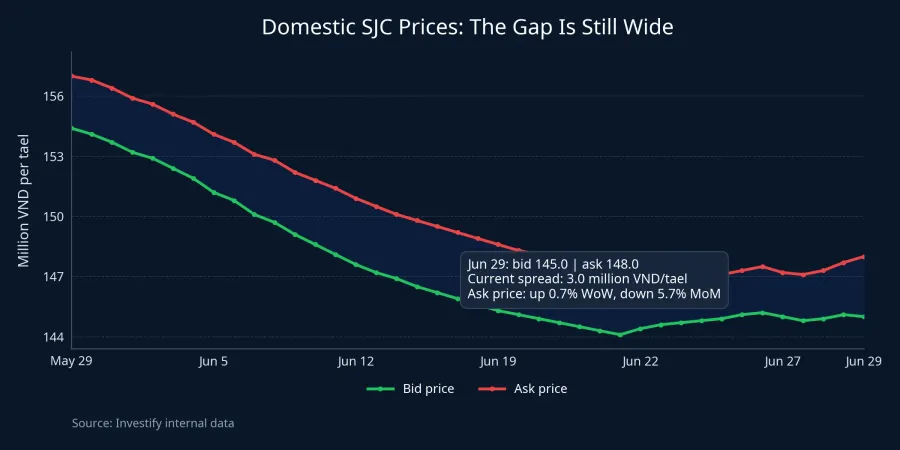
By late June, gold prices were no longer moving in a straight line. On June 29, global gold stood at USD 4,047.36 per ounce, down 3.4% from June 22 and down about 10.9% from May 29. On the domestic market, SJC gold bars were quoted at VND 145 million per tael on the bid and VND 148 million per tael on the offer, leaving a VND 3 million spread.
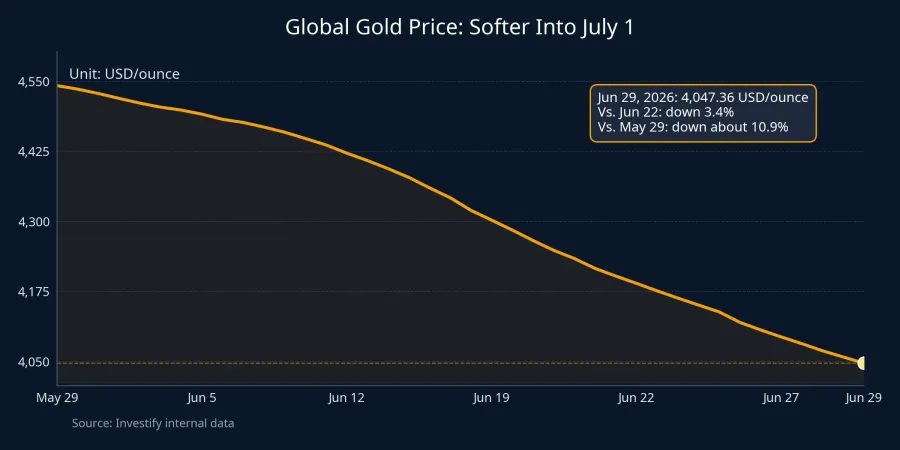
Those figures matter for two reasons. First, holders are no longer operating in a one-way rally where the only question is how much open profit they want to lock in. Second, even when the posted quote looks attractive enough to consider selling, a VND 3 million bid-ask spread remains a very real exit cost. Anyone who bought at elevated levels still has to be precise about the true breakeven point.
Once tax exposure and documentation are added back into the equation, realized profit becomes a layered calculation. Market price answers how much the asset can fetch today. The bid-ask spread answers how much it costs to leave the position. The transaction file answers whether the final proceeds can be kept smoothly, quickly, and with limited dispute risk. For newer investors, that is the difference between profit showing on paper and profit that is actually locked in.
Three checks before selling
The first step is to identify exactly what kind of gold is being held. The new tax language is explicitly about gold-bar transfers, not every gold product under one umbrella. If a portfolio includes gold bars, rings, and jewelry, they should not all be pushed through the same mental model. That basic classification step alone can prevent costly confusion when speaking to a dealer or preparing records.
The second step is to rebuild the original file. Is there a purchase invoice. Is there a bank transfer statement, receipt, or any document showing the payment flow. Does the buyer's name on the original paperwork match the person who is now planning to sell. Those questions sound administrative, but they are exactly what will determine whether a transaction moves smoothly as compliance checks become stricter.
The third step is to be honest about the reason for selling. If the sale is driven by a cash need, the top priority is a straightforward process and clarity over net proceeds. If the goal is profit-taking, the investor needs to include the bid-ask spread and the possibility of tax obligations once implementation guidance is issued. If the sale is motivated only by anxiety around the July 1 date, that is more of an emotional reaction than an investment thesis.

What to watch next
The clearest conclusion is that after July 1, profit on a gold-bar sale will no longer sit entirely on the price board. It will be split across three layers: market price, the bid-ask spread, and the quality of the transaction file. Investors already know how to watch the first two. The third is the layer many still ignore, even though it may decide whether the sale closes cleanly or turns messy.
That is why the most important adjustment now is not to sell in a rush or to freeze completely. It is to treat invoices, bank statements, and related records as part of the holding itself. The key signals to monitor over the next few weeks are the guidance on taxable thresholds, the withholding mechanism, and the practical filing process. Once those details are clear, investors will know which part of the gain is just a mark on the board and which part is money that truly lands in the account.