
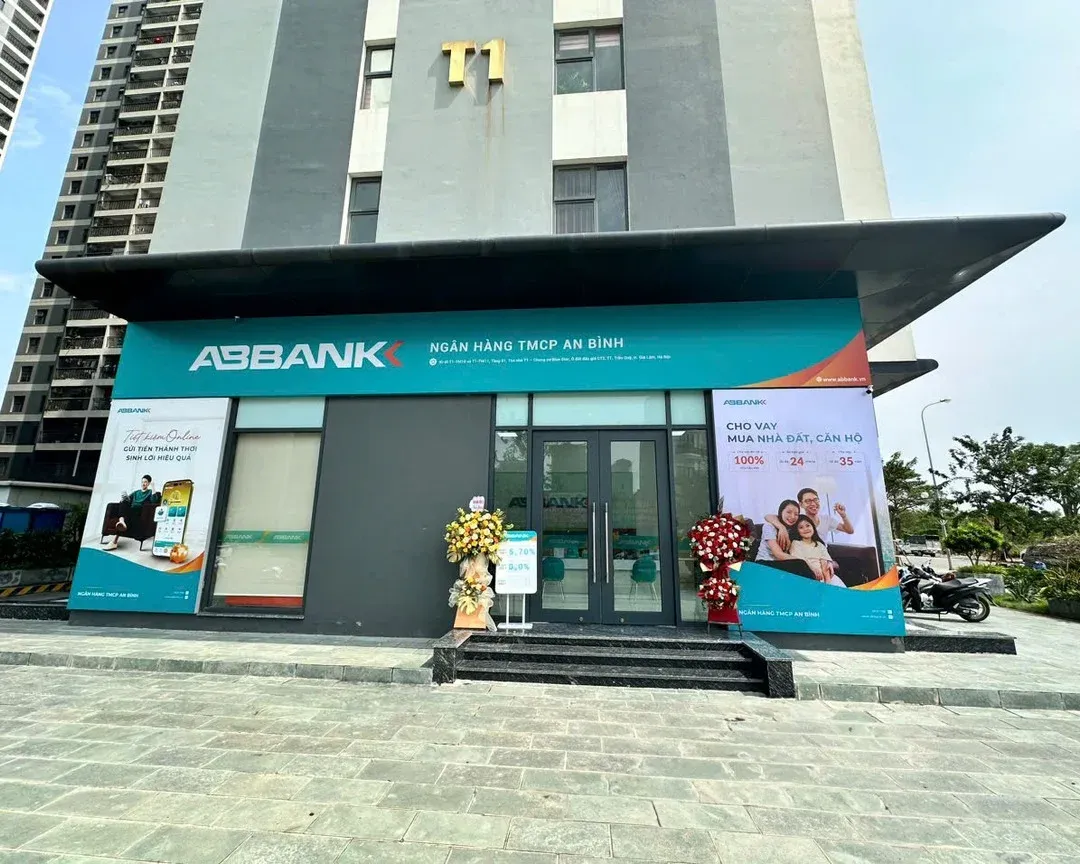

Owning 100 ABB shares may soon become owning 115. At first glance, that feels like an instant 15% gain. In practice, stock dividends do not work that way. The immediate change is the share count in the account. The real change in economic value depends on what ABBank does with a larger capital base in the quarters that follow.
That is why ABBank's plan to issue nearly 209.6 million shares at a 100:15 ratio should be read as one leg of a broader capital-raising program, not as a one-day windfall for shareholders.Người Đưa Tin The important question is no longer “How many extra shares do I get?” It becomes “Can the bank earn enough on the larger capital base to justify those extra shares?”
Why a 15% stock dividend is not a 15% profit
Cash dividends and stock dividends do very different things. A cash dividend moves money out of the company and into the shareholder's pocket. A stock dividend keeps the resources inside the bank and reclassifies part of retained earnings into charter capital. Shareholders receive more units of ownership, but the pie does not become bigger just because it has been cut into more slices.
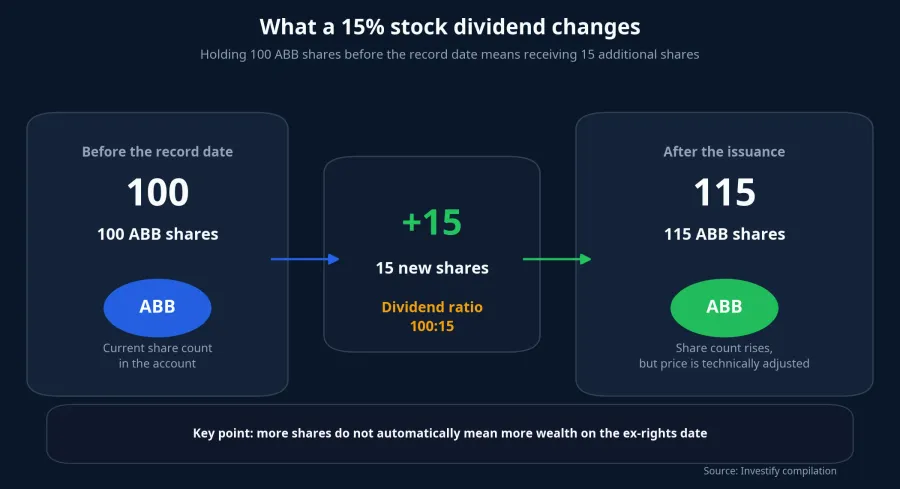
For ABBank, the ratio is 100:15, meaning an investor with 100 shares would receive 15 additional shares. The issuance carries a par-value amount of roughly VND 2,096 billion and is funded from undistributed accumulated profits.Người Đưa Tin That means existing holders do not have to inject fresh cash in this first step. It does not mean their wealth jumps 15% on the ex-rights date, because the market price is usually adjusted to reflect the larger share count.
That is the trap for newer investors. More shares are visible immediately. If profit does not rise in tandem, EPS still has to be spread across more shares. A stock dividend only becomes meaningful if it opens the way to stronger growth later on.
The real issue is the VND 6,112.8 billion capital plan
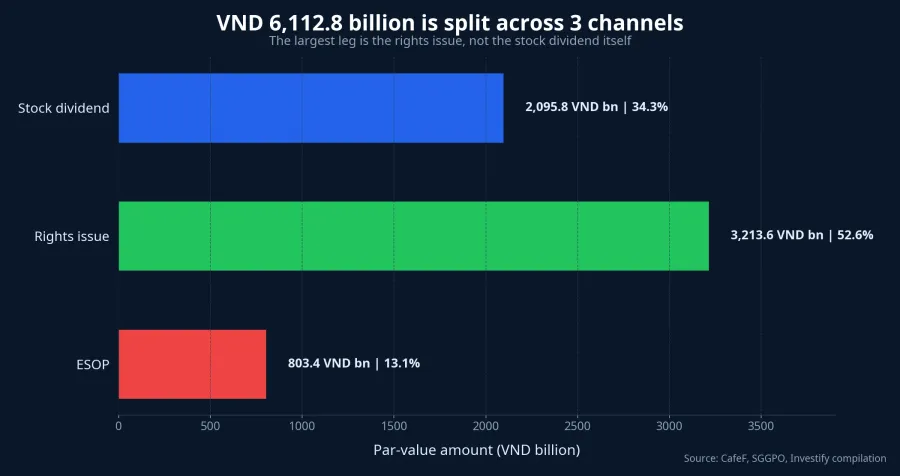
Looking only at the 15% stock dividend misses the more important half of the story. On June 19, reports said the State Bank of Vietnam approved ABBank's plan to raise charter capital by VND 6,112.8 billion through three channels: a stock dividend, a rights issue for existing shareholders, and an ESOP program.SGGP CafeF later reported that the approval remains valid for 12 months from the signing date, and that ABBank's board had already issued the June 19 resolution to launch the stock-dividend leg.CafeF
The key point is that the stock dividend is only one part of that package. The dividend portion accounts for just over VND 2,095 billion, while the rights issue for existing shareholders is much larger at over VND 3,213 billion, and the ESOP portion adds more than VND 803 billion.CafeF Read by weight, the largest piece of the plan is not the “free shares” narrative. It is the stage where existing holders may have to decide whether to commit more money to defend their ownership.
For current holders, the 15% stock dividend is the easiest part of the plan because it does not require fresh cash. The rights issue is a different matter. Participating means bringing in capital. Not participating in full can mean dilution. So treating the whole program as a reward misses the harder decision still ahead.
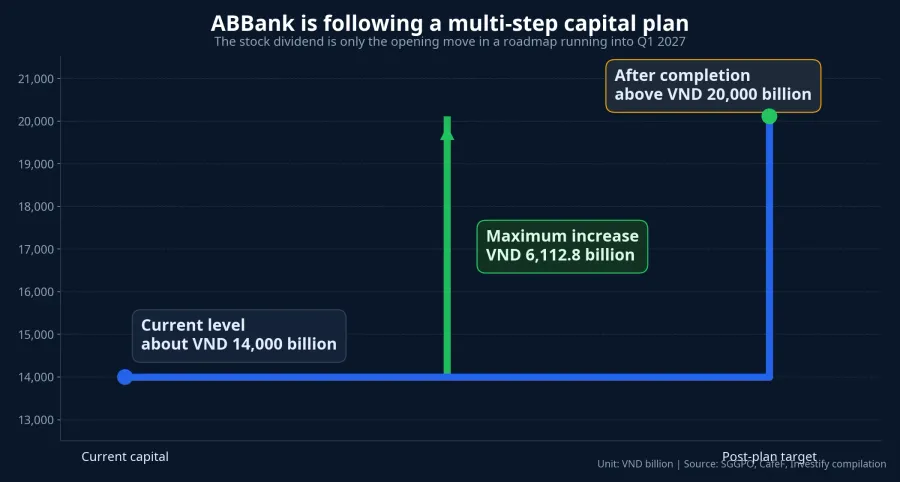
Fresh reports also say ABBank aims to move from about VND 14,000 billion in charter capital today to above VND 20,000 billion after the capital plan is completed, with the new funds earmarked to support lending.SGGP For investors, that only matters if the larger capital base turns into quality credit growth, steadier profits, and dilution the business can absorb.
ABB's price has already priced in part of the story
Markets rarely wait until the formal issuance date to react. Investify's internal data show ABB rising from VND 15,300 on May 18 to VND 18,000 on June 26, a gain of roughly 17.6%. That is large enough to say the market has already noticed ABBank's capital story. This is no longer a hidden development.
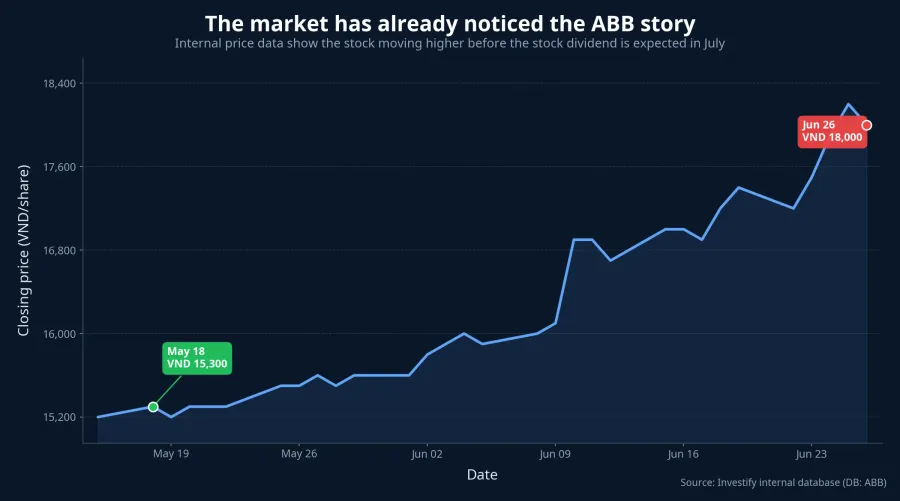
At the same time, it would be too neat to say the move came entirely from the stock-dividend headline. The same stretch may also reflect expectations around the next rights issue, hopes for a transfer to HOSE, or a broader improvement in appetite for smaller bank names on UPCoM. The stock rose alongside the capital narrative, but the evidence is not strong enough to assign exact weights to each driver.
That matters most for investors arriving late. Once part of the story has already been priced in, the next leg higher would need to come from execution, not from the headline itself.
The next test is the rights issue and the HOSE timeline
From a shareholder's perspective, the more consequential milestones come after the dividend step. Reporting on June 19 said ABBank is targeting a HOSE listing in the fourth quarter of 2026 and completion of its broader capital plan by the first quarter of 2027, taking charter capital above VND 20,000 billion.SGGP That could improve liquidity and institutional visibility, but it is still a plan in motion, not an outcome already delivered.
For newer investors, four signals matter from here: the record date, the detailed structure of the rights issue, the stock's behavior after the market absorbs the added float, and whether the HOSE roadmap stays on schedule. A successful transfer creates a very different valuation story from a plan that remains on paper.
Conclusion: treat the dividend as an opening move
The clearest thesis here is straightforward: the 15% stock dividend is mechanically positive in the short term, but the real payoff depends on whether ABBank can turn a VND 6,112.8 billion capital plan into stronger earnings, manageable dilution, and on-time progress toward HOSE. None of those pillars has been disproven. None of them has been proven by a single issuance announcement either.
So if you hold ABB, the practical framework is not to count how many extra shares are about to land in the account. It is to watch how the bank executes the rights issue, how the market digests the added supply, and whether the HOSE timetable stays intact. Those are the signals that will determine whether this dividend becomes the start of a stronger shareholder story or just a short-lived catalyst on the trading screen.