

Gold falling below USD 4,000 an ounce is the kind of headline that instantly feels like an invitation to buy the dip. For many first-time investors, the logic sounds clean: if the world price is lower than it was yesterday, getting in early should be better. In Vietnam's gold market, though, that shortcut misses the real problem. What determines profit or loss is not the headline on an overseas terminal, but the retail price you actually pay and the price a local shop is willing to buy back from you.
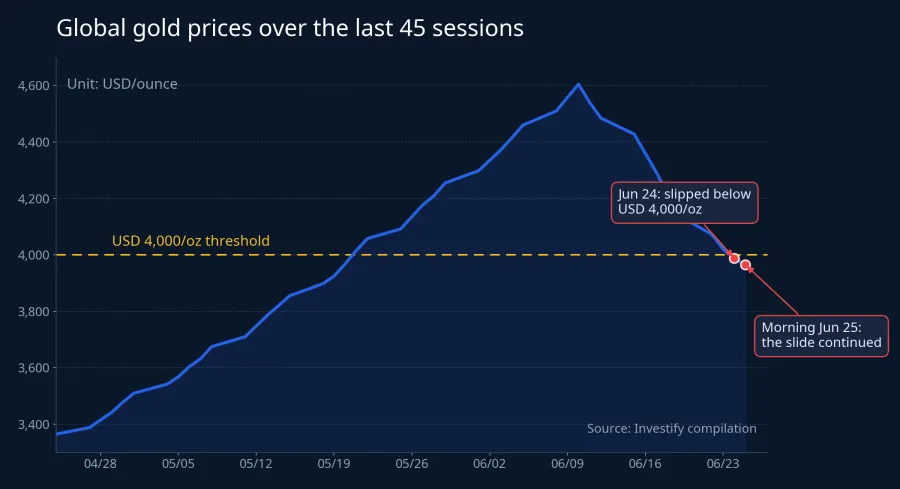
In the June 24 US session, the most-active gold contract briefly dropped to USD 3,992 an ounce, its first move below USD 4,000 since November 2025.MarketWatch Investify's internal data also shows spot gold at USD 3,999.60 an ounce at the June 24 close, down 2.77% from the previous session, and still sliding to USD 3,985.10 by the morning of June 25. That matters because the decline was not just a momentary shakeout. It was still unfolding as Vietnam's domestic market was getting ready to trade.
The Global Move: Why Gold Lost Support
MarketWatch attributed the drop to a firmer US dollar and higher US rate expectations, two forces that usually hurt gold because bullion does not generate yield.MarketWatch Investify's internal data shows the DXY dollar index at 101.40 on June 24, up 0.41% on the day. When the dollar rises, buyers using other currencies have to pay more for the same ounce of gold. When rate expectations rise, the opportunity cost of holding a non-yielding asset also rises.
That is an important distinction for beginners. An asset that falls on a brief sentiment shock can rebound quickly. An asset that is under pressure from the dollar and rates often needs more time to stabilize because the macro driver is broader than a single trading session.
Still, reading the global move correctly solves only half of the puzzle. The other half is whether Vietnam's domestic market has passed that decline on to retail buyers. If the international drop does not flow through to local asking prices, the feeling that gold is suddenly cheaper can be badly misleading.
Local Retail Pricing: The Entry Point Is Still Expensive
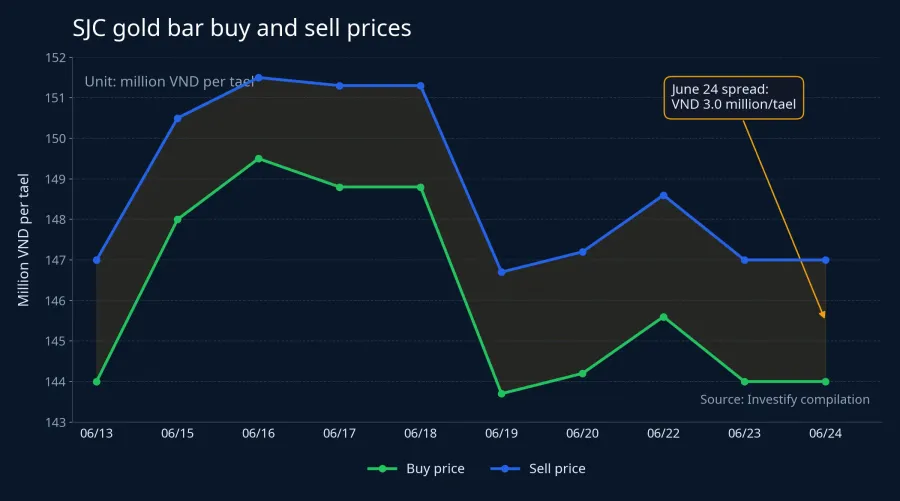
VOV reported on the morning of June 25 that SJC gold bars were quoted around VND 143.2 million to VND 146.2 million per tael, while DOJI remained in a VND 144 million to VND 147 million range.VOV Investify's internal data for the end of June 24 showed SJC gold bar bid prices at VND 144,000,000 per tael and ask prices at VND 147,000,000 per tael. Look only at the selling side and the message is straightforward: local buyers are still entering at a very elevated retail price even after gold broke a major psychological threshold internationally.
The conversion gap is even more revealing. Based on VOV's use of Vietcombank's June 25 exchange rate of VND 26,456 per US dollar, the world gold price worked out to roughly VND 126.8 million per tael after taxes and fees. That was VND 19.4 million below the SJC selling price at the same moment.VOV Put simply, the international market may have become cheaper, but the Vietnamese retail buyer is still looking at a thick local premium.
That premium is not a side detail. It is the reason the statement "global gold is cheaper" is not the same as saying "the domestic entry point is better." A contract traded overseas can respond quickly to the dollar, rates and futures positioning. A tael of SJC gold on a local counter still has to move through physical supply, company pricing decisions and a risk buffer that dealers keep in place.
The Buy-Sell Spread: Your Exit Cost Starts on Day One
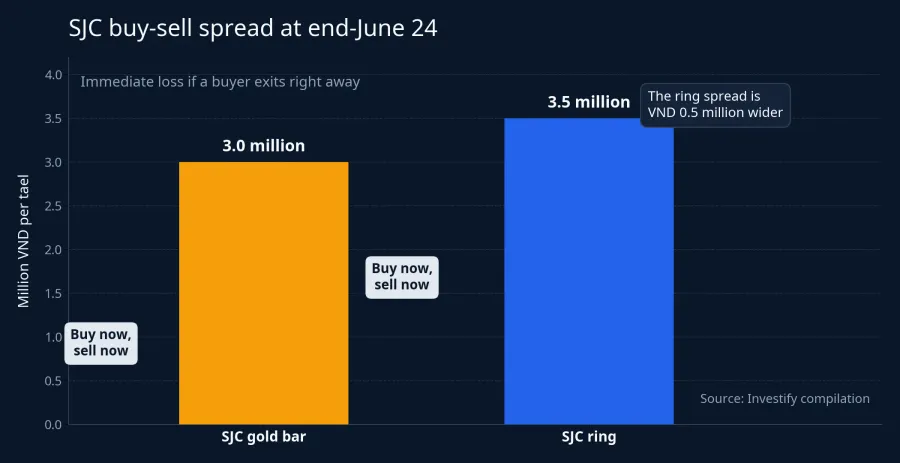
The second layer of risk is the spread between the buying and selling quote. CafeF reported on June 25 that the buy-sell spread for gold bars and gold rings at several brands was running between VND 3 million and VND 4.5 million per tael.CafeF VOV also cited a roughly VND 3 million spread on some widely watched boards.VOV Investify's internal data shows the same pattern: on June 24, the SJC gold bar spread was VND 3,000,000 per tael, while the SJC ring spread was VND 3,500,000.
This is the piece that many new investors underestimate. With a stock trade, you usually focus on the market price and a relatively small brokerage fee. With physical gold, the cost of getting out is embedded in the quote from the start. If you buy an SJC gold bar at the VND 147,000,000 asking price and have to sell back immediately at the VND 144,000,000 bid, you lose VND 3,000,000 per tael before global gold even moves again.
The ring market is even less forgiving in the short run. Investify's internal data shows an SJC ring selling at VND 145,400,000 per tael while the bid stood at VND 141,900,000, leaving a VND 3,500,000 gap. That does not mean gold rings are always the worse instrument. It does mean that, at this moment, anyone trying to capture a quick bounce has a larger cost buffer to clear before the trade becomes profitable.
A Beginner Can Read the Trend Correctly and Still Get the Trade Wrong
A buyer stepping in now could be right on direction. Global gold has dropped sharply, international sentiment has clearly weakened and the USD 4,000 threshold no longer looks secure. Yet that same buyer can still be wrong on execution if local pricing has not adjusted enough.
Think of it like spotting a sale sign while the shelf price has barely changed and the return policy still charges you a hefty penalty. In that setting, being correct about the direction is not enough. The outcome depends on the price you pay, the price you can exit at and how quickly Vietnamese retail boards react to the world market.
That is why the lag in the domestic market matters so much. International gold responds almost continuously to the dollar, interest rates and futures positioning. Gold bars and rings in Vietnam move through dealer price boards and physical supply-demand conditions. In practice, that can produce a quick drop on the bid side while the asking price comes down much more slowly. If that happens, the buyer's margin of safety keeps shrinking.
What to Watch Over the Next Few Sessions
Rather than fixating on USD 4,000 an ounce alone, first-time investors should watch three more practical signals. First, does the local asking price fall fast enough to reflect the world-market decline. Second, does the buy-sell spread narrow from the VND 3 million to VND 4.5 million zone.CafeF Third, does the gap between SJC prices and the world price in local-currency terms compress meaningfully from the current VND 19.4 million area.VOV
If all three improve together, then the story "global gold is cheaper" can start to become "the domestic entry point is less punishing." Right now, though, the evidence supports a more careful conclusion: the international gold price has come down, but the entry gate for Vietnamese retail investors still is not genuinely cheap. That view changes only if local asking prices fall further, the buy-sell spread tightens clearly and the premium over the world-converted price starts to compress in the next few sessions.