


LPB ended the June 23 session at its ceiling price of VND 52,600 per share, up 6.91% in a single day. The headline was the appearance of Pham Nhat Vuong, Chairman of Vingroup (VIC), on LPBank's list of shareholders owning at least 1% of charter capital, with 146.2 million shares, or 4.894% of the bank.Nhà Đầu tư
For first-time investors, the instinct is straightforward: a famous businessman shows up, the stock hits its ceiling, so the signal must be bullish. That is too simplistic. The more important fact is that LPBank has just forced the market to reassess its ownership structure, while the price spike only tells us investors are paying in advance for a possibility, not for a change that has already been confirmed.
What the new shareholder list really changed
Under LPBank's June 23 update, the bank now has two shareholders above the 1% disclosure threshold. Vietnam Post owns more than 195.3 million shares, equal to 6.537% of charter capital, while Vuong owns 146.2 million shares, equal to 4.894%; LPBank also said parties related to Vuong do not hold shares in the bank.Vietnambiz
That matters because this was not a voluntary media move. Vietnam's 2024 Law on Credit Institutions requires any shareholder owning at least 1% of charter capital to disclose identity details, related parties, share count and ownership ratio, and requires banks to publish that information on their websites within seven working days.LuatVietnam In plain language, the market has just been given a clearer view of a layer of ownership that used to be harder to see.
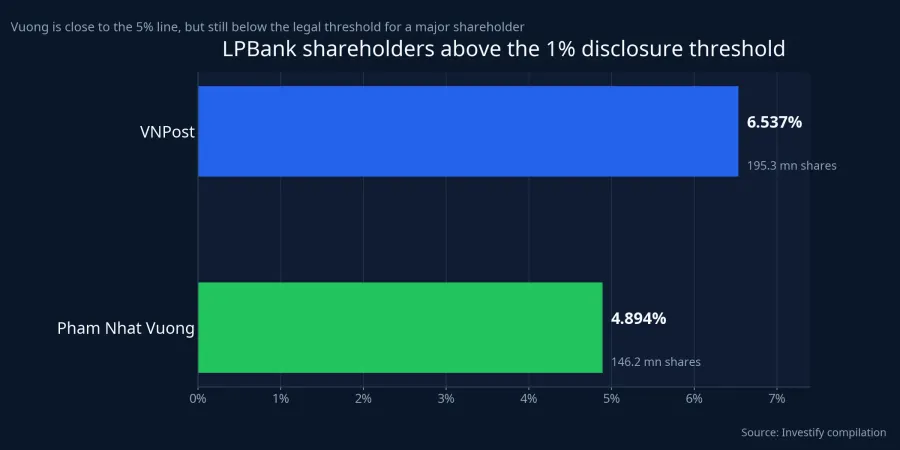
The detail many readers will miss is that 4.894% is close to the 5% line, but still below the threshold that typically defines a major shareholder in banking discussions.LuatVietnam That means investors still do not have the basis to jump to conclusions about control, management changes or a strategic alliance. The real question for now is narrower: does higher ownership transparency justify a different valuation range for LPB?
How much has the market already priced in
On the tape, the market moved quickly. LPB hit its ceiling at VND 52,600 per share on June 23, pushing its market capitalization to roughly VND 157.1 trillion after the session. When a bank stock of that size can still rise the full daily limit in one day, it signals that the market is re-pricing expectations aggressively.
But the move did not really start on June 23. LPB's matched volume that day was 7.1976 million shares, up from 4.2477 million shares on June 22, yet still far below the 37.043466 million shares traded on June 19. That tells us money had already started watching LPB before the new-shareholder story became widely discussed.
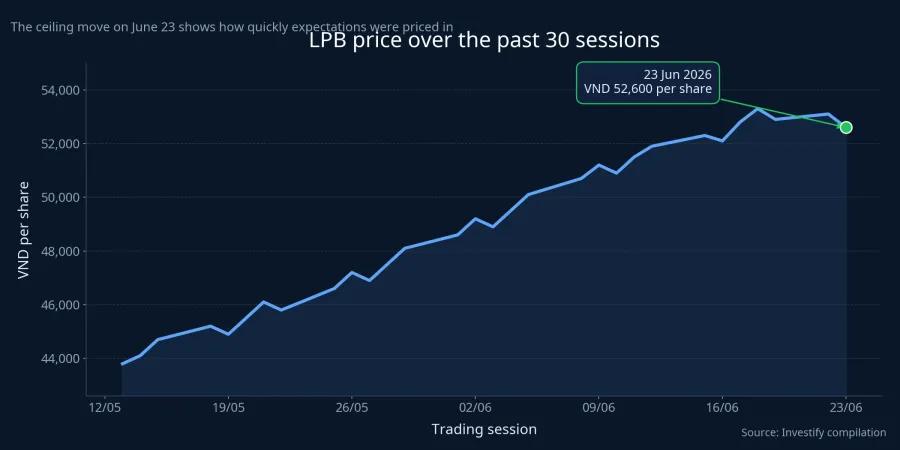
If you only look at the limit-up candle on June 23, it is easy to believe the entire impulse appeared in one session. The 30-session chart says otherwise. LPB had already been climbing, and June 23 looks more like an acceleration point than a completely fresh turn. In situations like this, the biggest risk for new investors is confusing what has just been confirmed with what has already been priced in.
What the market is betting on, and what still is not confirmed
It would be too neat to attribute LPB's entire jump to Vuong's appearance on the list. The current evidence allows at least three explanations. First, the market may be rewarding greater clarity around ownership. Second, some capital had already moved in earlier, as seen in the June 19 liquidity spike. Third, the presence of a well-known billionaire can attract additional short-term attention.
Of those three, the evidence most strongly supports a re-pricing based on ownership transparency and expectation, not yet a confirmed new strategic story for LPBank. The disclosure so far does not show Vuong taking an executive role, does not mention a cooperation agreement, and does not provide evidence of governance changes or capital support tied to his position.Nhà Đầu tư Without those layers, the market is still valuing a future scenario based more on assumption than confirmation.
That matters for risk reading. A famous shareholder can create a powerful sentiment shock, but sentiment does not automatically become earnings growth, loan expansion or stronger asset quality. When the main driver of a rally is expectation, the durability of the price move usually depends on whether that expectation is later backed by new information.
What volume and block trades are actually telling you
The other key piece is negotiated trading. According to Nhà Đầu tư, LPB recorded very large block trades on the morning of June 23 at around VND 46,000 per share, creating a reference point very different from the VND 52,600 closing price on the matched-order market.Nhà Đầu tư
This is where first-time investors most often misread the tape. A block trade can help explain a shift in ownership, but it does not mean buyers in the open market will keep accepting a much higher price the next day. Put simply, a large transfer agreed around VND 46,000 is not proof that public demand will sustain LPB above VND 52,000 for several more sessions.
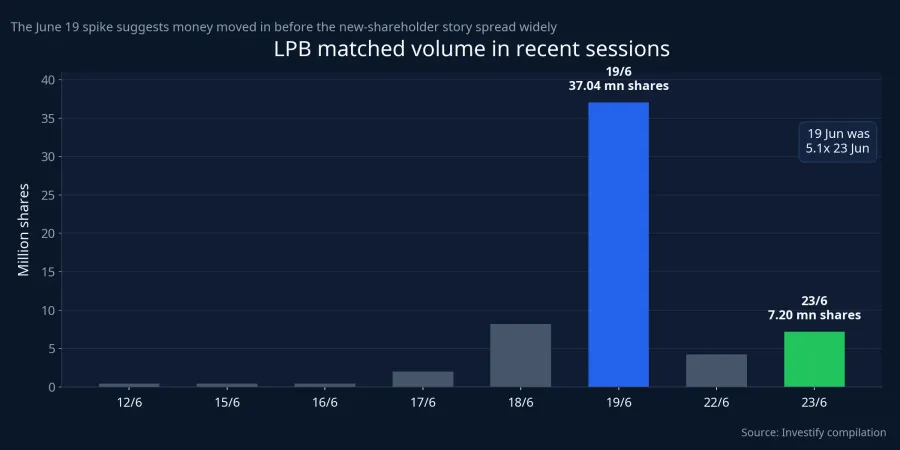
The volume chart makes the difference between "money that moved first" and "money that chased the story" easier to see. June 19 volume was more than five times June 23 volume, even though June 23 was the session that attracted the most headline attention. That gap is a reminder that the board does not only react to newly visible news; it also reflects positions that were built before the crowd fully noticed.
How new investors should read the next session
If you are new to the market, the next LPB session should be read as a durability test, not as a contest to guess the short-term top. The first signal is matched volume. If liquidity stays elevated while price holds the new range, it suggests additional buyers are accepting the post-news valuation. If liquidity fades quickly and the stock loses altitude, the previous surge may have leaned more on excitement than on staying power.
The second signal is follow-up disclosure from LPBank or related parties. If the story stops at "a new shareholder owns nearly 5%," the market will have to recalibrate expectations on its own. If more information emerges around cooperation, strategy, customer linkages or governance, then the market will have a stronger basis for extending today's narrative.
The third signal is how LPB stands within the broader banking sector. A stock can jump on a company-specific story for a few sessions, but to defend a new price range for longer, it still has to compete on valuation, growth quality and capital attraction against peers. That is why one limit-up session is never a substitute for the verification process that follows.
The cleanest conclusion for now is that LPB has been re-priced in the short term because ownership has become more transparent and the new name was strong enough to pull in attention fast. But the best working thesis remains this: the June 23 rally priced in expectation first, and the durability of the new price range will only be confirmed if matched-order liquidity and future disclosure keep supporting that story. The real thing to watch over the next few sessions is not what a famous name implies by itself, but whether the market finds enough new evidence to justify keeping LPB at this higher valuation.