

An approval notice can trigger a very familiar instinct in new investors: if a stock is heading to HoSE, surely it has another leg higher. The logic sounds tidy. HoSE is the larger exchange, it draws more attention, and it carries a natural sense of promotion in the eyes of retail money. But with BVB, BVBank's stock, the real issue is not that instinct. The real issue is separating listing approval, the first actual trading day on HoSE, and the harder question of whether the business deserves a new valuation at all.
The Ho Chi Minh City Stock Exchange has approved the listing of 640.82 million BVB shares, equivalent to charter capital of more than VND 6,408 billion.Vietstock Before that, BVBank shareholders had already approved the plan to delist from UPCoM and move the full share base to HoSE at the bank's 2026 annual general meeting.ANTT In plain English, the bank has moved one step further in the process. But one more procedural step does not mean the investment case has already shifted into a new phase.
Listing approval is not the same as switching venues
This is where beginners are most likely to blur the lines. Many readers see a listing approval notice and instinctively assume the stock will start trading under HoSE rules the next day. That is not what the approval means. At the moment the news broke, BVB was still on UPCoM and the market was still waiting for the final steps before its first official HoSE session.Vietstock
That distinction may sound technical, but it matters directly for how investors should read the price. Before the stock actually changes venues, the market is still trading expectations around the transfer story. It is not yet trading the stock inside a new exchange structure with a new reference point, a new audience and new early-session behavior.
Put differently, the approval is a process update. A rerating, if it comes, is a money-flow outcome after that process is completed. Those are separate layers. Collapsing them into one can push a buy or sell decision ahead of the evidence.
The market had already moved before the headline
Price action since early June makes that point hard to ignore. From June 9 to the close on June 22, BVB moved from roughly VND 12.4 thousand to VND 13.8 thousand, a gain of about 11.3%. That tells you the market was already reacting to expectations before the approval notice was widely circulated.
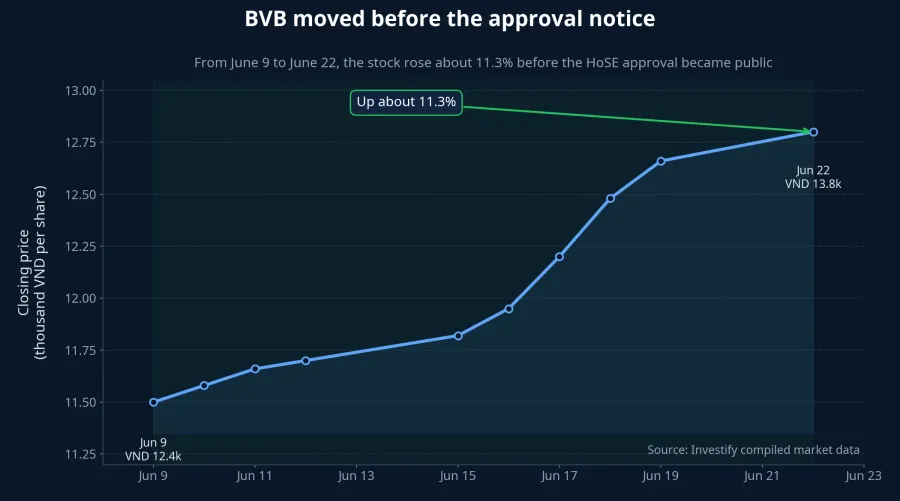
This matters because it protects beginners from a common mental trap: believing they are buying fresh news when they may actually be buying the part of the story that the market has already priced in. Investors entering after the approval are not buying at the same starting point as those who had followed the transfer story earlier. Once the price base has shifted, the margin of safety has shifted with it.
That does not mean the opportunity is over. It means the easiest part may already be behind the market. Once a stock has risen ahead of the official news, the next question is no longer whether the story exists. The next question is whether the story can still attract durable follow-through demand.
HoSE can increase visibility, but visibility is not rerating
The positive case for a venue transfer is not fictional. HoSE hosts many of Vietnam's most liquid names, it is watched more closely by retail investors, and it tends to feature more prominently in brokerage screeners and daily market coverage. A stock that leaves UPCoM for HoSE will almost certainly be seen by more investors. In market-attention terms, that is a real upgrade.Vietstock
But being seen by more people is not the same as being worth more money immediately. A useful analogy is a store moving from a small alley to a major boulevard. Foot traffic rises. More people pass by. Yet whether those people walk in and spend still depends on the quality of the goods, the pricing and the experience once they are inside. Stocks behave the same way. The exchange only changes the audience. The decision to stay with the stock still belongs to the numbers.
There is also the transparency angle. Moving to HoSE often comes with a higher expectation that disclosure schedules, reporting discipline and governance will be scrutinized more tightly. For a bank, that matters even more because investors do not look only at earnings. They also look at non-performing loans, provisioning and overall asset quality. That is a long-term positive. But higher scrutiny does not erase the underlying balance-sheet reality overnight. Better visibility is helpful. It is not magic.
Liquidity has to be read across several sessions, not one
BVB was not a completely illiquid name on UPCoM to begin with. Vietstock put its average turnover at roughly 1.9 million shares a day.Vietstock On June 22, matched volume reached about 3,858,800 shares, clearly above the base seen earlier in the month. That is a valid sign that attention intensified around the transfer story.
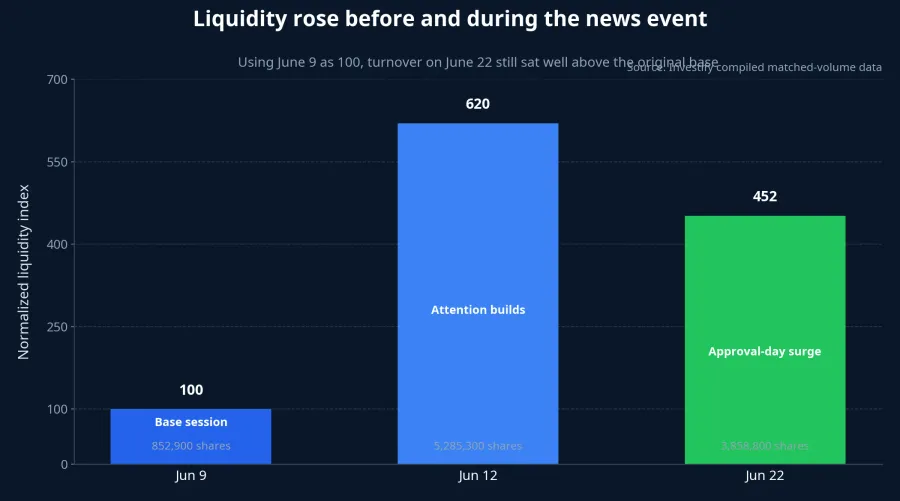
Still, a single busy session is not enough to prove that new demand will last. New investors often read liquidity the way they read fireworks: one bright burst and the whole sky feels different. In reality, turnover only becomes informative when it holds for several sessions. If volume stays firm after the news while the stock holds its ground or climbs in an orderly way, the market is likely digesting the event well. If volume spikes for a day and then collapses, short-term excitement may have run ahead of fundamental conviction.
It is also important to acknowledge the counterfactual here. The available evidence does not prove that all of the turnover jump came from the approval notice itself. Part of it may reflect expectations that had already built before the official decision. Another part may simply be event-chasing by retail traders. The cleanest conclusion is that liquidity rose around the venue-transfer story, but the data is not strong enough yet to assign exact causal weights.
In the end, BVB still has to answer with profit and bad loans
This is the part event-driven stories often push into the background. BVBank's first-quarter 2026 report included some genuinely supportive numbers: nearly VND 216 billion in pre-tax profit, up 1.7x from a year earlier, and more than VND 785 billion in net interest income, up 56%.ANTT Those figures help support the argument that the bank's operating performance is improving.
But the balance sheet does not tell a one-way story. As of March 31, 2026, BVBank's non-performing loans stood at VND 2,466 billion, up 5% from the start of the year, while the NPL ratio rose from 3.01% to 3.11%.ANTT For a bank, that is not a side note. Higher profit makes the story look better, but a rising bad-loan ratio is a reminder that credit risk has not disappeared.
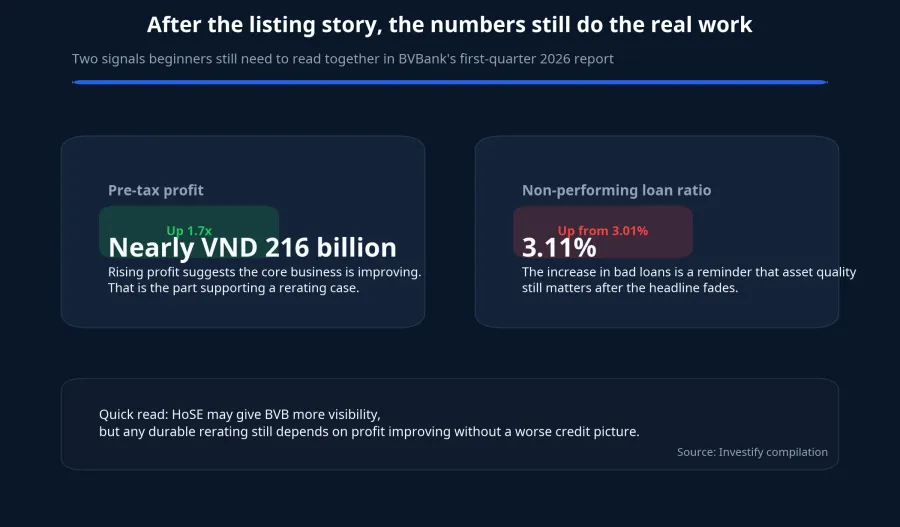
So if investors want to read BVB's move to HoSE correctly, they should not stop at the phrase “listing approved.” The more important question is what happens after the stock reaches the new venue. If the bank can preserve its profit momentum without letting asset quality deteriorate further, the rerating case gets a firmer base. If earnings improve while credit quality keeps weakening, the market may have to rethink how much reward the transfer story really deserves.
How beginners should read the setup from here
The right framework is not “HoSE means buy,” and it is not “the stock rose before the news so now it is untouchable.” A better sequence is simpler and more disciplined. First, check what stage the process has actually reached: approval only, or a confirmed first trading day. Second, look back at price action to judge how much expectation was already priced in before the official notice. Third, track liquidity over several sessions instead of reacting to one high-volume candle. Finally, go back to the financial statements and ask whether the operating base is strong enough to carry a higher valuation.
That leads to a fairly clear thesis. Moving to HoSE can make BVB more visible, but it is not enough on its own to turn the stock into an automatic buy signal. The easiest part of the story sits in the headline. The harder part is whether the market keeps paying for BVB after the event itself is over. The signals worth monitoring over the next few weeks are the date of the first HoSE session, the durability of post-news liquidity, and whether the bank's next reports confirm or weaken the case for an operational improvement.