
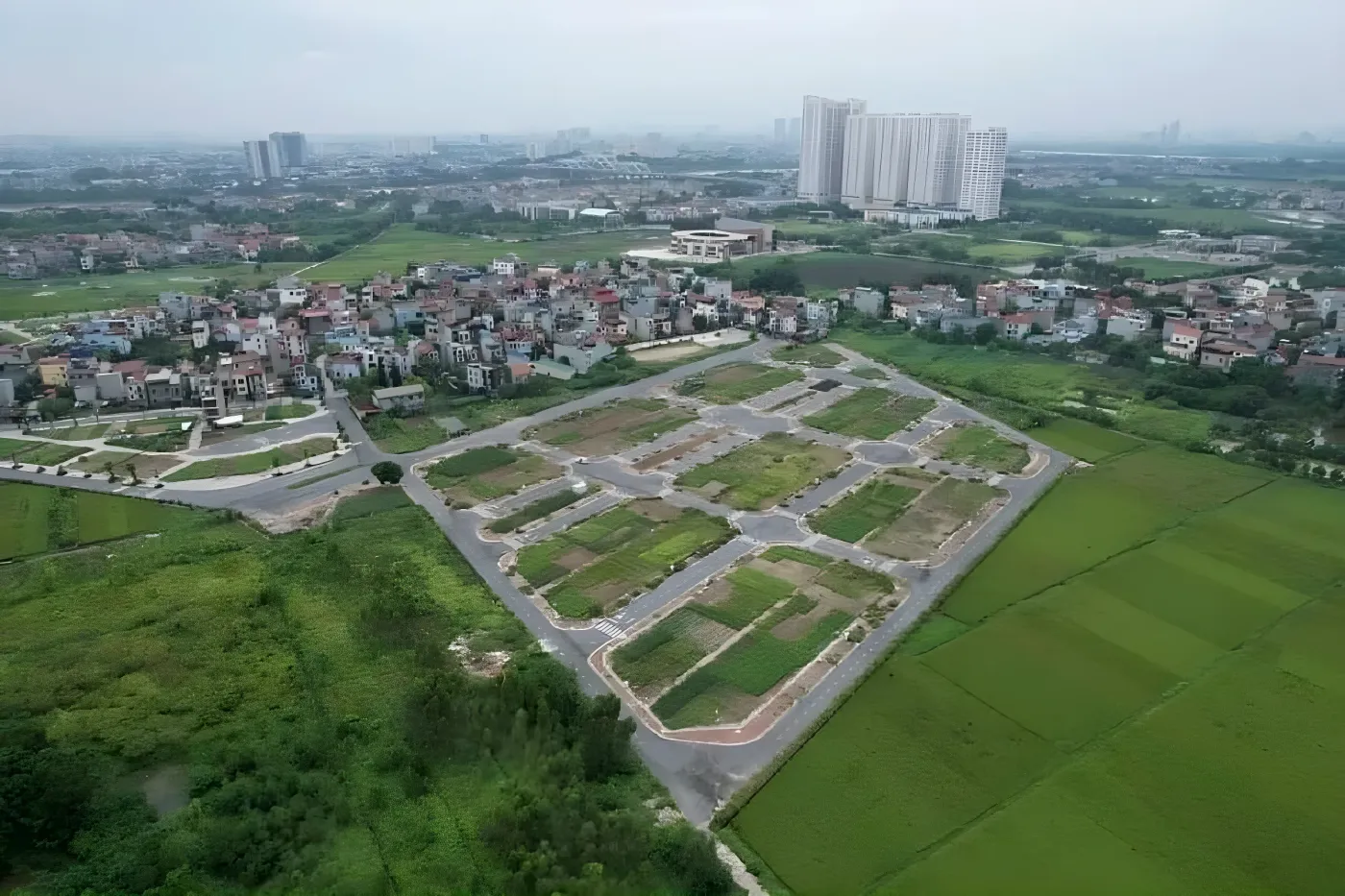

A 20% or 30% markdown always looks dramatic. For many first-time property investors, that number almost automatically leads to one conclusion: sellers are weaker now, so buyers finally have the edge. In Hanoi’s suburban land market, that conclusion is only half right. Prices may have come down, but real bargaining power still depends on harder questions: legal clarity, usable infrastructure, holding costs, and how easy it will be to sell later.
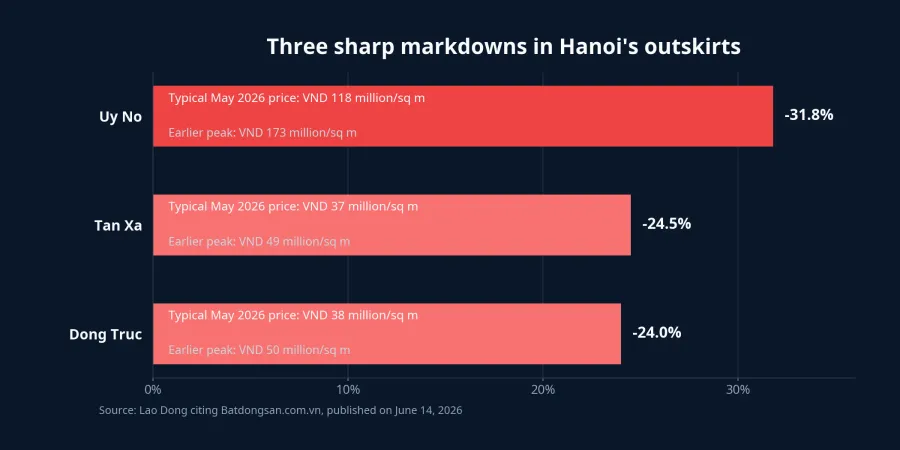
In several former hot spots, the correction is visible. Data from Batdongsan.com.vn cited by Lao Động shows that typical land prices in the former Uy Nỗ area, now part of Đông Anh, were around VND 118 million per square meter in May 2026, down 31.8% from the earlier peak of VND 173 million per square meter in February 2026. In former Tân Xã, now part of Hòa Lạc, the typical level was about VND 37 million per square meter, down 24.5% from VND 49 million. Former Đồng Trúc, now in Hạ Bằng, stood at roughly VND 38 million per square meter, 24.0% below the earlier peak of VND 50 million.Lao Động

Put simply, this is a phase where listed prices are becoming softer, but the market is not becoming easier to read. In equities, a sharp decline often shows up quickly in both liquidity and sentiment. Land works differently. Every plot is its own case. In the same area, one lot may sell because the road access is clear, the title is ready, and people already live nearby. Another may sit idle because zoning is messy, access is poor, or the asking price is still anchored to memories from the boom.
A discount does not tell the whole story
The first thing newer investors tend to miss is that you are not buying a percentage decline. You are buying a specific plot. If that plot still has unresolved paperwork, unclear building potential, or no evidence of real transaction prices nearby, then the markdown on the listing is just a reason to start looking, not a reason to commit capital.
Even within the same fresh source, the picture is more complicated than a simple “buyer’s market” narrative. Lao Động noted that a 100-square-meter plot in former Bình Yên was being offered at about VND 2.5 billion, or VND 25 million per square meter, roughly VND 8 million below the area’s current typical level. Another 128-square-meter lot in Phú Cát was listed at around VND 3.0 billion, equivalent to VND 24 million per square meter, about VND 640 million below the local prevailing level. Those numbers suggest sellers are willing to negotiate more aggressively, but they still describe asking prices. They do not guarantee that the next buyer will be easy to find.Lao Động
That matters because “cut-loss” language can create a false sense of urgency. Buyers see the word and assume they are looking at an unusually cheap asset. The more realistic reading is different. A seller may be under personal financial pressure while the asset itself still carries the same old weaknesses. If a plot sits in an area with thin end-user demand, unfinished infrastructure, and a price story that was driven mostly by expectations, then the decline may simply be pulling the product closer to fair value. It does not automatically move it into bargain territory.
Buyers do have more leverage, but not all buyers equally
This is the central point. Bargaining power really has shifted back toward people holding cash or using modest leverage. When sellers are no longer in a “first come, first served” mood, buyers gain time to ask harder questions, compare documents more carefully, and negotiate more firmly. But that advantage is not distributed evenly across buyer types.
End-users and very long-term accumulators benefit the most. They do not need the asset to reprice higher within a few months. What they need is a plot with a clear use case, the ability to hold through multiple cycles, and no pressure on personal cash flow. For that group, today’s correction creates room to move from a reactive mindset to a selective one.
Short-term flippers face a much tougher equation. To trade successfully, you need a good entry and an even better exit. Once the outer-district market loses its heat, the next buyer becomes slower, more skeptical, and more demanding on price. At that point, the advantage from a lower purchase price can be eaten away by holding costs, loan interest, and time.
In other words, the market is no longer rewarding fast reactions. It is rewarding homework. That shift matters for first-time investors because property is an asset class where a bad decision is rarely corrected as quickly as it can be in stocks or funds.
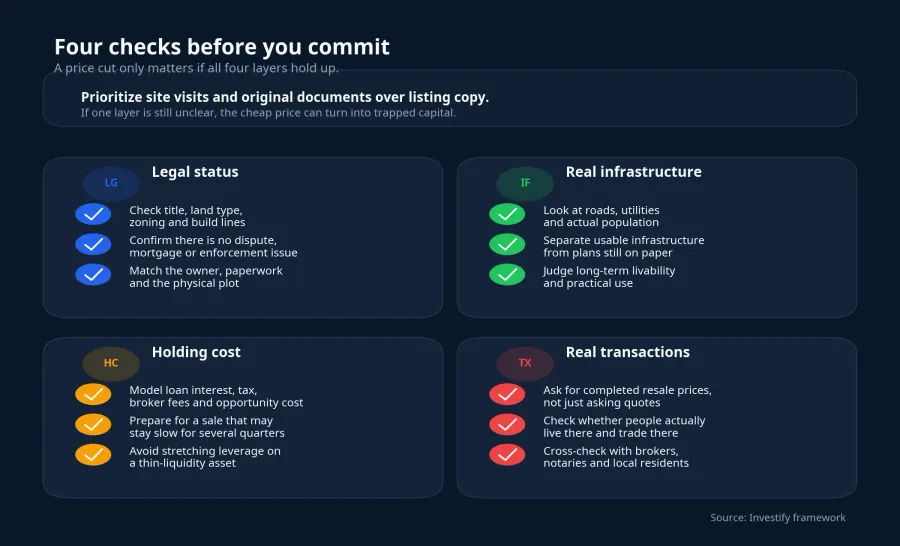
Four checks before calling this an opportunity
The first layer is legal status. That remains the main gate, especially when listings are framed around sharp discounts. Is the title registered to the seller? What is the land classification? Is it mortgaged, disputed, or exposed to problematic zoning? If those questions are still unresolved, the lower price is not a reward. It is compensation for risk.
The second layer is real infrastructure, not narrated infrastructure. In suburban land, there is a huge gap between a road that already exists and a road that only appears on a planning map. The same is true for actual residents, active shops, and stable utilities. Newer buyers often confuse potential with current reality. In this phase, the better discipline is to give credit only to infrastructure that can already be used.
The third layer is holding cost. This is where many people lose perspective once they see a 24.5% or 31.8% decline. If you are borrowing, ask a simple question: if the property stays flat or hard to sell for several quarters, how long can your cash flow absorb it? Even if you are using idle cash, there is still an opportunity cost. If the money gets trapped in a low-liquidity plot, what are you giving up over the next 12 months?
The final layer is proof of real transactions nearby. A market can be full of listings and still have very few genuine resales. That gap is where liquidity risk hides. To understand the true market, buyers need multiple channels: local brokers, notary offices, residents in the area, and competing sellers on the same road. A lower price only matters if someone is actually willing to transact around that level.

How first-time investors should read these declines
For first-time investors, the safer question is not “how far has it fallen?” It is “has the decline compensated enough for what I still cannot verify?” If the answer is vague, you are not looking at an opportunity yet. You are looking at an unfinished risk assessment.
It is also crucial to separate “down sharply” from “truly cheap.” An asset can fall 30% after rising too fast in the first place. In that case, the move may just be expectations returning closer to reality. A different plot that falls less, but has clean legal status, completed infrastructure, and real use demand, may be far more attractive. In property, cheap is not the biggest percentage decline. Cheap is when today’s price already reflects the relevant risks and still leaves room for practical use or long-term accumulation.
Bottom line: the edge is real, but only for disciplined buyers
The bigger picture does not say buyers have won. It says bargaining power has returned after a period when sellers held nearly all of it. That is an important shift, but it is not enough to turn every discounted plot into a good opportunity.
The clearest thesis here is this: today’s edge belongs to buyers with cash or moderate leverage, enough time to investigate properly, and the discipline to reject plots that look attractive only on listing sites. For anyone hoping to buy fast and sell fast, a 24.0% to 31.8% decline in a few former hot spots is still not enough to erase liquidity risk or legal risk.Lao Động
The signal worth watching over the next few weeks is not how many more “cut-loss” listings appear. It is the quality of the assets being brought to market. If plots with clean titles, usable infrastructure, and real end-user value still need to fall further before they sell, then buyer leverage will truly be broadening. For now, the price cuts have only opened the door to negotiation. Whether that turns into a genuine advantage still depends on the buyer’s own discipline.