

Within less than a week, TVS, BSC and Vietcap all made the news for three different balance-sheet moves: an ESOP issuance, a stock-dividend capital increase, and a syndicated offshore loan. On the surface, those look like separate corporate events. Put side by side, though, they point to a broader message: Vietnamese brokerages are preparing their balance sheets for a market phase that could require far more capacity.Báo Pháp luậtDNSEVietcap
For new investors, the first instinct is usually simple: will this dilute shareholders, and does it make brokerage stocks more attractive or less? That reaction is understandable, but it only captures the outer layer of the story. At a brokerage, capital is not just a headline number on the charter. It is the operating capacity behind margin lending, institutional execution, underwriting and the ability to absorb volatility when market activity accelerates.
Three capital moves, one shared message
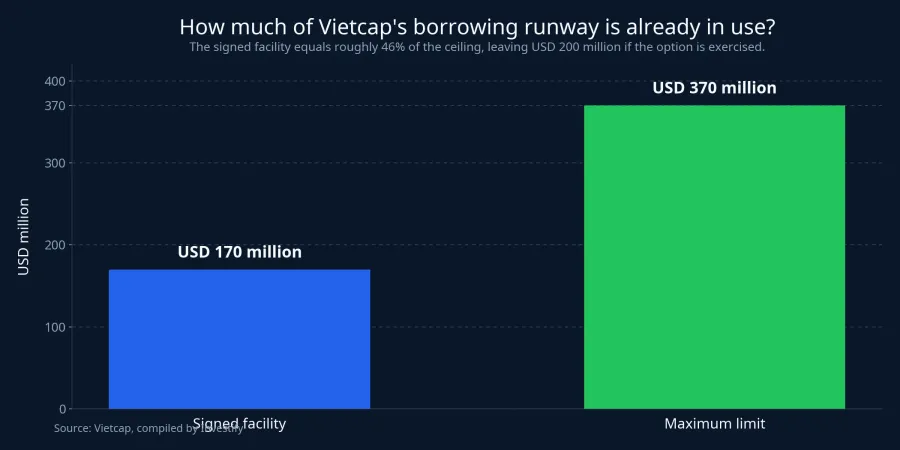
TVS has completed the distribution of 4.2 million ESOP shares to 32 employees, equal to 1.87% of its outstanding share count, lifting charter capital to VND 2,286 billion.Báo Pháp luật BSC also completed a stock-dividend payout that raised charter capital from VND 2,453.6 billion to VND 2,699 billion.DNSE Vietcap took a different route, signing an unsecured syndicated loan worth USD 170 million with an option to increase the ceiling to USD 370 million.Vietcap
The structures differ, but the intent is similar. One firm is adding equity capital, another is turning retained resources into charter capital, and the third is extending its medium-term funding line. In plain terms, all three are widening their ability to carry business volume in the next cycle.
What stands out is that this is not the kind of pattern that usually comes from a one-day burst of optimism. When several brokerages all choose to thicken capital around the same time, it often means demand is building inside the market's intermediary layer. That is exactly the part retail investors tend to miss, because the tape shows price action but not the capital pressure underneath the system.
The first destination of fresh capital is usually margin
Margin lending is the clearest capital sink inside a brokerage. When investors borrow to buy more stocks, the firm needs enough equity, enough funding and enough risk headroom to support that leverage. Without a sufficiently thick balance sheet, the brokerage can run into internal or regulatory limits even if client demand keeps rising.
A market outlook report cited by Tin Nhanh Chứng Khoán said total margin debt across the market was estimated at around VND 424,000 billion at the end of March 2026, up 3% from the previous quarter and equal to roughly 102% of sector equity.Tin Nhanh Chứng Khoán That alone says quite a lot. Daily trading may not look euphoric every session, but leverage demand is already high enough that brokerages are preparing capacity ahead of time.
That is why a capital raise should not be read as automatically good or bad. If new capital is deployed into margin lending just as turnover strengthens, interest income can ramp up quickly. If the firm raises capital but cannot expand productive lending, shareholders may absorb dilution before they see any real operating benefit.
This is not only about margin
Retail investors often think brokerages mainly make money from commissions and margin interest. In reality, once the market matures, the most capital-intensive opportunities may sit elsewhere. Large institutional orders, securities borrowing, underwriting mandates and capital-raising transactions all require the firm to sit in the middle of the flow for a period of time and carry balance-sheet exposure.
Vietcap is the easiest case to visualize. A USD 170 million syndicated facility does not look like a cosmetic financing move. It looks more like a new funding pipeline that can be tapped when client demand or transaction activity picks up. The option to lift that ceiling to USD 370 million matters because the message is not simply "we borrowed big." The message is "we are building extra room in case the next cycle asks for it."Vietcap
BSC and TVS follow different structures, but the operating logic still holds. Thicker capital gives a brokerage more optionality. It can allocate more room to margin, improve its financial-safety ratios, or create a cushion for new mandates. That matters more to long-term growth than a few sessions of stock-price reaction.
The next cycle will test capacity, not just risk appetite
One important point for new investors is that stock markets do not run on sentiment alone. Money may want to move in faster, but the intermediary layer must be able to absorb it. If brokerages are short of capital, if funding costs rise, if margin room tightens or if safety ratios come under pressure, the market's ability to sustain activity can be constrained.
Vietnam's Ministry of Finance issued Circular 102/2025/TT-BTC on October 29, 2025, and the regulation took effect on December 15, 2025, amending financial-safety rules for securities firms.Chính phủ That matters because it reminds investors that growth for brokerages is not just about running faster. It is also about keeping enough braking power as the scale of operations expands.
Put more simply, if the market wants to move faster, the firms in the middle must have both money and disciplined risk control. A brokerage can raise capital and still struggle if its systems or underwriting discipline do not keep pace. The firms with stable funding, thicker capital and better control frameworks are the ones better positioned if turnover strengthens again.
How new investors should read this signal
Instead of jumping straight to which brokerage stock may rise next, it is more useful to test these moves with three questions. First, is the new capital actually bringing fresh money into the business, or is it mostly a reshaping of the capital structure? Second, where is that capital likely to go: margin lending, institutional services or investment banking? Third, over the next few quarters, does the thicker balance sheet translate into sustainable revenue and earnings?
BSC's stock-dividend increase and TVS's ESOP issuance are good reminders that not all capital raises are the same. One keeps resources inside the firm, the other also ties into employee alignment. Vietcap, by contrast, is expanding through international borrowing capacity. Read carefully, and the market is not telling you a single dilution story. It is telling you that different firms are preparing for different kinds of demand.

The bigger story is capacity, not dilution alone
The core thesis here is straightforward: the moves at TVS, BSC and Vietcap should be read first as preparation for the next liquidity cycle, not merely as isolated dilution events.Báo Pháp luậtDNSEVietcap Dilution is still a real risk for existing shareholders, but it is only half the picture. The other half is whether a thicker balance sheet becomes better business capacity.
So the more useful signals to track over the next few quarters are not just stock prices. Watch whether margin balances expand in a healthy way, whether institutional business contributes more meaningfully, and whether brokerages can preserve strong financial-safety discipline as they scale. Once those answers become clearer, new investors will be reading the brokerage sector with a much more mature framework than the reflexive view that "raising capital is bullish" or "raising capital is dilution."