


Wall Street delivered one of those sessions that can easily confuse newer investors. On June 16, the Dow Jones Industrial Average closed at a record high, while the Nasdaq dropped hard enough to make the market feel uneasy. If you only looked at the Dow, the message was strength. If you only looked at the Nasdaq, the message was caution. Taken together, the cleaner interpretation is different: money is not leaving U.S. equities altogether, but it is rotating away from the most expensive winners and toward areas that look easier to justify on current earnings.AP News
That distinction matters because a split session is not the same thing as a broken market. What happened on June 16 looks more like a repricing of leadership. Technology, especially AI-linked names, was forced through a valuation check. Meanwhile, financials, industrials, and other less stretched parts of the market held up better as oil eased and inflation anxiety softened.
One session, two messages
At the close, the Dow had gained 328.64 points, or 0.6%, to 51,999.67. The Nasdaq fell 307.60 points, or 1.2%, while the S&P 500 lost 0.6%. On the surface, that looks contradictory. Structurally, it makes sense. The Dow has heavier exposure to financials, industrials, and consumer-facing companies, while the Nasdaq is far more sensitive to large-cap technology and semiconductor names.AP News

Once you frame it that way, the divergence becomes easier to read. Investors can grow more selective without turning fully defensive. In that setup, the most crowded growth trades usually take the first hit, while parts of the market tied to current cash flow and more reasonable multiples can keep working.
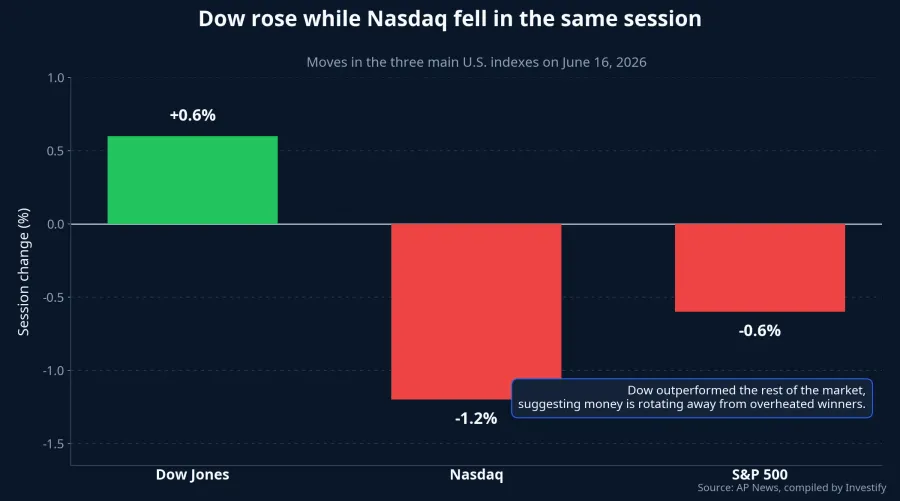
This is the part beginners often miss. An index is not the market in a uniform sense. A higher Dow does not mean every corner of U.S. equities is being bought. A lower Nasdaq does not automatically mean investors are fleeing risk. Quite often, money is simply changing seats inside the same room.
The Nasdaq fell because the old leaders were tested
The heaviest pressure came from stocks that had benefited most from the AI trade. AP reported that Nvidia fell 2.4%, Broadcom lost 4.4%, and Micron dropped 6.2%. All three sit at the core of the semiconductor story that has driven sentiment for months. When that cluster sells off together, the Nasdaq will almost always feel the damage more than the rest of the market.WRAL
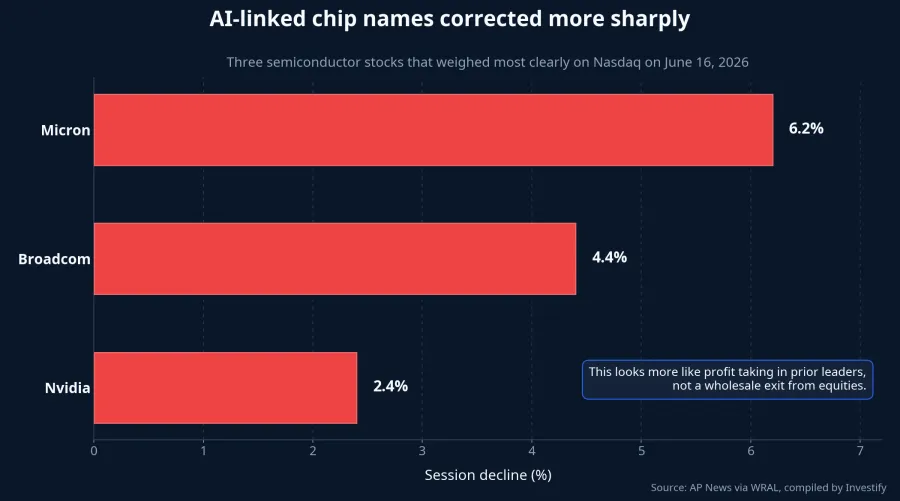
That still does not look like panic. A 2.4% to 6.2% decline is meaningful, but it is also consistent with profit taking after a long stretch in which investors were willing to pay up for future growth with very little pushback. The market seems to be asking a familiar question again: at these prices, how much more upside is still left in the AI narrative?
It is also worth avoiding a single-cause explanation. Rotation out of overheated winners is the strongest reading, but it is not the only one. The market is also entering a Fed meeting with a more cautious posture, and that often means investors trim positions in the stocks that have run the hardest. In other words, this may be partly about valuation and partly about event risk ahead of a major macro catalyst.
Lower oil prices are changing how risk is priced
Oil was a key link in the session. AP said Brent crude fell below USD 80 a barrel for the first time since early March as optimism built around a tentative U.S.-Iran deal. Investify's internal data also showed Brent at USD 80.50 per barrel on June 16, down 3.21% on the day, while WTI stood at USD 77.67, down 3.81%.WRAL
Lower oil does not only matter for energy companies. It also eases concerns around input costs, freight, and broader inflation pressure. For equities, that can improve the valuation backdrop for industrials, consumer names, and financials because investors no longer have to discount a higher-for-longer inflation scenario as aggressively.

That is why fast conclusions can be misleading. Saying “oil is down, so energy is under pressure” is not wrong, but it is incomplete. The same variable can hurt one group and help another. What made June 16 interesting was not oil on its own. It was the combination of cooler oil prices and simultaneous selling in the technology leaders. Together, those two moves helped shift the market’s center of gravity for the day.
What Vietnamese investors should watch before the open
As of the latest reading before the June 17 session in Vietnam, the VN-Index stood at 1,807.94, up 0.48%. That number alone says very little about whether local equities will follow the Dow or echo the Nasdaq. The more useful question is whether the split in Wall Street leadership changes how domestic investors read sector positioning in the next few sessions.
Put simply, if global money is becoming less willing to pay extreme prices for the most expensive part of the market, Vietnamese stocks that have rallied mainly on long-duration expectations may also face a tougher valuation conversation. On the other hand, companies that benefit from softer input costs or from a shift back toward current earnings quality could start to look relatively more attractive. That is not a call to buy a specific sector. It is a framework for reading how money reacts across different narratives.
So the signal to monitor in Vietnam is not “the Dow was green, therefore the market is safe.” Watch breadth, liquidity, and whether money is spreading across multiple groups. If the index rises but liquidity stays concentrated in a handful of leaders, that is still a narrow market. If improvement becomes broader and comes with healthier turnover, then the case for a genuine expansion in risk appetite gets stronger.
The core thesis is rotation, not panic
The cleanest conclusion from June 16 is that Wall Street is most likely going through a rotation across sectors rather than a broad withdrawal from equities. A record close in the Dow alongside a notable drop in the Nasdaq suggests the market is re-checking the most expensive segment while still supporting areas with easier valuation math. Cooler oil prices made that pattern more visible because they reduced inflation pressure at the same moment profit taking hit the technology leaders.AP News
To call this more than a one-session move, two signals still matter. First, breadth in the U.S. after the Fed meeting: does money continue to stay with financials, industrials, and consumer names? Second, the reaction in Vietnam over the next few sessions: does liquidity broaden out, or does it remain trapped in a narrow set of leaders? If both improve, the rotation story becomes more durable. If not, this may end up looking more like a pause in technology after an exceptionally strong run.