


Global gold prices fell over the June 8-12 week, but the board Vietnamese buyers saw on the morning of June 14 still looked expensive. SJC gold bars were quoted around VND 144 million per tael for buying and VND 147 million per tael for selling, while gold rings were still trading just below the same VND 147 million area.VOV If you only read that “global gold is down,” it is easy to assume domestic prices should have fallen in lockstep. That is only half the story.
The missing half is the structure of Vietnam’s gold market. Retail buyers do not pay only for the world gold price translated into Vietnamese dong. They also pay for brand, legally available supply, bid-ask spreads, and the domestic premium that the market continues to hold on top. As long as that premium remains wide, a decline in global gold is not enough on its own to pull SJC fully out of the high-price zone.
One quote, two layers of pricing
At a basic level, domestic gold prices can be split into two layers. The first layer is the global gold price, usually quoted in ounces and driven by international trading. The second layer is the domestic add-on: the gap between the converted world price and the actual retail price Vietnamese buyers must pay at the counter.
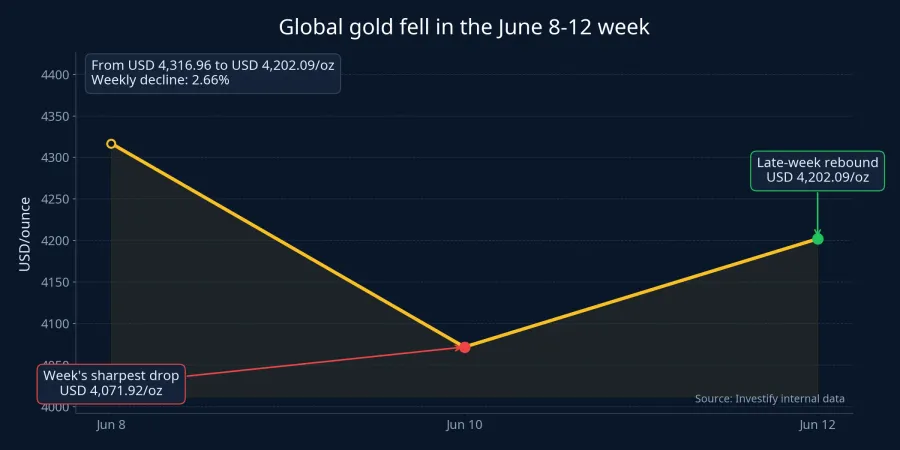
Over the June 8-12 period, global gold fell from USD 4,316.96 per ounce to USD 4,202.09 per ounce, a decline of 2.66%. The sharpest point of the week came on June 10, when the price dropped to USD 4,071.92 per ounce before recovering into the end of the week. That confirms that the international trend did weaken. But it only describes the base layer of the price.
When USD 4,202.09 per ounce is converted at a USD/VND rate of 26,337.5, one tael of world gold works out to roughly VND 133.43 million. Against that, the SJC selling price on the morning of June 14 was still VND 147 million per tael. The difference is about VND 13.57 million per tael. That is why buyers can still look at the board and feel gold is expensive even though the world price underneath has already come down.
This is the point new investors often miss. A lower world price does not mean retail prices in Vietnam must fall by the same amount, because the two numbers are not built the same way. One is the international reference price. The other is the final retail quote inside a market with its own licensing rules, supply conditions, and trading frictions.
Domestic prices did fall, but not enough to feel cheap in global terms
This is where the confusion usually starts. Saying SJC is still near VND 147 million per tael does not mean domestic prices were flat. In reality, local selling prices did come down from the previous week. The problem is that even after that decline, the new price range still sits very high relative to the converted world benchmark.VOV
Investify’s internal data show SJC bar selling prices falling from VND 150.2 million per tael on June 6 to VND 147 million per tael on June 13. SJC 99.99% gold rings also fell from VND 148.5 million to VND 145.4 million over the same period. So the domestic market did respond to the global pullback. It just did not respond enough to erase the premium local buyers still have to pay.
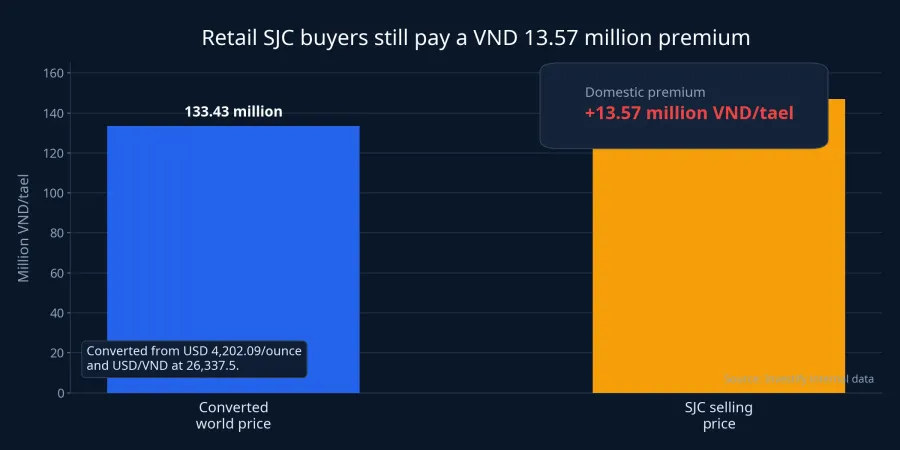
The easiest way to think about it is to treat a gold purchase right now as a two-part bill. The first part, the underlying gold price, has cooled. The second part, the domestic market premium, is still elevated. If buyers focus only on the first part and ignore the second, they can easily convince themselves that gold has become “much cheaper,” when in reality the remaining VND 13.57 million premium is still a meaningful cost.
According to analysis cited by Dân trí, the gap between domestic gold and world gold has narrowed materially from the more extreme periods, moving from above VND 20 million per tael to around VND 10 million, and at times even lower.Dân trí That is a constructive sign, because it suggests the market is no longer as detached as it was at its most stressed moments. But “narrower” is not the same as “gone.” For anyone accumulating gold, the remaining gap is still large enough to shape short-term outcomes.
Why the domestic premium has not disappeared
The first reason is that legally recognized supply does not open up overnight. Decree 232/2025/ND-CP changed the management framework for the gold business and took effect on October 10, 2025, ending the previous rule under which the state held a monopoly on gold bar production and on imports of raw gold for minting bars.Chính phủ But removing the monopoly does not automatically flood the market with new gold bars the next day.
Under the framework published by the government, enterprises seeking permission to produce gold bars must have charter capital of at least VND 1,000 billion, while commercial banks need at least VND 50,000 billion in charter capital.Chính phủ In plain terms, the system is broader than before, but it is still a tightly conditioned market. Between a rule change and actual supply reaching retail counters, there are multiple steps: licensing, production capacity, import quotas, and distribution.

The second reason is that policy expectations usually move faster than physical supply. Once the market hears that the framework has changed, buyers start to expect the premium to compress. But expectations are a pricing story for today, while real supply is a story about actual bars reaching the market over the weeks and months that follow. Those two timelines rarely line up perfectly.
The third reason is that retail buyers always face trading spreads. Even if the gap between domestic and world gold has become less extreme, the spread between buying and selling prices at retail outlets can still erode profits very quickly for anyone trading over short horizons. That means even in a scenario where world gold stabilizes or rebounds modestly, buyers may still struggle to make money if the domestic premium and bid-ask spread do not normalize further.
What new buyers should watch before focusing on the headline price
The first signal is the gap between the domestic selling price and the converted world price. If global gold falls while that gap stays wide, buyers are not truly getting “cheaper” gold in international terms. They are simply buying an asset whose global base price has cooled while the domestic add-on remains thick.
The second signal is the direction of that premium itself. If global gold does not surge over the next few weeks but the domestic premium keeps compressing, that is the better sign that retail pricing is becoming more favorable for long-term accumulators. By contrast, if global gold falls further while SJC only edges lower, the market is telling you the bottleneck is still mostly domestic rather than international.
The third signal is the pace of implementation under the new framework. The useful thing to watch is not a vague claim that “policy has changed,” but the concrete markers beneath it: which institutions are licensed, how much new gold bar supply actually reaches the market, and whether the premium truly shrinks after each step. For new investors, that is a more practical way to read this market than relying on a single morning headline about global gold.
This week’s conclusion is fairly clear. Whether SJC feels expensive or cheap is not decided by the world gold quote alone. It is decided by how much domestic premium buyers are still paying after conversion. As long as that gap remains in the double-digit millions of dong per tael, a softer global price is still not enough to turn domestic gold into the kind of bargain many retail buyers hope they are seeing.