
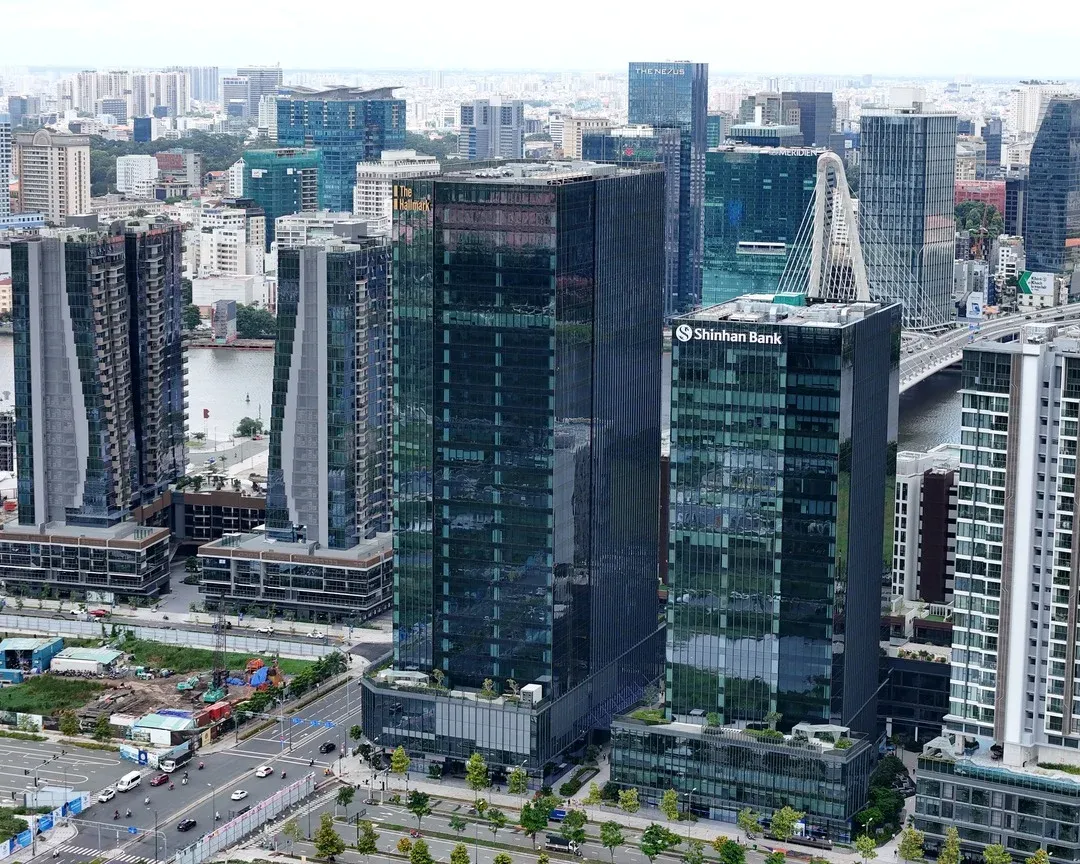

Apartment prices in southern Vietnam are stepping into a new range, but that does not automatically make every buy-to-let deal more attractive. The sale price only tells you the asset has become more expensive. Investment quality depends on something else: whether the unit stays occupied, how long it sits vacant, how much operating cost it absorbs, and whether the cash left after all of that is thick enough to create a margin of safety.
A new price floor: Rising faster than many expected
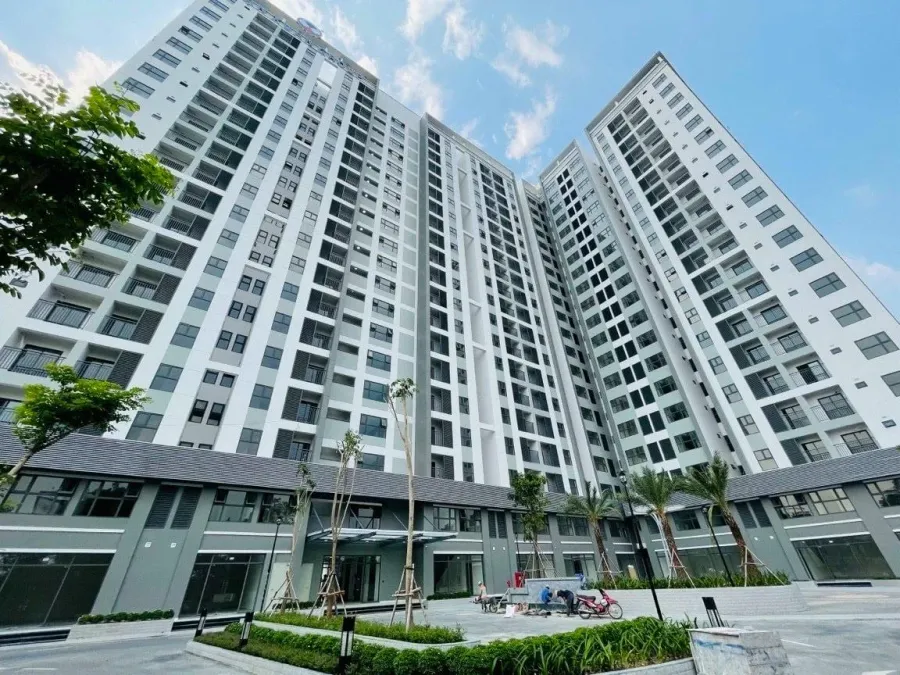
Vietstock reported on June 14 that average primary prices in HCMC's core area had climbed to nearly USD 7,300 per square meter, up 19% from the prior quarter and 53% from a year earlier; in the city's central districts, the average primary price reached roughly VND 102 million per square meter.Vietstock In Binh Duong, OneHousing put first-quarter apartment prices at VND 56 million per square meter, up 7% from the fourth quarter of 2025 and 37% year on year, with some projects marketed around VND 70 million per square meter.Vietstock
The speed of the increase is what changes the investment math. For investors pursuing capital appreciation, a higher price level may look like a sign of scarcity and further upside. For investors buying to rent out, the same price level immediately increases the denominator in the return equation. The larger that denominator becomes, the more income the asset must generate just to keep yields at an acceptable level.
When the city pushes rental housing, the signal is not only social policy
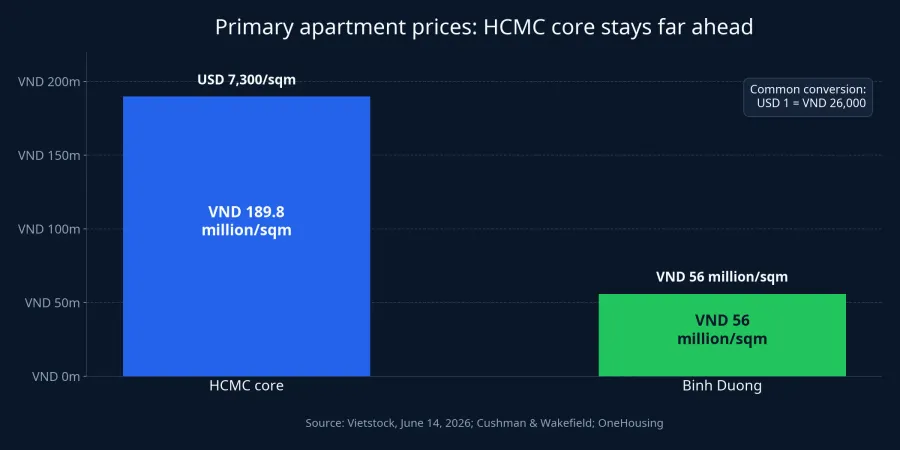
At the same time, Ho Chi Minh City is targeting an additional 181,257 social housing units in 2026-2030, including around 50,000 for rent. The city has also proposed a credit package for rental social housing with interest rates of roughly 3-4% a year, loan tenors of 15-20 years and a three-year grace period.Báo Chính phủ
This is not only a social-policy story. A city does not start planning large-scale rental supply with long-tenor funding support unless stable housing demand is running ahead of what many households can afford to buy. To stay disciplined, the policy shift should not be treated as proof on its own that sale prices have overshot affordability. It also reflects a deliberate choice to build a more professional rental market. Still, alongside the new pricing levels in HCMC and Binh Duong, the strongest interpretation is that purchasing power and end-user demand are moving further apart.

Developers are responding, but that is not a yield guarantee
Corporate moves show that developers are reading the same shift. Thời báo Tài chính Việt Nam reported that Vingroup announced plans for 4,500 rental housing units, equivalent to 146,000 square meters of floor area in Ba Diem commune.Tài chính VN At the same June 9 conference, 13 organizations registered to build more than 97,000 rental homes, including 20,000 units from CT Group, 10,000 from Bcons, 4,500 from Vingroup and 25,000 from the HCMC Housing Development Fund.ĐTTC
For individual investors, that does not amount to a yield guarantee. Developers building rental projects have advantages that individual investors usually do not: larger land banks, potentially lower funding costs, centralized operations and a much longer holding horizon. More developer participation is evidence that rental demand is deep enough to support a real market. It does not automatically mean that every apartment purchased at today's higher price points will deliver an attractive rental yield tomorrow.
For rental buyers, an apartment is not just a sticker price
The simplest way to think about it is this: buying an apartment to rent out means buying a future stream of income, not just a physical asset. When purchase prices rise faster than rents can adjust, yields get squeezed. If that thinner cash flow cannot cover funding costs and vacancy periods, the investor becomes more dependent on further price appreciation to make the deal work. At that point, the purchase stops being a pure cash-flow investment and starts looking more like a bet on future prices.
That is the core difference between two layers of assets inside the same market. One lives on the expectation that the next buyer will pay more. The other has to prove itself through monthly income. A buyer living in the unit, or a long-term holder using mostly equity, may accept a more expensive asset. Someone using leverage or expecting rents to drive payback has to be much stricter.
The equation matters more than the price per square meter
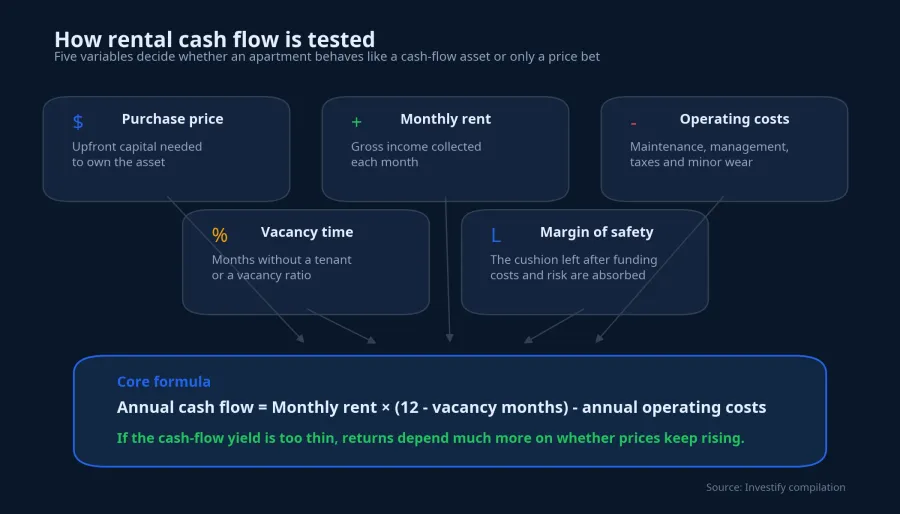
New investors are often drawn to the price per square meter because it is the first number in every sale pitch. For rental housing, the first number that matters is net cash flow after costs. Only after that should investors ask about payback time, how the unit holds up if it sits vacant for several months, and whether rents can remain firm if professionally managed rental supply expands.
An apartment near an industrial zone, a university cluster or a major transport spine may look less glamorous than one in the urban core. But if its tenant pool is broader, occupancy is steadier and the purchase price is easier to absorb, it may prove more resilient as a cash-flow asset. By contrast, a higher-priced unit can still be a good asset for an owner-occupier or a long-term buyer using their own capital. The problem starts when investors expect rental income to carry the deal while the margin of safety is already too thin.
The clearest thesis now: High selling prices are not enough
The broader lesson from the new price range in HCMC and Binh Duong is that the market is splitting more clearly into two paths. One path belongs to assets held on faith in future price appreciation. The other belongs to assets that must prove themselves through real cash flow and durable occupancy.
The more defensible thesis is that the higher apartment prices go, the tighter cash-flow discipline has to become. Only if rents, occupancy and operating costs move in the right combination does the new price floor translate into genuine investment performance. If those variables do not improve alongside price, a more expensive unit simply means a more expensive asset, not a more attractive rental trade.
The signals worth watching over the next few quarters follow that same logic: how quickly the announced rental supply is actually delivered, how well tenants absorb it in each area, and whether rents can keep up with the new cost base. In residential property, the sale price is always the easiest part to see. Cash flow is the hardest part to fake.