


VinaCapital has updated the names and investment strategy framing of six open-ended funds while keeping the existing fund tickers unchanged.VinaCapital On the surface, that can look like a straightforward branding refresh. For newer investors, though, it is a useful reminder of how mutual funds should actually be read: not by the label that sounds most appealing, but by the asset bucket the fund owns, the level of volatility it can bring and the job it is meant to do inside a personal portfolio.
That distinction matters because the June 12, 2026 update did not force investors to relearn the product shelf from scratch. VEOF, VESAF, VMEEF, VDEF, VIBF and VFF all kept their tickers, which means the real shift is in how VinaCapital now explains the role of each strategy rather than in any basic restructuring of the lineup.VinaCapital For beginners, that is the right way to approach the story: the new names are useful only if they push readers to ask better questions.
The new names are only the outer layer
Read closely, and the updated naming system is really an effort to make each strategy easier to decode. VEOF now points more clearly to leading enterprises, VESAF leans into strategic growth, VDEF stresses pioneer opportunities, VIBF makes its balanced mandate easier to spot and VFF signals a more explicit fixed-income role. VMEEF is the exception, keeping its existing name and positioning around Vietnam's modern economy.VinaCapital
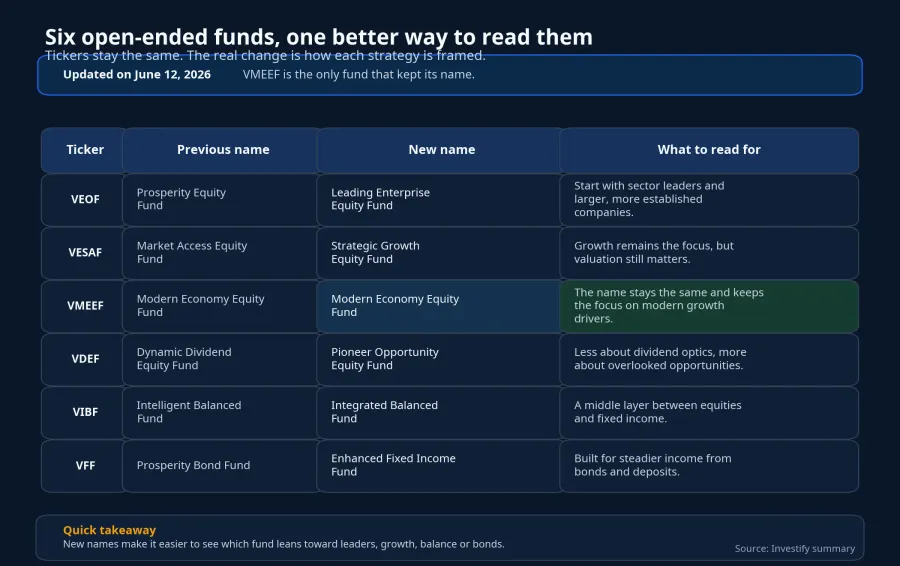
But stopping at the name still leaves an investor at the surface level. A better way to use the new naming system is to treat each label as a clue about style: VEOF points toward market leaders, VESAF points toward growth, VMEEF points toward modern-economy themes and VDEF points toward getting into opportunities earlier than the crowd.VinaCapital In other words, the renaming matters only if it helps investors understand what kind of story each fund is trying to tell.
Sort the funds by asset bucket before thinking about returns
The most efficient way for a beginner to read this lineup is not to memorize six updated names. It is to place each fund back into its proper asset bucket. VEOF, VESAF, VMEEF and VDEF are equity funds. VIBF is a balanced fund. VFF is a bond fund. That simple grouping already prevents one of the most common retail mistakes: treating all fund certificates as if they should behave in the same way.VinaCapital
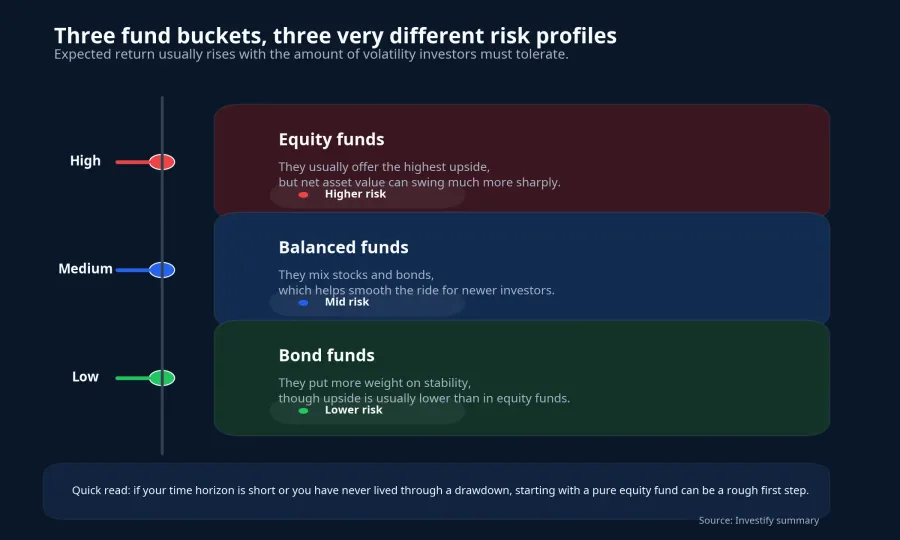
Equity funds usually offer more upside, but the trade-off is that NAV can swing much more sharply with the market. That does not make them inherently better or worse than bond funds. It simply means investors need a longer holding period and a steadier temperament so they can live through weak stretches without bailing out at the worst possible moment.
VIBF sits in the middle of that range. Even from the name alone, its job is easier to read: it is the bridge between growth and stability, which makes it a more natural starting point for investors who want fund exposure without taking the full emotional hit of a pure equity strategy. At the defensive end, VFF signals a clearer fixed-income role. The right way to read that fund is not as a total replacement for equities, but as the steadier sleeve of capital inside a broader portfolio.VinaCapital
What beginners should read before pressing buy
Once the six funds are sorted into the right buckets, newer investors should return to three basic questions. The first is time horizon. If the money may be needed within a few months, an equity fund is usually a poor fit no matter how attractive the new name sounds. If the capital is meant for a multi-year goal, then the equity bucket has enough room for active management to work as intended.
The second question is real risk tolerance, not imagined risk tolerance. Many people think they can handle drawdowns while they are still reading a brochure. The real test comes when NAV falls for several weeks in a row. If an investor has never lived through that kind of stretch, starting with a balanced vehicle like VIBF or a bond fund like VFF is often more realistic than jumping straight into the equity bucket and quitting after the first uncomfortable correction.
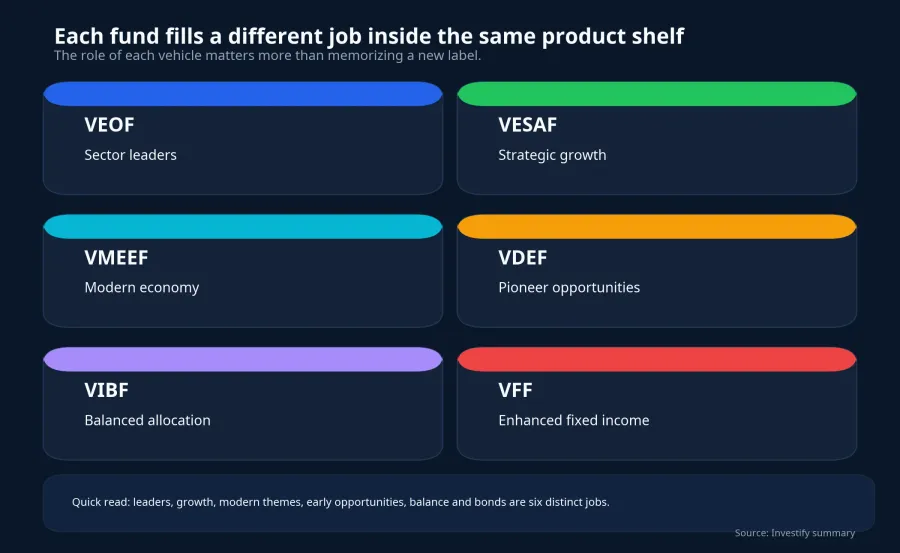
The third question is what role that money plays inside total household assets. Capital meant for long-term growth can lean toward VEOF, VESAF, VMEEF or VDEF, but each one still suggests a different posture. VEOF is for people drawn to market leaders. VESAF is for those who want growth at the center of the pitch. VMEEF is for investors who believe in the longer arc of Vietnam's modern economy. VDEF is better suited to people willing to enter earlier-stage opportunities and accept a rougher holding experience along the way.VinaCapital
That leads to a simple rule. If an investor still cannot tell whether the money is meant for growth, balance or stability, another product slogan will not solve the problem. The money has to be put into the right drawer first, and only then should the fund inside that drawer be chosen. That is what this renaming exercise actually helps clarify.
Conclusion: the renaming matters only if it leads to better questions
VinaCapital's update does not change the core rule of fund selection. What it does is make the product map easier to read. And on that map, the key distinction is not which fund just adopted which new name. It is which funds belong to the equity bucket, which one sits in the balanced middle and which one is meant to provide a steadier fixed-income layer.
That is the central thesis of this post: for beginners, the renaming is a prompt to read deeper, not a reason to choose faster. If there is one framework worth keeping, it is this three-step order. Start with the asset bucket. Then judge the level of volatility you can realistically live with. Only after that should you move to the investment story the fund is trying to tell. The next signals worth watching should still follow that same framework: what bucket the fund belongs to, what job that money needs to do and whether the investor can live with the path the fund may take during weaker months.