


Most gold buyers in Vietnam start with the world price and assume the local market will eventually follow. That instinct is understandable, but it only explains part of the story. In Vietnam, the world price sets the floor. What buyers actually pay above that floor depends on domestic supply, import rules, brand preference, and the premium between local prices and the converted global benchmark.
That is why the new draft from the Ministry of Science and Technology matters. Not because it guarantees cheaper gold tomorrow, but because it touches a key part of the supply mechanism. The draft circular on measurement and quality management for gold entered public consultation on June 9 and remains open until July 9. It covers jewelry, handicraft gold, gold bars, and raw gold used in production, import, and market circulation.MSTBáo Chính phủ
The headline provision is the purity threshold. As reported by Báo Chính phủ, imported gold bars and imported raw gold would need a gold content of at least 99.5%. Jewelry is treated differently. Instead of one uniform threshold, it would be classified by purity or by karat. A 21.5K jewelry item, for example, can be classified as 21K under the karat-based system.Báo Chính phủ
The legal stage matters more than the headline. This is still a draft under consultation, not an issued regulation and certainly not one already in force. In plain terms, the market is looking at a proposed policy direction, not a completed rule change. Expectations can move ahead of reality, but actual supply only changes once a final text is signed and implemented.
Local prices do not simply mirror world gold
If you only watch global gold, it is easy to miss the cost embedded in the domestic quote itself. On June 11, the SJC gold bar selling price stood at VND 138.4 million per tael, while the buying price was VND 133.4 million. That leaves a buy sell spread of roughly VND 5.0 million per tael, or about 3.6% of the selling price. For a retail buyer, that is the immediate friction cost if the trade has to be reversed on the same day.
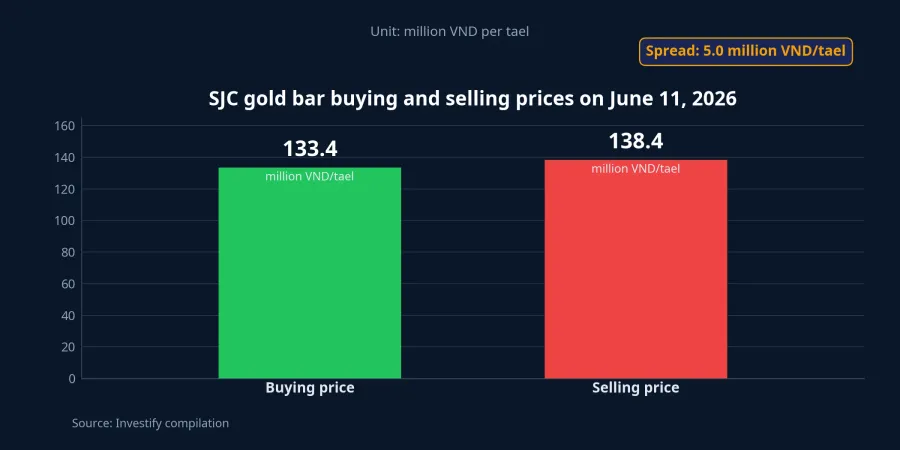
That spread says something practical for first-time investors: buying gold is not just a view on the direction of world prices. It is also an acceptance of a local cost layer, and that layer can widen or narrow very quickly depending on market psychology. When buyers are chasing the market, they tend to accept a larger premium. When demand cools, that premium can compress before global prices make a major move.
The move in early June makes the point even clearer. The SJC gold bar selling price fell from VND 158.5 million per tael on June 1 to VND 138.4 million on June 11, a decline of about 12.7% in just over a week. SJC 99.99% gold rings also fell from VND 156.8 million to VND 136.8 million over the same period, down about 12.8%. That is large enough to show that Vietnam's gold market is not reacting only to the underlying commodity price, but also to a compression in the local premium.
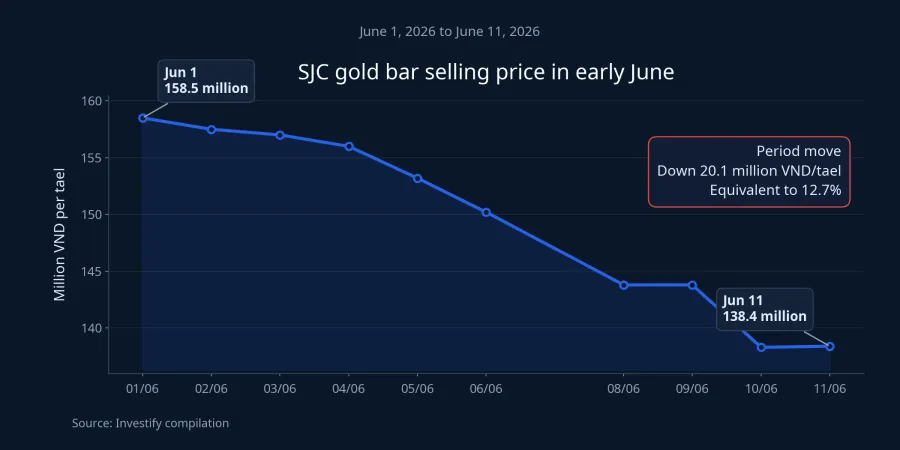
The important point is that this adjustment did not come from one single cause. World gold still matters as the baseline, but the domestic move also reflects weaker momentum chasing and rising expectations that legal supply could become more predictable. In other words, at least two layers are moving at the same time: the international price and the local premium.
The premium has narrowed, but it has not disappeared
On June 9, Thanh Niên reported that the gap between domestic gold prices and world gold had narrowed to about VND 6 million to VND 7 million per tael, versus more than VND 30 million at one point in March.Thanh Niên Those two reference points alone show that the amount buyers pay above the global benchmark is far from fixed. It can expand sharply when supply is tight and sentiment is euphoric, then contract quickly when expectations turn.
June 11 offers a second cross-check. World gold was at USD 4,075.84 per ounce, while the latest USD/VND rate in the data was VND 26,324.5 per dollar. A rough conversion gives a world-gold equivalent of about VND 129.4 million per tael. Against the SJC selling price of VND 138.4 million the same day, the local market was still about VND 9.0 million higher. That differs from the VND 6 million to VND 7 million estimate in the press because closing times, exchange rates, and calculation methods are not identical, but the direction is the same: the premium is far smaller than it was at the March peak.
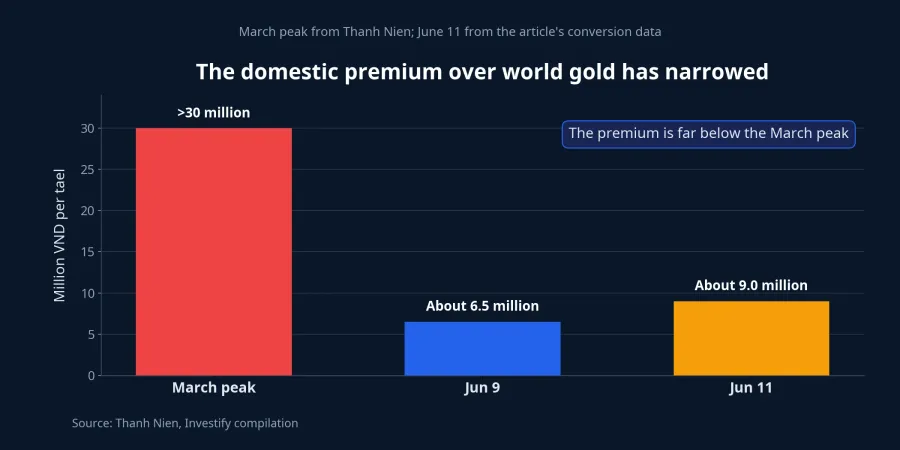
This is the layer new investors miss most often. When domestic prices fall, many assume world gold itself is weakening. Sometimes that is only part of the explanation. A sharper domestic decline can come from the local premium shrinking. In hot phases, the opposite also happens: domestic prices can rise faster than world gold because the premium widens.
Where the 99.5% standard could have an effect
Reading the draft as a trading signal would be the wrong frame. The draft does not say gold will become cheaper immediately, and it does not say a new import mechanism is already active. A better reading is that the regulator is proposing a clearer quality standard for imported gold entering the formal system. If that standard survives into the final text, businesses importing gold bars or raw gold would face a more explicit set of requirements on purity and disclosure responsibility.Báo Chính phủ
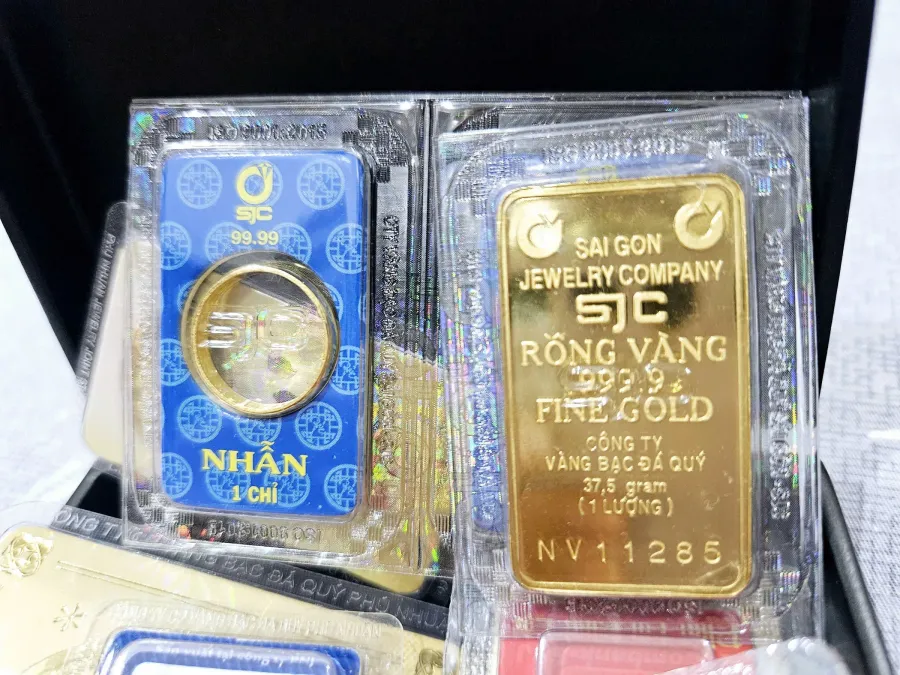
That means the most relevant effect is not an instant price change. It is a shift in expectations around legal supply. If the market starts to believe that the path for official gold imports is becoming clearer, it becomes harder for the domestic premium to stay extremely elevated on scarcity alone. But that still does not mean local prices will suddenly converge with world gold. Actual supply depends on licensing, implementation speed, import costs, business demand, and how raw gold is allocated across different product lines.
Put simply, the 99.5% threshold is one piece of the supply puzzle. It can make the market more transparent, but it cannot erase the entire premium by itself. That is why the draft should not be dramatized into an immediate regime shift. For retail buyers, the lesson is that market structure matters almost as much as the gold price itself.
A simple way to read Vietnam's gold board
For new investors, the cleanest framework is to break the gold quote into three layers. The first is the world gold price, which sets the commodity baseline. The second is the USD/VND conversion rate. The third is the domestic premium, the extra amount created by supply conditions, brand preference, regulation, and sentiment.
When all three layers move in the same direction, domestic gold can swing very sharply. But when the third layer compresses, local prices can fall faster than world gold. That is why gold buyers in Vietnam are exposed not only to global downside, but also to the risk that the domestic premium itself gets squeezed. That risk is very real because it directly affects how much money comes back when a position has to be sold into a narrowing spread.
The bottom line is straightforward. The 99.5% draft does not change the market in the short term because it is still under consultation. But if it makes it into a final rule and is implemented transparently, its longer term pull would be to make extremely high domestic premiums harder to sustain. The signals worth tracking over the next few weeks are not just world gold prices, but whether the gap between SJC, gold rings, and the converted global benchmark keeps narrowing or starts widening again.