


News that OpenAI has confidentially filed for an IPO can trigger a familiar reflex: a major name is heading toward the market, so should investors buy something tied to it right away. But that is not what this moment means. There is still no OpenAI ticker on a trading screen for retail investors. What happened on June 8 was the opening step of a regulatory review process, not a public invitation to buy.AP
In plain terms, OpenAI is closer to the stock market than it was a week ago, but the actual instrument needed to buy that story directly still does not exist. That leads to the core thesis of this piece: if retail investors want AI exposure now, the sensible starting point is not the symbol everyone is talking about, but the path that matches their ability to absorb risk.
What the confidential filing says, and what it does not
AP reported that OpenAI said it submitted a confidential draft IPO filing to the U.S. Securities and Exchange Commission on June 8, 2026.AP The key words are "draft" and "confidential." They tell us the company has entered the review pipeline, but they do not give the market the full prospectus that retail investors would need to read, compare and value the business.
That is very different from a deal with a firm listing date or a clearly disclosed offer price range. At the confidential stage, investors still cannot see where revenue comes from, how heavy the infrastructure bill is, whether cash burn is tightening or easing, or how voting control is distributed. The details that determine whether a stock is worth owning, or merely worth watching, are still ahead.
So the headline mainly answers one question: is OpenAI preparing for public markets? Yes. It does not answer the question that matters once money is on the line: what price would make sense. For newer investors, this is the easiest place to get out of sync. A big filing headline feels like an open door. In reality, the information door is still only partly unlocked.
Why retail investors still cannot buy OpenAI directly
In the U.S. IPO process, institutional investors usually move earlier through bookbuilding, draft review and demand testing. Retail investors typically enter only after the stock begins trading in public. That does not mean retail investors always lose. It does mean they usually arrive after expectations have already been tested and partially priced.
That is why the most direct route for anyone who wants to own OpenAI itself is still to wait. But waiting here should not mean chasing valuation rumors or social media guesses about a first-day pop. The real milestone is the public S-1, because that is when the market can finally ask serious questions about profitability, cost structure and control.
This is also where newer investors need to separate liking a story from owning a suitable asset. You may believe OpenAI is one of the defining symbols of the current AI cycle. That belief alone still does not create a buy button. Between excitement and investment action, there has to be a layer of usable data.
Listed stocks offer a faster route, but not the same asset
The second route is to skip the wait for OpenAI and buy listed companies that benefit from rising demand for software, data centers, enterprise technology or computing infrastructure. This is a more actionable path because investors can buy immediately through familiar markets. The trade-off is that the link to OpenAI is always indirect.
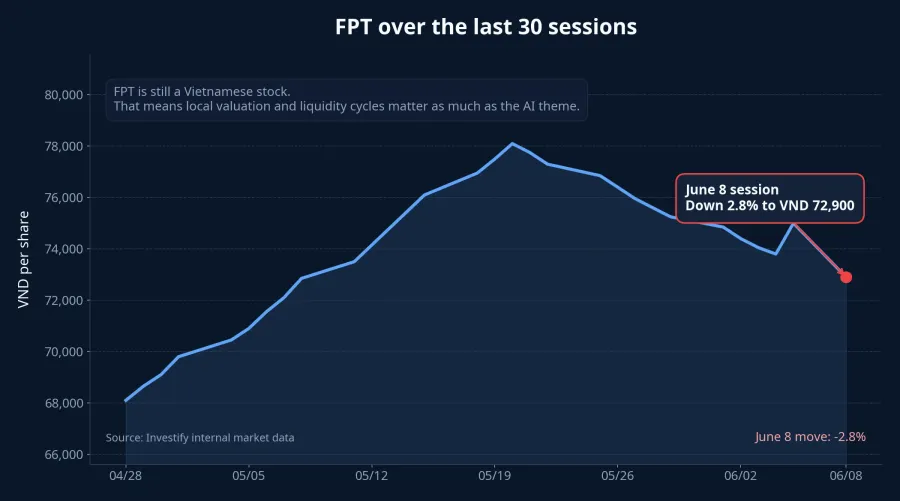
In Vietnam, FPT is usually the first name that comes up when the AI theme heats up. But its price action also shows an important reality: Vietnamese technology stocks still trade inside local valuation cycles. FPT closed at VND 72,900 per share on June 8, 2026 and fell 2.8% on the same day OpenAI disclosed its confidential filing. That does not invalidate FPT's AI narrative. It simply reminds investors that buying a listed stock means buying the whole company and the market it trades in, not just a headline.
For beginners, this is where it is easy to misread how much AI exposure a company really has. A software vendor, a chipmaker, a data-center operator and a company using AI to streamline internal processes can all be grouped under the broad label of "AI beneficiary." But their upside differs in speed, margins, barriers to entry and durability of revenue.
So if the route is through listed stocks, the better question is not "which ticker touches AI." The better question is what the company actually sells, which part customers pay for, and whether AI shows up in earnings as real revenue or mostly as positioning. That is how investors reduce the risk of buying the label instead of the business.
Funds fit investors who want fewer single-name mistakes
The third route is through mutual funds or ETFs. This path is usually less dramatic because it does not concentrate everything in one name, and it does not deliver the thrill of catching OpenAI directly. For newer investors, that is often a strength rather than a weakness because diversification lowers the odds of one bad stock selection dominating the outcome.
The mechanism is straightforward. Instead of deciding on your own which company in the AI value chain will win, you buy a basket built around a set of rules. Some baskets lean toward software, some toward semiconductors, others toward robotics and automation. Each still comes with trade-offs, but they share one advantage: they reduce dependence on a single narrative.
Funds do not make risk disappear. If a portfolio is too concentrated in a handful of large holdings, investors still carry concentration risk in another form. If the basket is too broad, the upside from a specific theme can be diluted. But for beginners, dilution risk is often easier to live with than buying the wrong stock after expectations have already been fully priced in.
From a portfolio-management angle, funds also force investors to think in terms of asset classes rather than symbols. That affects real money decisions. When the market turns volatile, a basket of stocks will often produce a more tolerable ride than a single name. Less excitement can be a real advantage, especially for people who are still learning how much volatility they can handle.
How beginners should read the OpenAI filing
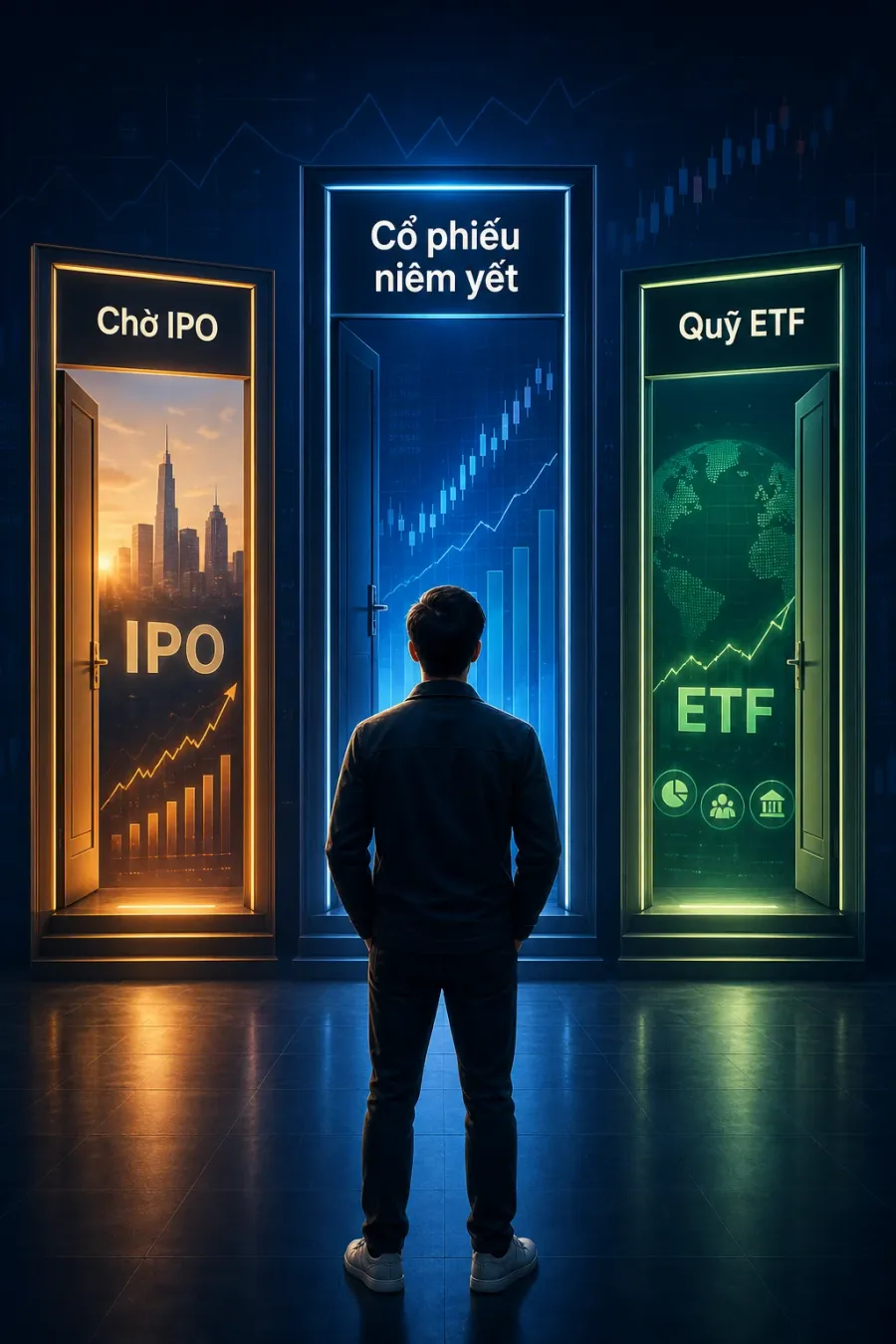
If the goal is to own OpenAI itself, there is still no clean shortcut other than waiting for the stock to list. If the goal is to participate in the AI theme today, listed stocks are the more active route but require stronger company-selection skills. If the goal is to lower the chance of making a single-name mistake, funds or ETFs are usually the better starting point.
The important thing is not to let a major headline create pressure to do something immediately. A famous company filing confidentially for an IPO does not automatically create a good investment opportunity that same day. Sometimes it mainly creates noise, while capital allocation still comes back to the same old questions: what exactly am I buying, how much readable data do I have, and how much volatility can I truly absorb?
That leads to a fairly clear conclusion. OpenAI's confidential filing is a sign that the AI wave is moving closer to public markets, but it is not a signal for beginners to rush into any ticker carrying a technology label. The more sensible approach is to choose the access route that matches your ability to read risk: wait if you want OpenAI itself, pick stocks only if you understand the business, and lean toward funds if your immediate goal is to reduce stock-picking mistakes.