


When SJC gold bars and gold rings both moved below VND 144 million per tael on June 9, the instinctive reaction was simple: gold had become easier to buy. The sticker price was lower than it had been a week earlier. But that shortcut can be misleading, because a lower posted price is not the same thing as better value for someone about to put fresh money into gold.
The cleaner way to read the market is to split the price into three layers. A listed domestic gold price includes the global gold benchmark, the premium embedded in the local market, and the bid-ask spread charged by the seller. Those three layers sit inside one number, but they create three very different risks. That is why the same VND 143.8 million per tael can look like a long-term accumulation opportunity to one buyer and an unattractive short-term trade to another.
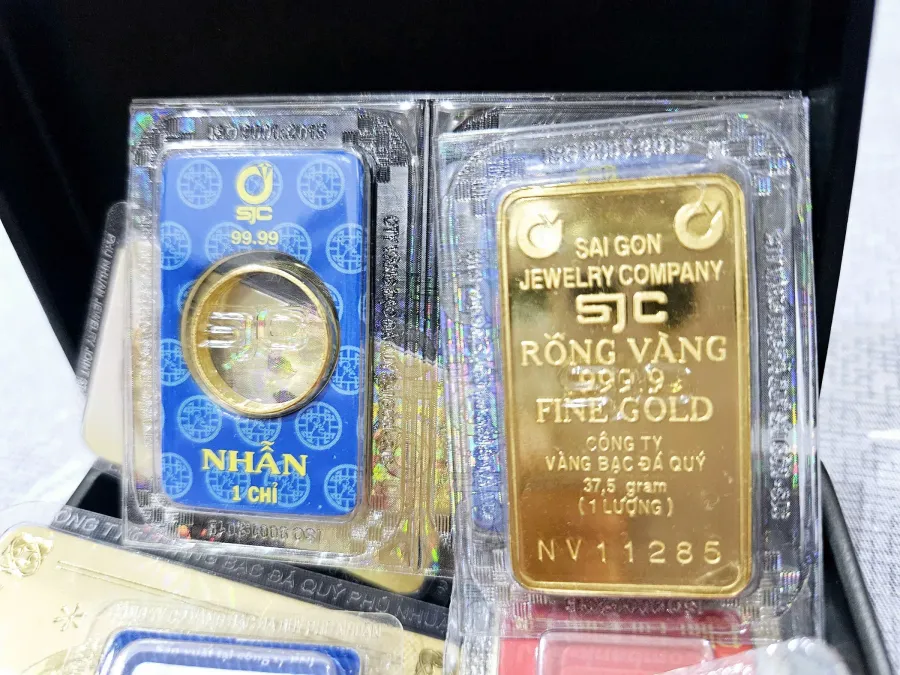
One quoted price is hiding three separate costs
What many first-time buyers miss is that domestic gold does not track global gold one-for-one. On June 9, global gold stood at USD 4,340.21 per ounce in Investify's market data. Using the latest USD/VND rate of VND 26,345, that works out to roughly VND 137.9 million per tael. Yet SJC gold bars were listed at VND 143.8 million per tael, while SJC gold rings were listed at VND 142.1 million per tael.
That gap between VND 137.9 million and the domestic sticker price is the second layer buyers are still paying for. For SJC gold bars, the local premium still comes to roughly VND 5.9 million per tael. For SJC gold rings, it is about VND 4.2 million. Put differently, a June 9 buyer was not just paying for gold at the world price. They were also paying for a domestic market that still carried a meaningful markup over the converted international benchmark.
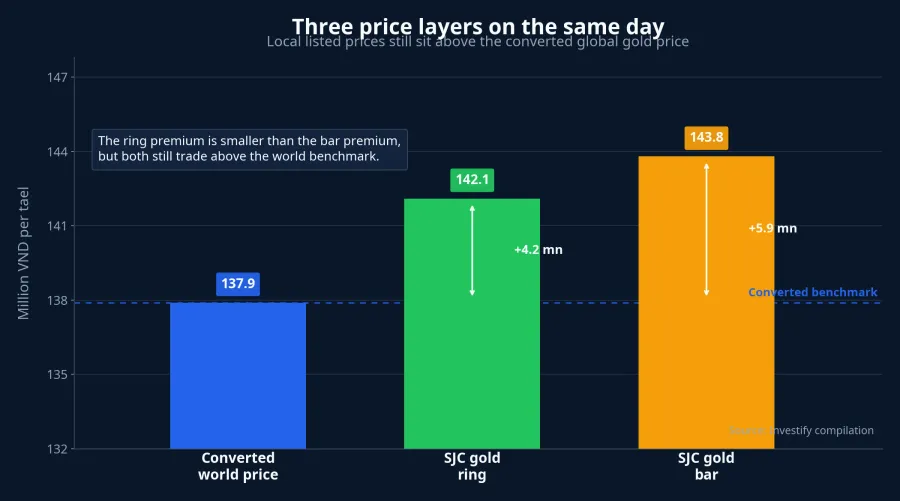
This distinction matters because it changes the meaning of the phrase "gold is cheaper now." If part of the decline came from a shrinking domestic premium, then today's buyer is entering a market that is less overheated than it was before, but not one that has fully converged with global pricing. If you ignore that premium, it is easy to mistake a smaller markup for outright cheapness.
Why domestic gold fell much more than global gold
Compared with June 2, global gold was down about 3.3%. That is a meaningful pullback, but it does not explain everything that happened in Vietnam's domestic market. Over the same window, SJC gold bars fell from VND 157.5 million per tael to VND 143.8 million, a decline of about 8.7%. SJC gold rings dropped from VND 155.8 million to VND 142.1 million, or about 8.8%.
That means the domestic move was not driven by the world gold price alone. Part of the decline came from the local premium compressing. For new investors, this is the key mechanism to understand. A lower domestic price does not automatically mean the asset itself has become cheap in an absolute sense. In some cases, what is really falling is the layer of local exuberance that had been built on top of the global benchmark.
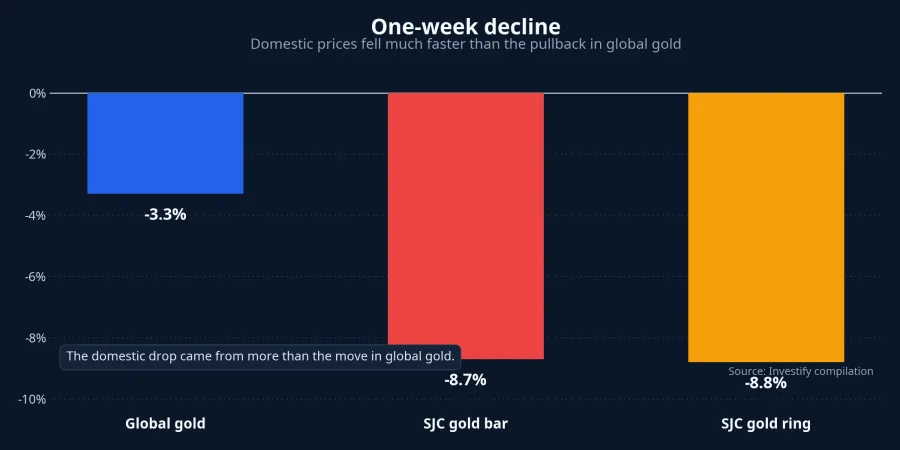
Seen this way, the early-June drop looks less like a collapse in global gold and more like a release valve on domestic overpricing. That does not weaken gold's role as a store of value. It does, however, remind buyers that local prices can move much more sharply than the underlying international market. Anyone who assumes domestic gold merely mirrors global gold is starting from the wrong risk model.
The bid-ask spread is the real pain point for short-term buyers
The third layer is the bid-ask spread. For long-term accumulators, it can be an acceptable carrying cost if the holding period is long enough. For anyone hoping to trade a quick rebound, it is the biggest obstacle. On the evening of June 9, major brands including SJC, DOJI and PNJ were posting SJC gold bar prices around VND 138.8 million to VND 143.8 million per tael, implying a spread of VND 5 million per tael.24H
Gold rings were not necessarily easier on that front. Investify's internal SJC data showed a buyback price of VND 136.6 million per tael and a selling price of VND 142.1 million, leaving a spread of VND 5.5 million. VTC News also reported that DOJI's 9999 round rings and PNJ's 999.9 plain rings were both quoted in the equivalent VND 138.8 million to VND 143.8 million per tael range on June 9.VTC News So the product with the lower sticker price does not automatically offer the easier break-even point.
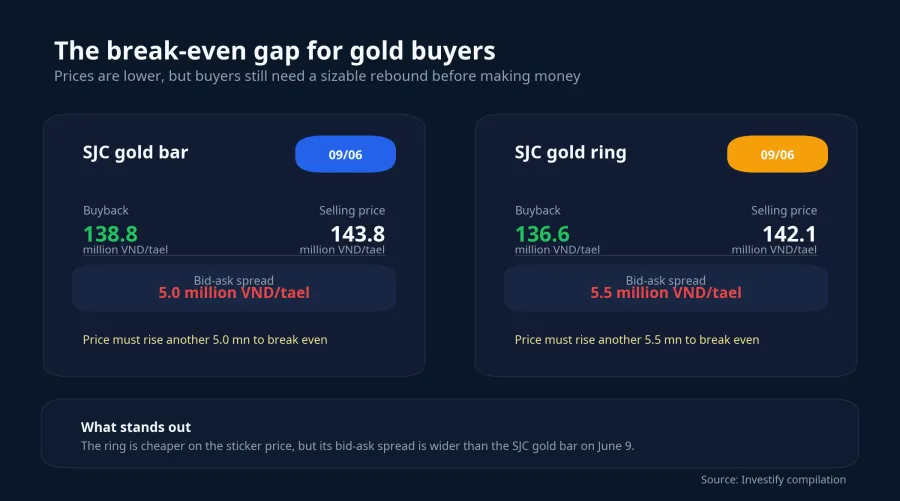
The math is straightforward. If you buy an SJC gold bar at VND 143.8 million per tael and then sell immediately, the store is only buying back at around VND 138.8 million. Before thinking about profit, the market has to move another VND 5 million per tael just to get you back to break-even. For SJC gold rings, the hurdle is even wider at VND 5.5 million.
That is why a mild rebound often does not help short-term buyers much. The price can recover somewhat, but if it does not close the spread, the trade is still underwater. For new investors, this is the most frustrating part of the gold market because it is less visible than the big quoted price on the board.
Gold bars and gold rings solve different problems
As a wealth-preservation asset, SJC gold bars still occupy a distinct place in Vietnam. They carry stronger brand recognition, appear more often in discussions about supply and policy, and are widely seen as the standard product when it comes time to sell. The trade-off is that buyers are paying a larger local premium than they are for gold rings on the same day.
SJC gold rings are closer to the needs of buyers who accumulate gradually. At VND 142.1 million per tael, the selling price was VND 1.7 million lower than SJC gold bars, and the premium over the converted world price was lower by roughly the same amount. For a long-term saver building a position over time, that is a meaningful advantage because the entry cost is lighter and the embedded domestic markup is smaller.
But it would be wrong to conclude that rings are automatically the better bargain. A product can carry a lower premium to global gold and still be less attractive for short-term trading if its bid-ask spread is wider. On the other side, a higher-priced product with stronger market acceptance may suit buyers who care more about standardization and resale familiarity. Gold bars and gold rings are not simply expensive and cheap versions of the same thing. They are different products for different objectives.
Crowded shops do not mean everyone is making the same bet
At around 7 a.m. on June 9, Mi Hong's gold shop in Ho Chi Minh City saw a heavy flow of customers, with many people taking queue numbers before transacting. A company representative said demand had picked up sharply, mostly from people buying gold to accumulate after the price drop.SKĐS It is easy to read that scene as a single market verdict. In reality, the crowd may be acting on two very different theses.
One group is betting on a short-term rebound. For them, the key variable is not whether gold is cheaper than last week, but whether it can recover enough to clear the bid-ask spread. Another group sees gold primarily as a way to preserve purchasing power over many years. For them, the more relevant question is how much domestic premium is still embedded in the price and which product better fits their accumulation habit.
That is why a return of buyers to gold shops after a sharp drop does not automatically prove that gold has entered an attractive zone for everyone. The same lower sticker price can lead to very different conclusions depending on the buyer's goal. Short-term traders should focus on the break-even hurdle. Long-term accumulators should focus on the remaining domestic premium and resale practicality.
A more useful framework for first-time buyers
At June 9 price levels, the key takeaway is not how much gold bars or gold rings have fallen from a week ago. The real takeaway is that buyers are still paying for three things at once: the world gold price, the domestic premium and the shop's bid-ask spread. If those layers are not separated first, the conclusion that "gold is cheaper now" is missing the most important part of the story.
The core thesis here is straightforward. Today's lower sticker price is still not enough to call gold genuinely cheaper for short-term investors. Gold rings may be easier to access because the entry price and the premium over world gold are lower. Gold bars still have an advantage in familiarity and symbolic status. But both products still carry a wide enough bid-ask spread to make short-term trading difficult.
So instead of asking whether gold bars or gold rings are cheaper right now, a better starting point is to answer three questions. Are you buying to hold value for years or to trade a rebound. How much of the domestic premium has actually come out of the market. And is the current spread narrow enough for your goal to make sense. If those answers are unclear, a lower sticker price is still just a more comfortable feeling, not yet a real edge.