

On the surface, the May US jobs report looked like an unambiguous positive for the economy. For Nasdaq, though, it landed as the kind of good news that makes investors uneasy, because a stronger labor market also raises the odds that interest rates stay higher for longer. Once markets are forced to reprice the cost of capital, growth stocks usually take the first hit.
That is where newer investors often get tripped up. It is natural to think that a healthier economy should lift stocks across the board, but markets do not respond in such a straight line. Equities are also being judged against Treasury yields, the likely path of the Fed, and the price investors are willing to pay today for profits that may not arrive for years.

What the jobs report actually said
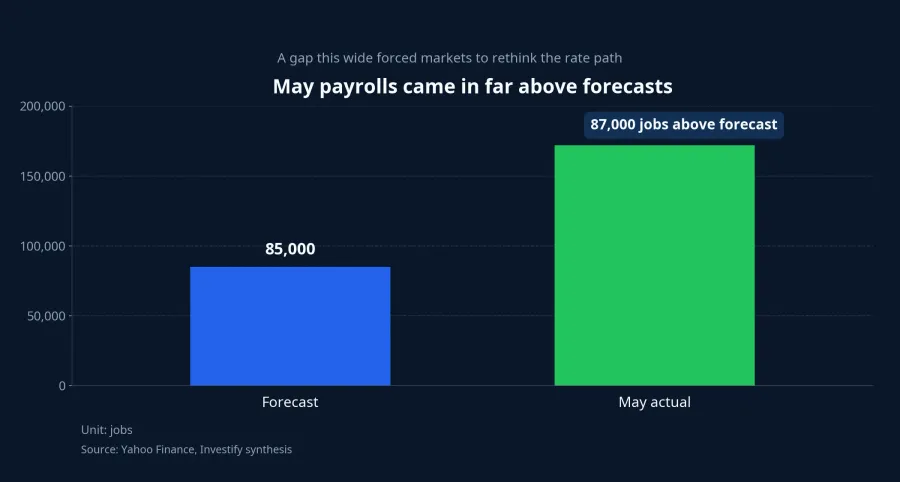
The first takeaway was the pace of hiring itself. The US economy added 172,000 jobs in May while the unemployment rate held at 4.3%. Before the release, economists surveyed by Bloomberg were looking for roughly 85,000 new jobs, which means the actual print came in at nearly double expectations.Yahoo Finance
The second point matters just as much: older data got revised higher too. April payrolls were lifted from 115,000 to 179,000, which makes this look less like a one-month surprise and more like a labor market that has become firmer than investors had assumed. In macro analysis, that distinction is important. One strong month can be noise. A stronger month plus upward revisions is much harder to dismiss.Yahoo Finance
Under the hood, most of the gains came from leisure and hospitality, local government, and health care. Yahoo Finance's running coverage of the report, based on US labor data, showed those three segments contributing about 70,000, 55,000, and 35,000 jobs, respectively, in May. In plain terms, the economy was not just holding up. It still had enough hiring strength in a few large pockets to pull the headline number meaningfully higher.Yahoo Finance
Why good economic news can still hurt stocks
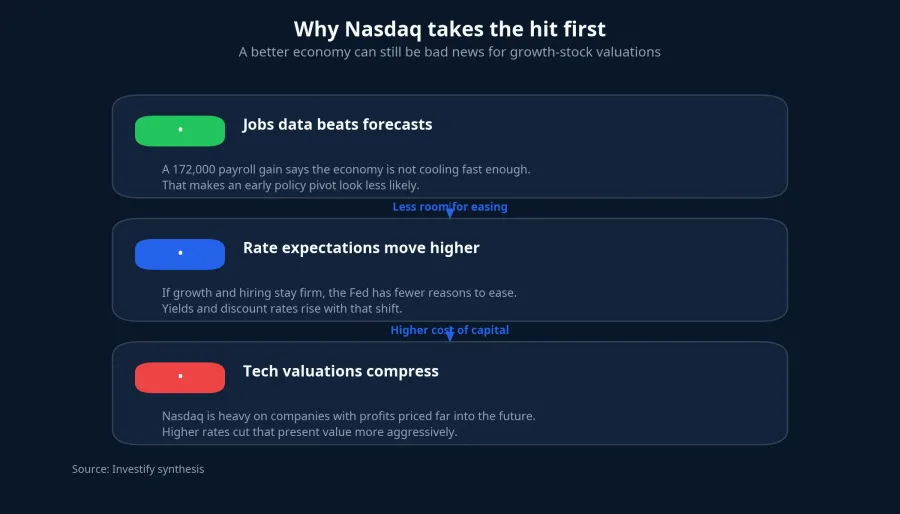
Markets were not only asking whether the economy is healthy. They were also asking what that strength means for monetary policy. If the economy still looks firm, the Fed has less reason to cut rates quickly. Once that answer shifts toward "not yet," risk assets, especially growth stocks, start getting repriced.
After the jobs report, the interest-rate futures market raised the probability of a Fed hike by December to 65%, up from 48% before the release. At the same time, traders still expected the June meeting to leave rates unchanged in the 3.50%-3.75% range. The key shift was not an immediate policy move. It was a rewrite of the market's assumptions for the rest of 2026.Yahoo Finance
Put simply, higher rates make bonds relatively more attractive. To keep investors in stocks, especially in names already priced for long-term growth, the market has to demand a lower valuation. That does not mean those companies suddenly became worse businesses overnight. It means the discount rate used to value their future profits changed.
That is why a strong jobs report is not automatically bullish for every corner of the market. Defensive sectors or companies with steady current cash flow may absorb the move more easily. But firms trading heavily on distant expectations are much more exposed when the cost of capital rises.
Why Nasdaq felt more pain than the rest
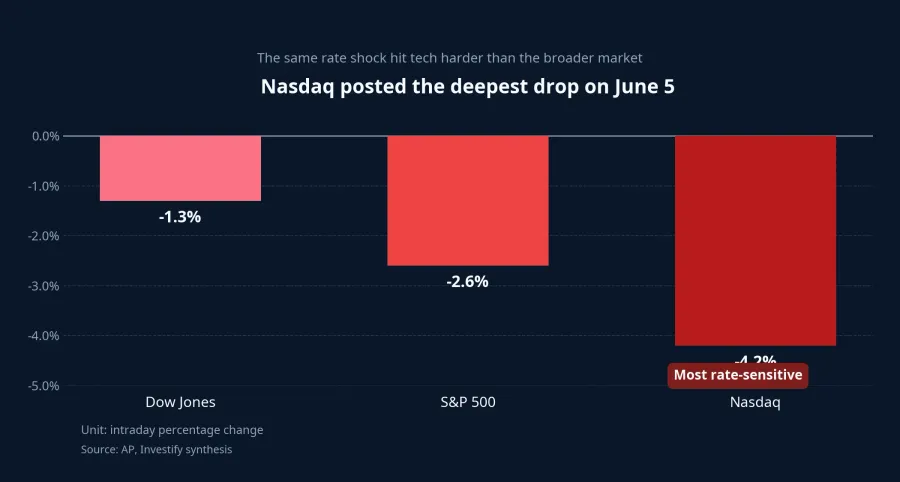
The June 5 session made that split obvious. The S&P 500 fell 2.6% to 7,383.74, the Dow Jones Industrial Average lost 1.3% to 50,866.78, and the Nasdaq Composite dropped 4.2% to 25,709.43. That gap tells you the market was not selling everything equally. The heaviest pressure landed where rate sensitivity is highest.AP
Nasdaq is packed with technology and high-growth companies. In many of those businesses, a large part of what investors are paying for sits well beyond the next quarter or even the next year. When rates rise, the present value of those distant profits gets compressed faster than it does for companies generating stable cash flow right now.
So Nasdaq's reaction should not automatically be read as a judgment that the fundamentals of the entire tech sector have deteriorated. A tighter reading is that the market is testing whether previously rich valuations still make sense when the rate path becomes less friendly. That distinction matters, because one interpretation is about business quality while the other is about the price investors are willing to pay.
What investors in Vietnam should watch next
For Vietnamese investors, the main lesson is not to guess whether Nasdaq bounces in the next session. The more useful lesson is to understand how US markets can prioritize rate expectations over growth headlines in the short run. Once you read the market's fear correctly, the apparent contradiction of "good economic news, falling stocks" becomes much easier to process.
The first signal to watch is the direction of US Treasury yields, especially at the short and intermediate parts of the curve. If yields keep climbing after more inflation data or after the Fed's June meeting, pressure on growth stocks can continue. If yields cool down, the sell-off may look more like a valuation reset than a break in fundamentals.
The second signal is market breadth. If the major indexes are being dragged down mainly by a handful of giant tech names, the story remains concentrated in the repricing of market leaders. But if the weakness spreads into financials, consumer names, industrials, and small caps, then the market is signaling something broader: higher rates are beginning to weigh on both funding costs and economy-wide growth expectations.
The third signal is how Vietnam reacts in the first sessions of next week. The VN-Index closed at 1,838.90 in the latest session, based on internal market data from June 6. US shocks usually reach Vietnam through sentiment first, and only later through sector-level differentiation. Domestic stocks trading at rich valuations, relying heavily on foreign flows, or leaning on long-duration growth stories are typically examined more critically in this kind of environment.
That does not mean the Vietnamese market will mirror Nasdaq trade for trade. Sector composition, valuation levels, and the role of domestic money are all very different. But the risk framework is similar: when the cost of capital rises, the stocks that require the most belief in the future usually face the toughest valuation test.
Conclusion: This is still a rate story
If the June 5 session has one clean takeaway, it is this: the market was not afraid of a weak US economy. It was afraid that the economy was strong enough to keep the Fed from turning softer anytime soon. For Nasdaq, that is primarily a valuation and discount-rate story, not an instant verdict on the entire technology sector.
That is why the most useful framework for next week is still to watch yields before making a bigger call on how far this move can run. If yields continue to edge higher, pressure on growth stocks remains intact. If yields cool, the sharp sell-off is more likely to look like a forceful reminder that, in this phase of the market, rates are still the main valve for valuation.