


Greg Abel’s first major deal in the top job is not about AI, chips or software. Berkshire Hathaway is buying Taylor Morrison, a U.S. homebuilder, for USD 72.5 per share, implying an equity value of about USD 6.8 billion and an enterprise value of about USD 8.5 billion.PR Newswire That is large enough to read as the first clean signal of how Abel may deploy capital.
The timing matters even more than the size. Freddie Mac says the average 30-year fixed mortgage rate stood at 6.53% in the week ending May 28, 2026, still high enough to keep affordability under pressure in the U.S. housing market.Freddie Mac Berkshire is not stepping into an obviously easy cycle. It is buying while financing conditions are still working against demand.
What the first deal is really saying
Taylor Morrison is not a niche builder. The transaction announcement says the company operates more than 350 communities across 21 markets in 12 U.S. states, and the deal is expected to close in the second half of 2026 if shareholders and regulators approve it.PR Newswire Berkshire is also paying roughly 24% above Taylor Morrison’s May 29 closing price.PR Newswire
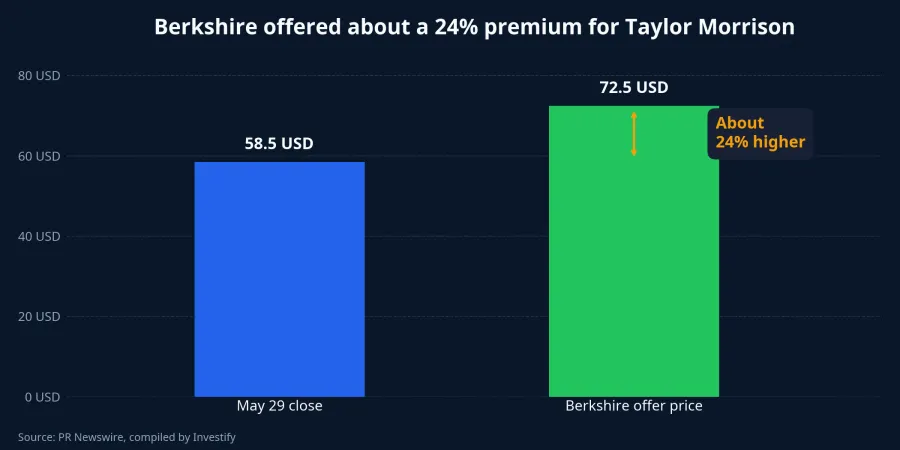
That premium matters because Berkshire is not valuing Taylor Morrison as a short-term stock trade. It is valuing control of the whole company: the land pipeline, the community-development capability, the sales platform and the cash-generation potential once the cycle becomes less hostile. For a buyer known for price discipline, a 24% premium only makes sense if the underlying asset is worth more than what the market had been pricing.
That makes this deal different from the market’s favorite growth stories. A software company can be bought on momentum, market share and optionality. A homebuilder forces the buyer to underwrite real assets, capital turns and operating resilience in a difficult market. Berkshire appears to be choosing the kind of business it believes it can measure with more confidence.
Why Taylor Morrison fits Berkshire
There are at least three plausible ways to read the decision. Berkshire may want to deepen its presence across housing. It may want to deploy capital into an industry that is still being squeezed by high mortgage rates. Or Abel may be signaling that his early tenure will favor businesses that are easier to underwrite than fashionable, harder-to-value growth narratives. Of those three, the first explanation is the best supported by the available evidence.
Berkshire has long owned pieces of the housing chain. Its annual reports show ownership of Clayton Homes in manufactured housing and related finance, Johns Manville in building materials and HomeServices of America in real estate brokerage.Berkshire 2025 ARBerkshire 2024 AR The missing piece was a large-scale traditional homebuilder with direct exposure to community development. Taylor Morrison fills that gap neatly.

Place Taylor Morrison next to Berkshire’s existing assets and the logic becomes clearer. Berkshire already touches materials, financing and brokerage. Buying a national homebuilder adds the operating layer at the front end of the chain. For Abel, that makes the deal both familiar to Berkshire’s industrial logic and meaningful enough to count as a real statement of intent.
That is also why USD 72.5 per share cannot be judged in isolation. A listed stock price reflects the market view of a minority stake. A full acquisition reflects control, integration potential and the ability to hold the asset through a difficult part of the cycle. Without that distinction, it is easy to stop at the headline premium and miss the capital-allocation logic underneath it.
U.S. housing is still a hard market
The most revealing part of the story may be the backdrop. A 6.53% average 30-year mortgage rate is still high enough to weigh on monthly payments for U.S. households.Freddie Mac For homebuilders, that usually means slower sales, more incentives and a tougher working-capital equation than in the cheap-money years.
That is why it would be a leap to say Berkshire bought Taylor Morrison because it expects an immediate housing boom. The evidence does not support that claim. A more defensible reading is that Berkshire is willing to buy while the cycle remains uncomfortable because it believes the asset will create value across years, not because the next quarter is about to look great.
For newer investors, the takeaway is straightforward. High mortgage rates are still making the housing market harder to navigate, so this is not an easy-cycle bet. If Berkshire is still willing to pay a control premium here, that says more about the quality of the asset and the patience of the buyer than about any short-term acceleration in the sector.
What Greg Abel is keeping
Berkshire has already said Greg Abel took over as chief executive on January 1, 2026, after Warren Buffett stepped away from day-to-day management while remaining Chairman of Berkshire Hathaway.Berkshire Hathaway That makes Taylor Morrison more than a standard M&A story. It is an early test of how Abel will use Berkshire’s balance sheet.
What stands out is how little this looks like a stylistic rebellion. According to the deal announcement, Sheryl Palmer, Chairman and Chief Executive Officer of Taylor Morrison Home Corporation, will continue leading the company after closing.PR Newswire That is classic Berkshire structure: buy a real business, keep the team that understands the industry and let time work in your favor.
In that sense, Abel is not announcing a new era by chasing the hottest theme on the board. He looks closer to a selective continuation of Berkshire’s old strengths: understandable assets, patient capital and a willingness to enter when the cycle still feels awkward for everyone else. If this is the first template, it is a very Berkshire one.
What individual investors should take from it
The first lesson is that the most interesting asset is not always in the loudest sector. Global capital is still obsessed with AI and computing infrastructure, yet Berkshire chose a homebuilder. That is a reminder that long-duration value can still sit in hard assets, operating capability and position within a real-economy supply chain.
The second lesson is that a bad cycle can be both a risk and an opening. High mortgage rates are bad news for housing demand, but they can also create a more reasonable entry point for buyers with time, funding and patience. That does not make the risk disappear. It means difficult timing can sometimes improve the price at which quality assets change hands.
The final lesson is about how to read a premium. About 24% above the undisturbed price does not automatically mean overpayment.PR Newswire A premium only means something when set against what the buyer gets back: control, underlying assets, management continuity and the ability to plug the business into a broader operating system.
The cleaner conclusion is that Taylor Morrison does not mark a post-Buffett turn toward trend-chasing. The stronger thesis is that Greg Abel is starting by holding tight to Berkshire’s old capital discipline: buy tangible assets, stay in sectors with long-term demand and be willing to enter while the cycle still feels awkward. The variable worth watching over the next few quarters is U.S. mortgage rates, because that is the factor most likely to speed up or slow down the payoff from this logic.