

A stock flashing a 50% cash dividend can trigger a very natural reaction: buy now and collect the money. For first-time investors, that sounds like an easy win sitting in plain sight. But dividend calendars do not work that way, and if you read them incorrectly, you can end up buying right as the entitlement is being stripped from the stock.
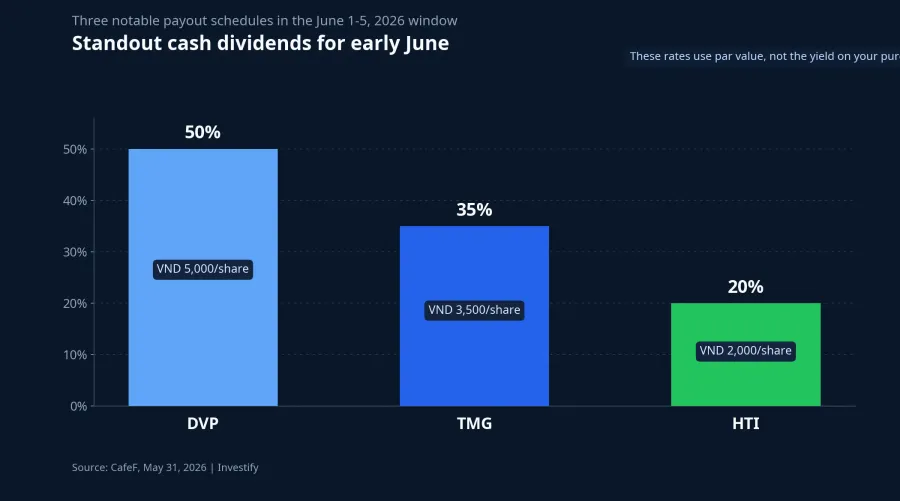
In the June 1-5, 2026 window, 35 companies announced dividend record dates, with nearly 30 of them paying cash. DVP tops the list at 50%, equal to VND 5,000 per share; TMG is at 35%, while HTI is at 20%.CafeF
The catch is that dividend ratios in Vietnam are quoted on par value, not on the price you actually pay in the market. If DVP is trading at VND 75,900 per share, that VND 5,000 payout works out to only about 6.6% on your purchase price, before tax, fees, and any move in the stock after the ex-dividend date. In plain English, the announcement tells you how much cash the company plans to distribute, but not how much money you will make from the trade.
The first date to check is the ex-dividend date
New investors often start with the payment date because that is when the cash lands in the account. The more important date, however, is the ex-dividend date. That is the point after which a new buyer no longer qualifies for the payout.
VSDC states that the ex-dividend date is the business day immediately before the record date. Investors who buy on the ex-dividend date do not receive the entitlement, while those who sell on that date still keep it.VSDC For DVP, the ex-dividend date is June 4, 2026, the record date is June 5, 2026, and the expected payment date is June 29, 2026.CafeF
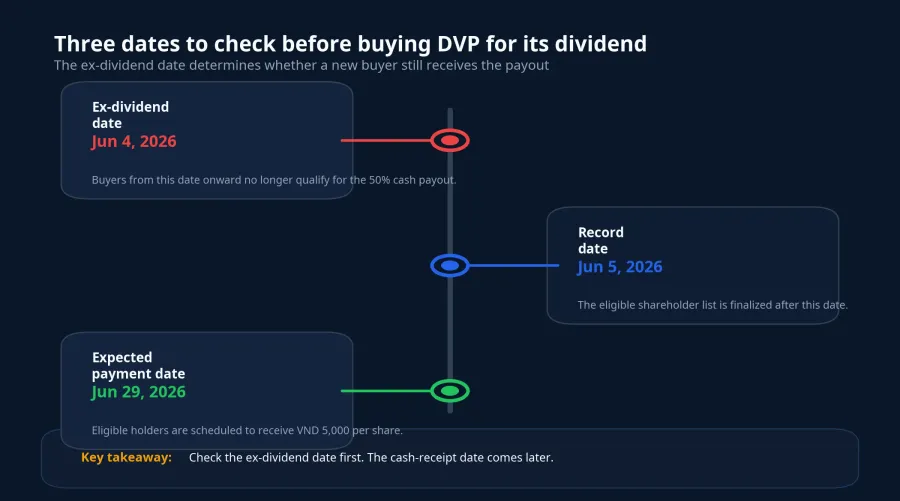
That may sound basic, but it is exactly where many first-time investors slip. If you see June 29 as the day the cash is paid and only buy after June 4, the dividend is already gone for you. A dividend calendar is not a “buy by this date and get free money” schedule. It is a timetable that defines who owned the stock early enough to qualify.
That is why the same announcement can lead to very different decisions. One reader sees “50%” and “cash payout soon.” A more disciplined reader starts with a simpler question: am I still buying early enough to have the right at all?
Cash dividends are not free money
Once you understand which date controls the entitlement, the next question is whether buying before the ex-dividend date guarantees a profit. It does not. On the ex-dividend date, the stock's reference price is usually adjusted downward to reflect the cash being paid out.
VSDC makes that point directly: for listed equities, the reference price on the ex-dividend date is adjusted for the value of the dividend or attached right, except in a few special cases under exchange rules.VSDC HOSE guidance says the same reference price starts from the previous close and is then adjusted for the value of the dividend and related rights.HOSE
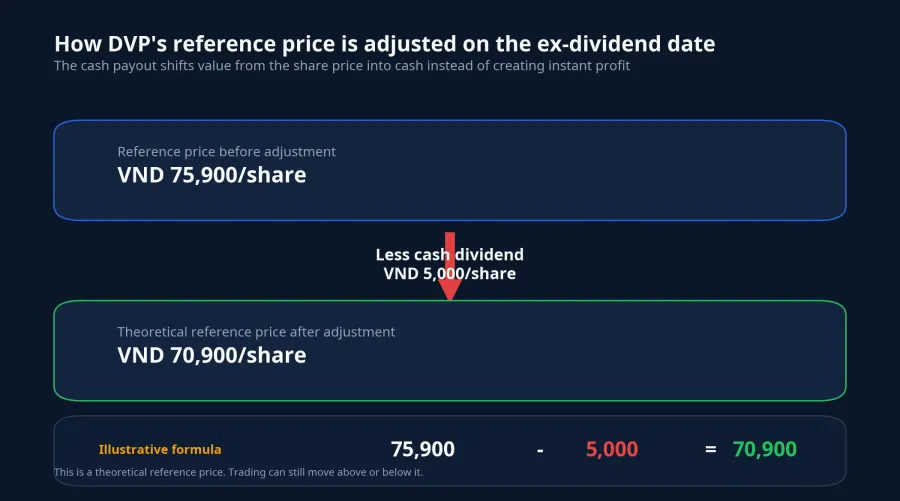
For DVP, if you start from VND 75,900 per share and subtract the VND 5,000 cash dividend, the theoretical post-adjustment reference price is about VND 70,900 per share. The stock can still trade above, below, or around that level afterward because supply, demand, and sentiment continue to matter. But the key point is that the dividend does not create new value at the moment the right is detached. It simply moves part of the value from the share price into cash.
This is where first-time dividend traders are most likely to fool themselves. Before they factor in the price adjustment, it feels as if they are getting both the stock and a cash bonus. In reality, the market has already reworked that equation by the ex-dividend date. What remains as a real gain or loss depends on entry price, tax and fees, and whether the stock holds up after the payout is separated.
A high payout ratio means little without liquidity
Liquidity is the other filter that many retail investors skip. On paper, DVP at 50%, TMG at 35%, and HTI at 20% all look attractive.CafeF But a high dividend on a regularly traded stock is not the same story as a high dividend on a name that barely trades.
In the latest session, DVP matched 10,900 shares. VGG matched only 1,900. TMG and TR1 recorded no trades at all. When trading is that thin, the real risk is no longer whether you qualify for the dividend. It is whether you can buy at a fair price and sell after the ex-dividend date without getting trapped.
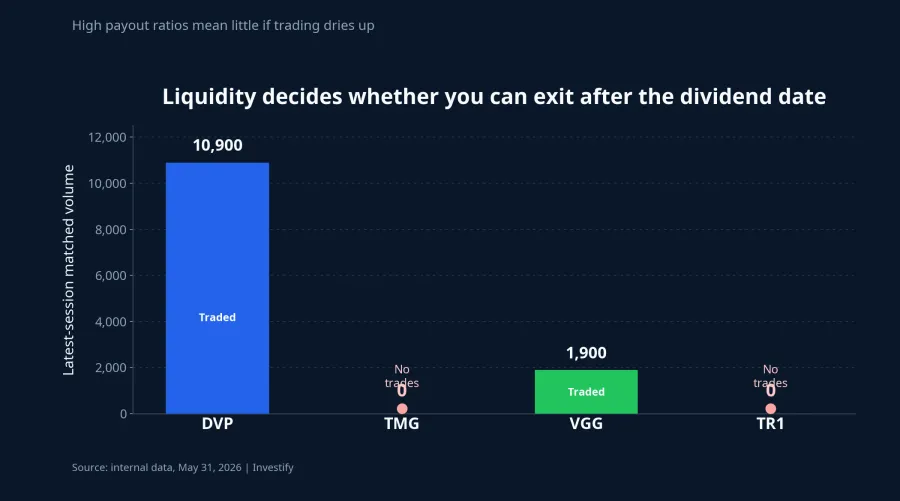
The easiest way to think about this is to imagine a shop with almost no buyers and sellers. A quoted price still exists, but that does not mean you can transact cleanly at that level. A small order can move the price sharply. In that situation, a few thousand dong per share in cash payout can be wiped out quickly by the bid-ask gap or by the stock sliding after the right is detached.
That is why the same “buy before the record date” idea carries very different risks depending on the ticker. A stock with steady turnover, consistent matched volume, and a clear dividend history may fit an income-oriented portfolio. A thinly traded name can turn a generous-looking payout into a liquidity trap, especially for investors who are still learning how execution risk works in smaller names.
Do not stop at the calendar
A dividend announcement shows only the most visible part of the story. To judge whether the payout is sustainable, you still have to go back to the usual investing questions: does the company generate cash consistently, is the dividend backed by recurring profit, and how is the market pricing the stock today?
For beginners, the right reading order is straightforward: check the ex-dividend date, the cash amount per share, the current market price, the likely reference-price adjustment, the stock's liquidity, and only then the dividend history and the quality of the business. That order matters because it prevents a common mistake: seeing an attractive headline number first and then searching for reasons to justify the trade afterward.
A practical trick is to translate the dividend ratio into the language of your own wallet. Instead of staring at “50%,” ask how much cash you receive per share, then divide that by the price you would actually pay. That small calculation often cools off the emotion immediately, because it pulls you away from the headline and back into the mechanics of the trade.
The real lesson for first-time investors
Early June may look like dividend season on the news feed, but the bigger lesson is not which ticker offers the highest payout ratio. The lesson is that a cash dividend matters only if you know exactly which date still gives you the right, how the stock price is likely to adjust, and whether the name is liquid enough for you to enter and exit sensibly.
The core thesis here is simple: buying a stock only because the dividend ratio looks high is usually not a strong strategy. Dividends can make sense as part of a longer holding plan in the right business, but for short-term trades around the record date, the apparent edge is often given back through the price-adjustment mechanism and through liquidity risk. The main signals worth watching over the next few weeks are still the same three: the ex-dividend calendar, post-adjustment price behavior, and real trading liquidity in each stock.