


The last week of May delivered one of the most important lessons a new investor can learn: the VN-Index is not the market in full. An index can look calm while the average portfolio feels anything but calm. When only a few heavyweight stocks are doing the lifting, the headline number ends up telling a shorter and cleaner story than what investors actually experience in their accounts.
For the week of May 25-29, the VN-Index closed at 1,863.49, down 13.64 points or 0.73% from the previous week. If you measure from the opening week close of 1,886.03 down to the May 29 close, the pullback comes to about 1.20%. Those are two different reference points, but they lead to the same conclusion: the benchmark did not break down sharply, yet the cushion underneath the market became visibly thinner.Index.vn
That matters because the VN-Index is capitalization-weighted. A small cluster of very large stocks can soften the index move even when a broad swath of listed names is under pressure. For a first-time investor, that is the difference between “the market is still holding up” and “my portfolio is already feeling weak.”
The Index Did Not Tell the Whole Story
The May 29 session captured that gap clearly. The VN-Index slipped just 0.18 points, or 0.01%, yet decliners still outnumbered advancers. More importantly, turnover in declining stocks reached roughly VND 7,141 billion, above the VND 5,720 billion traded in rising names. In other words, selling pressure was real. It just did not fully show up on the index because a few large-cap stocks were still doing enough to hold the line.Index.vn
That is where many beginners get misled. If the index looks almost unchanged, it is tempting to assume a red portfolio simply reflects bad stock selection. Sometimes that is true, but not always. In a week when money is rotating narrowly, an ordinary portfolio can easily underperform the index because it does not own the handful of names carrying the benchmark.
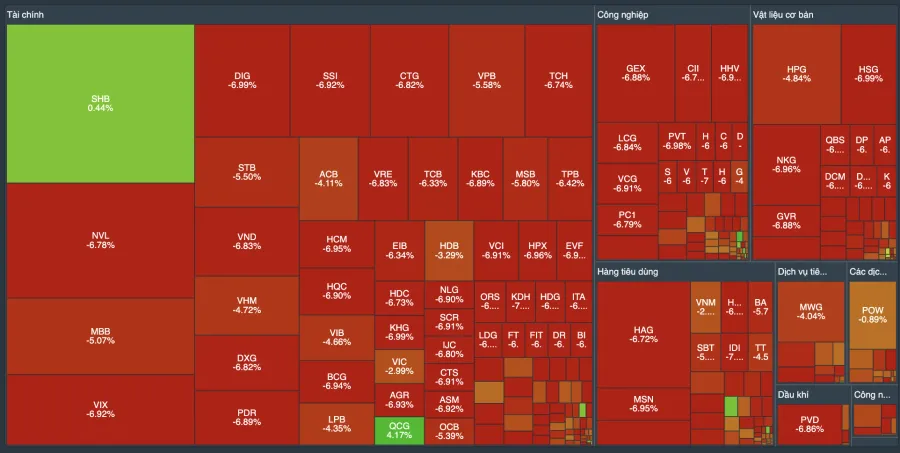
A useful way to think about it is this: the VN-Index is like the average temperature for an entire city. A pleasant reading on the average does not mean every neighborhood feels comfortable. If most blocks are still running hot, the lived experience remains uncomfortable even when the summary number looks fine.
Support Was Real, But It Was Narrow
The final session of the week showed exactly how that support worked. GAS rose 6.98% on May 29 and added 2.90 points to the VN-Index. BSR contributed another 1.32 points and MCH added 1.23 points. On the other side, VHM took away 1.50 points and VCB subtracted 1.43 points. Those numbers alone show that the benchmark was being held together by offsetting moves in a small group of heavyweight stocks, not by a market-wide wave of buying.Index.vn
That is why so many investors looked at the index and saw a relatively stable close, then opened their portfolios and felt something much heavier. If you did not own the oil and gas names or the large caps being lifted late in the session, the benchmark’s resilience did not help you much.
The VHM move over two sessions makes the same point from another angle. The stock surged 6.99% on May 28, then fell 1.08% on May 29. A heavyweight can dramatically improve the appearance of the index for a day, but that does not automatically create healthier breadth underneath. A better-looking benchmark is not the same thing as a stronger market base.
Foreign Selling Did Not Break the Market, But It Did Narrow the Flow
Another layer of pressure came from foreign investors. Over May 25-29, overseas investors sold a net VND 4,923.95 billion on HoSE and VND 5,033.9 billion across the entire market. The heaviest outflow came on May 25 at VND 1,915.38 billion on HoSE, and even by May 29 the figure was still VND 703.04 billion. So the pace eased, but the pressure clearly did not disappear.ĐTCK
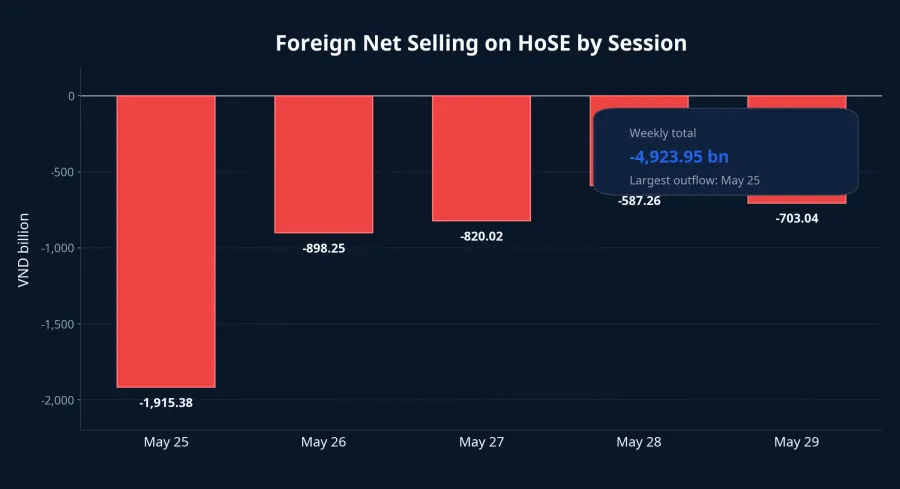
The right way to read that is not “heavy foreign selling means a full-blown sell-off.” Domestic money was still there to absorb part of the pressure, otherwise the benchmark would have looked much worse. But absorption is not the same thing as strength. It simply tells you that local capital is still present, though in a more cautious and selective form.
That distinction matters for retail readers. When foreign investors sell aggressively and the index still does not crack, it is easy to conclude that the market is sturdier than expected. A better conclusion is that the market is still resisting, but it is doing so with a narrower structure of support. And a narrow structure is always less durable than a rebound backed by broad participation.
Liquidity Was the Bigger Warning Sign
If there was one number that captured the mood of the week, it was probably not the VN-Index’s 0.73% weekly decline. It was the fact that average matched value on HoSE fell to about VND 20,440 billion per session, down 24.5% from the previous week. Vietnam News Agency reporting carried by Báo Tin tức described that as the weakest liquidity reading of the year so far. When turnover falls that quickly, the market becomes more dependent on isolated stories and much less able to sustain a broad move.
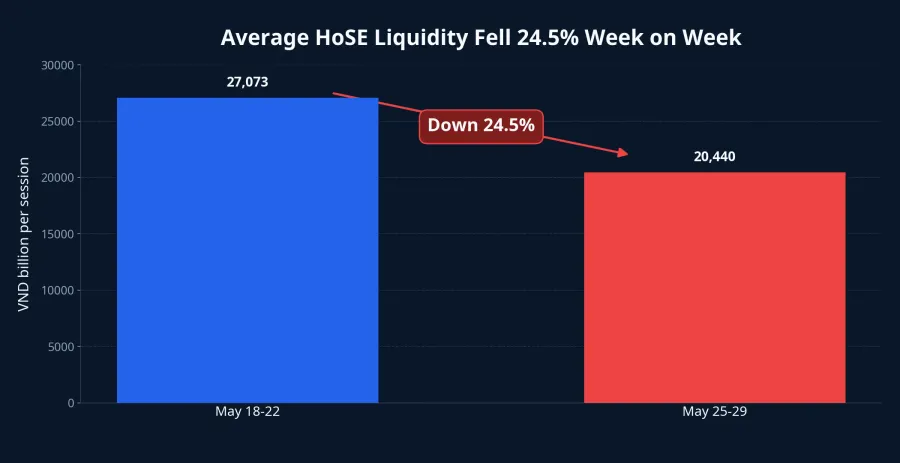
For newer investors, liquidity should always be read together with price action. An index rebound without improving turnover is far less convincing than a rebound supported by expanding money flow. The reason is straightforward: if prices rise while cash participation is still shrinking, the move is more likely to reflect rotation or late-session support in a few large caps than broad confidence returning to the market.
That is why last week did not look like a market moving in consensus. It looked more like a market trying to keep its balance. In that kind of environment, retail investors need to stop treating the index as a full health check and start asking what is happening under the surface.
What Matters in Early June
From a technical perspective, the key framework still centers on support around 1,850-1,860 and a broader expected trading band of 1,850-1,925 before a clearer direction emerges. That is the honest framing based on the current evidence: the market is in a test zone, not a zone where a stronger uptrend has already been confirmed.ĐTCK
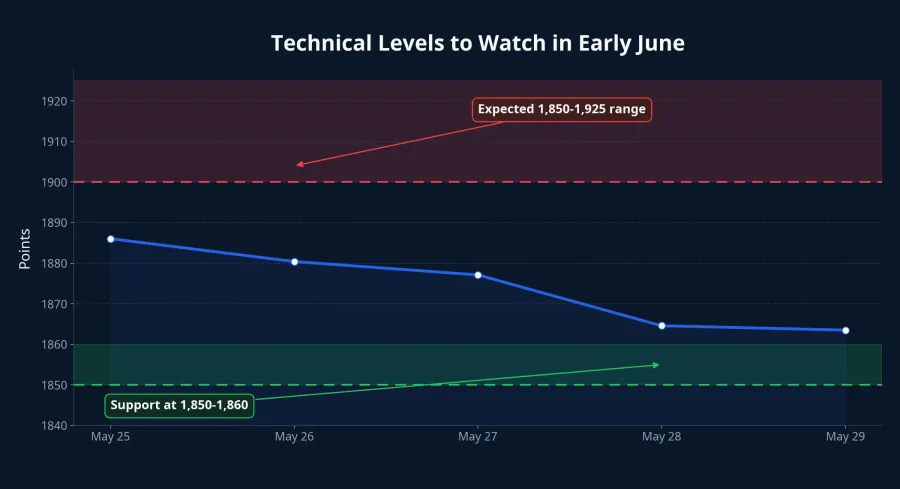
For first-time investors, three signals matter more than the color of the index on any single day. First, does foreign selling continue to slow? If the outflow moderates further, that should give sentiment more breathing room. Second, does liquidity return together with better breadth, or is the benchmark still being held up mainly by a few large names? Third, can the 1,850 area hold if selling pressure resurfaces? A support zone only deserves trust if it comes with sufficiently broad buying interest, not just a few technical lifts near the close.
The bigger takeaway is really about how to read the market. New investors do not need to predict whether the next session will be green or red. The better question is whether buying is spreading widely enough for multiple sectors and ordinary portfolios to benefit. If the answer is still no, then the market is being supported, not genuinely healed.
That leaves a fairly clear thesis for the first week of June. The VN-Index fell only modestly because a limited group of heavyweights still had enough influence to offset broader pressure. Until breadth and liquidity improve together, any rebound in the benchmark should still be read as narrow support rather than confirmation that the average portfolio is finally feeling lighter.