


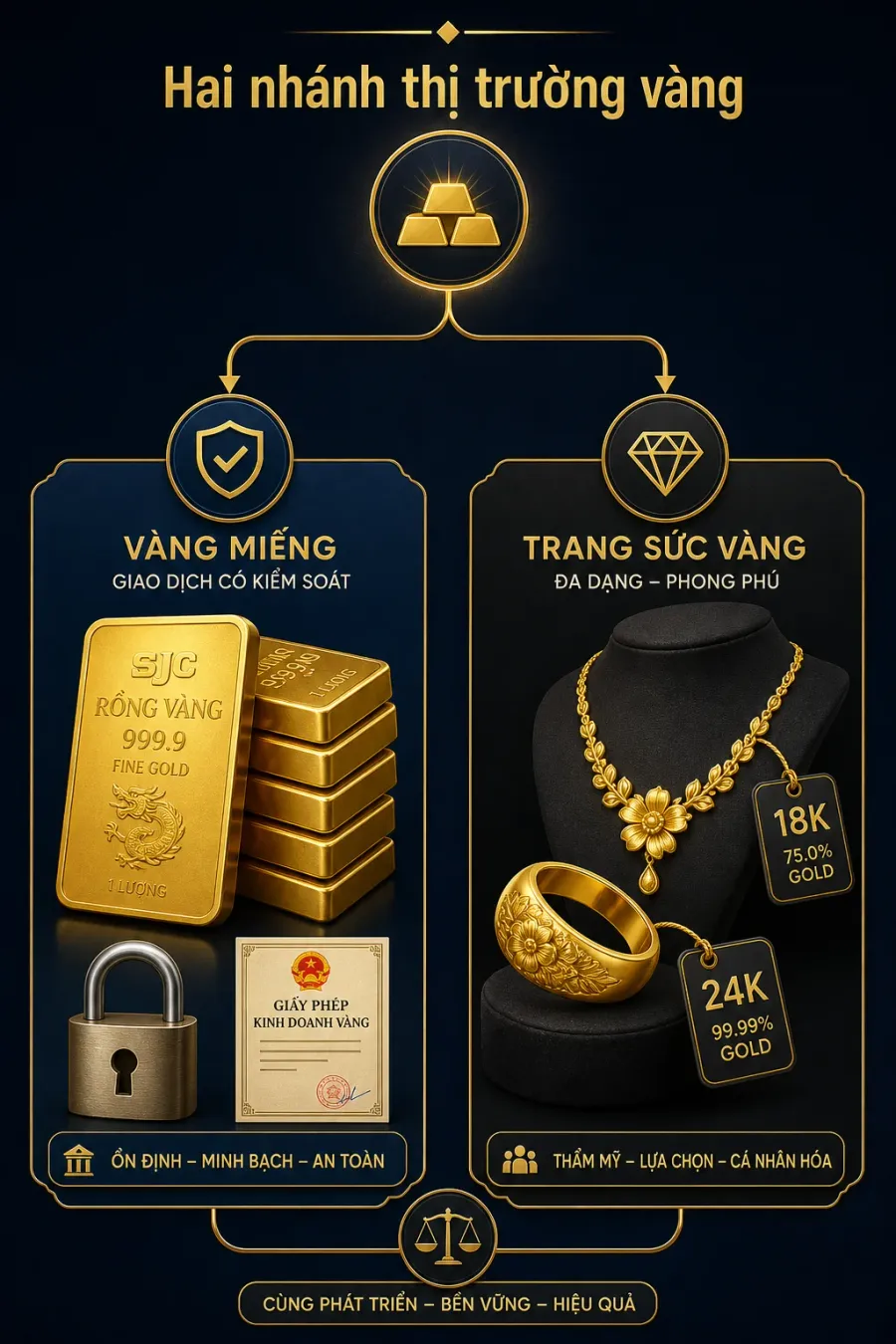
July 1, 2026 is easy to misread as a broad liberalization date for Vietnam's gold market. It is not. What really happens on that date is a clearer regulatory split: gold jewelry and handicrafts move out of the most restrictive bucket, while bullion stays inside a policy framework tied to monetary stability, licensing and transaction data.
That distinction matters for first-time investors because two very different stories are often blended together. One is the accumulation story around bullion and price expectations. The other is the consumer-goods story around jewelry, where quality, invoicing, labeling and retail competition matter more than macro hedging. Read the policy correctly, and the chance of mistaking an administrative change for a trading signal drops sharply.
What July 1, 2026 actually changes
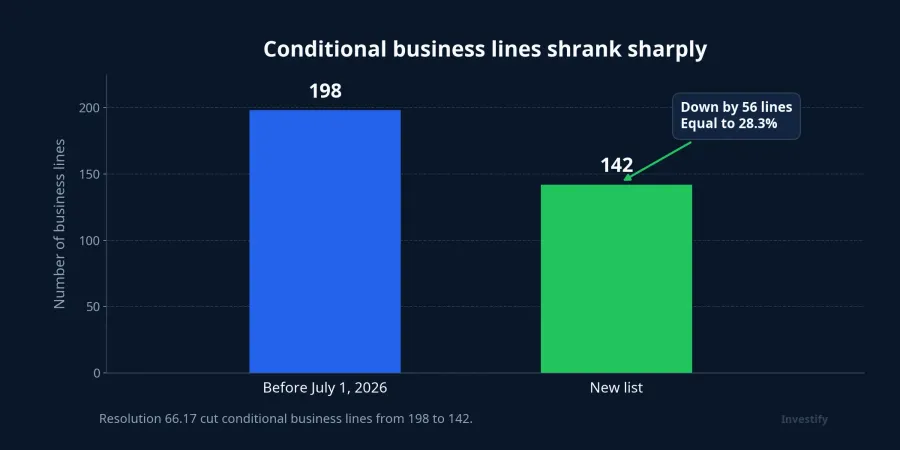
Resolution 66.17/2026/NQ-CP cuts the list of conditional business lines from 198 to 142, but it does not remove gold from special oversight.Gov Portal The key phrase is the wording of item 138 in the new list: “gold trading, excluding gold jewelry and handicrafts.”TVPL
In plain terms, the state is not stepping away from the gold market across the board. It is drawing a sharper line between the segment linked to monetary control and the segment that can be managed more like consumer goods. The government also asked ministries to prepare replacement management tools through standards, technical rules and post-audit oversight before July 1, 2026.Gov Portal
That makes this a structural change rather than a shock event. For jewelry, the center of gravity may shift from entry conditions toward proving quality and compliance when inspected. For bullion, the special policy layer remains intact because bullion is still treated as more than a product on a shelf; it sits close to savings behavior, exchange-rate expectations and monetary stability.
Why Decree 24 created two regulatory layers
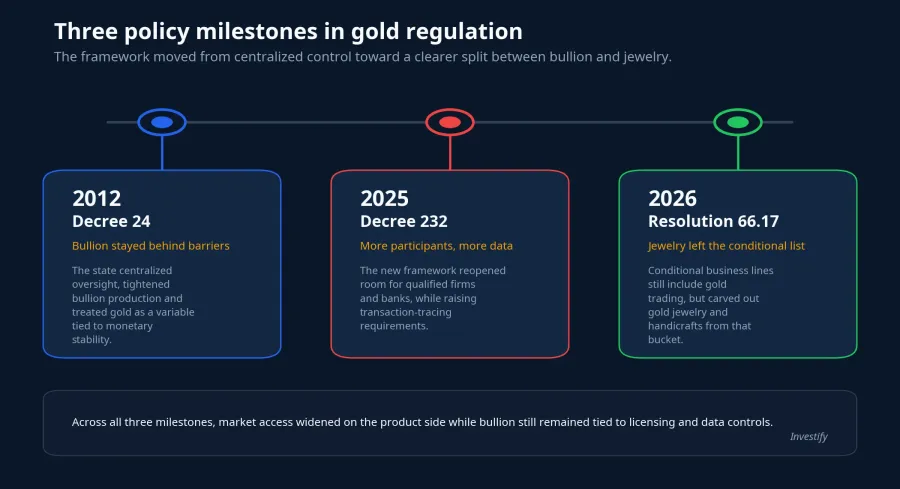
To understand July 1, it helps to go back to Decree 24/2012/ND-CP. Issued on April 3, 2012 and effective from May 25, 2012, the decree set the foundation for treating gold as a macro-sensitive variable rather than just a commodity.TVPL
Decree 24 separated gold into distinct categories at the definition stage. Gold jewelry and handicrafts were defined as products with purity from 8 karat, equivalent to 33.33%, that had already been processed for decorative or artistic use. Bullion, by contrast, was defined as cast gold bars stamped with weight, quality and identifying marks of an institution licensed by the State Bank of Vietnam, or produced directly under the SBV's organization.TVPL
From there, the two regulatory layers became obvious. Bullion trading could only be carried out by licensed credit institutions and enterprises. For enterprises, the requirements included charter capital of at least VND 100 billion, at least 2 years of gold-trading experience, tax payments from gold business of at least VND 500 million a year for 2 consecutive years, and a network spanning at least 3 provinces or cities. For credit institutions, the charter-capital threshold was VND 3,000 billion, with branches in at least 5 provinces or cities.TVPL
Jewelry sat in a softer regime. Firms still had to register their business lines, maintain facilities and take responsibility for product quality, but the focus was on purity disclosure, weight, buy and sell prices, and after-sales accountability. That difference is exactly why jewelry is the part of the market that can now move closer to a post-audit model.
Decree 232 widened access, but tightened data controls
If Decree 24 was about building barriers, Decree 232/2025/ND-CP was about redesigning the gate. Issued on August 26, 2025 and effective from October 10, 2025, it rewired several key parts of the earlier gold-management framework.TVPL
The easy mistake is to read “ending monopoly” as “opening everything.” Decree 232 did reopen the possibility of granting bullion-production licenses to qualified enterprises and commercial banks, but the thresholds were high. Enterprises had to already hold bullion-trading licenses, carry charter capital of at least VND 1,000 billion and have no unresolved penalties. Commercial banks needed charter capital of at least VND 50,000 billion.TVPL
The more important shift sits in data. Decree 232 added a requirement for account-based payment on gold transactions worth VND 20 million or more in a single day. It also required licensed bullion traders to post prices, retain transaction records and connect that information under the reporting rules.TVPL
So 2025 was not the moment when the state stepped back from the gold market. A better reading is that the model moved from fewer gateways to more potential participants, while forcing each participant through a denser filter of capital requirements, licensing and traceable data. Wider access in participant count did not mean lighter supervision.
Gold jewelry is moving toward normal goods regulation
When the new business list carves out gold jewelry and handicrafts from the conditional “gold trading” category, the biggest implication is not price. It is the regulatory lens itself. Jewelry can now be managed more like a product that needs standardized purity, origin, measurement, invoicing and consumer protection, rather than being fully boxed into the same monetary-control logic as bullion.TVPL
This is also where investors can overread the story. The policy does not mean jewelry prices will instantly fall on July 1, 2026, or that competition will become perfect overnight. Those outcomes depend on implementation rules, post-audit standards, raw-material supply and local enforcement. But the direction is now clearer: jewelry is being pulled toward a quality-regulated goods market rather than being fully bundled into the bullion-control framework.
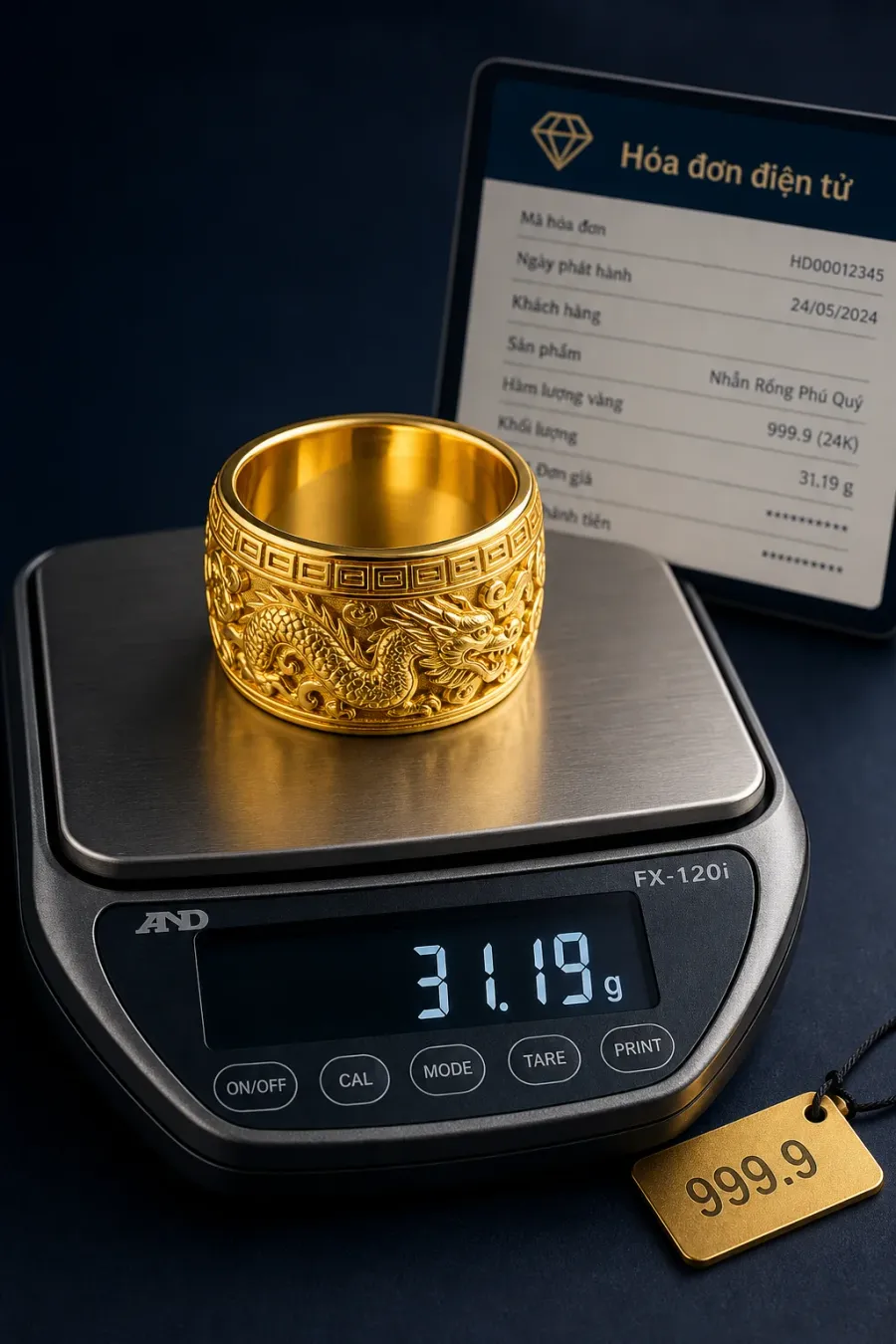
If the post-audit system is designed well, buyers benefit in practical ways that matter more than a short-term price narrative. They get firmer ground to compare purity, weight, fabrication fees, e-invoices and warranty responsibility. That is a micro-level gain, but it is also how healthier market structure is built over time.
How investors should read the shift
For people buying gold as a store of value, this policy change does not yet produce an immediate buy or sell signal. As of May 29, 2026, SJC bullion was quoted at VND 158.5 million per tael, while spot gold was at USD 4,523.85 per ounce in Investify's internal database. Those figures are a reminder that price still reflects many layers, from global markets to domestic supply structure, not a single line in a business-conditions list.
The more useful watchpoints sit in three layers of implementation. The first is the standards and technical rules that replace entry-condition management for jewelry after it leaves the conditional list. The second is how licensing for bullion production and trading works in practice under Decree 232. The third is the data infrastructure, including account-based settlement, transaction logging and reporting connectivity.
That leads to a clear thesis. July 1, 2026 is not the day Vietnam's gold market is set free; it is the day the management structure becomes more explicitly tiered. Jewelry moves closer to a goods market governed by quality standards. Bullion remains inside a monetary-control zone, and that will only change if later documents directly loosen licensing, raw-material supply or data rules. Until those links move, this should be read as a structural regulatory shift rather than a price pivot.