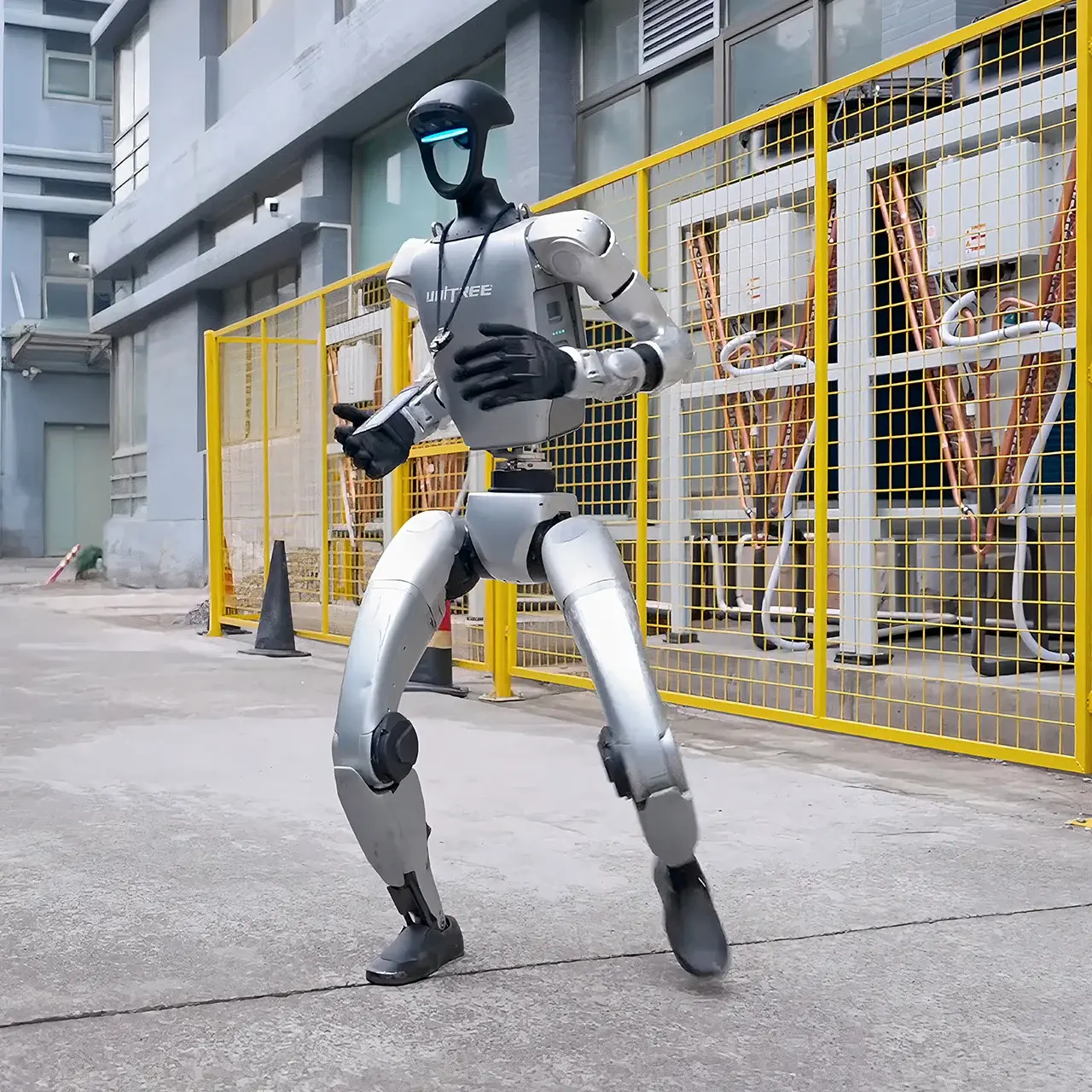

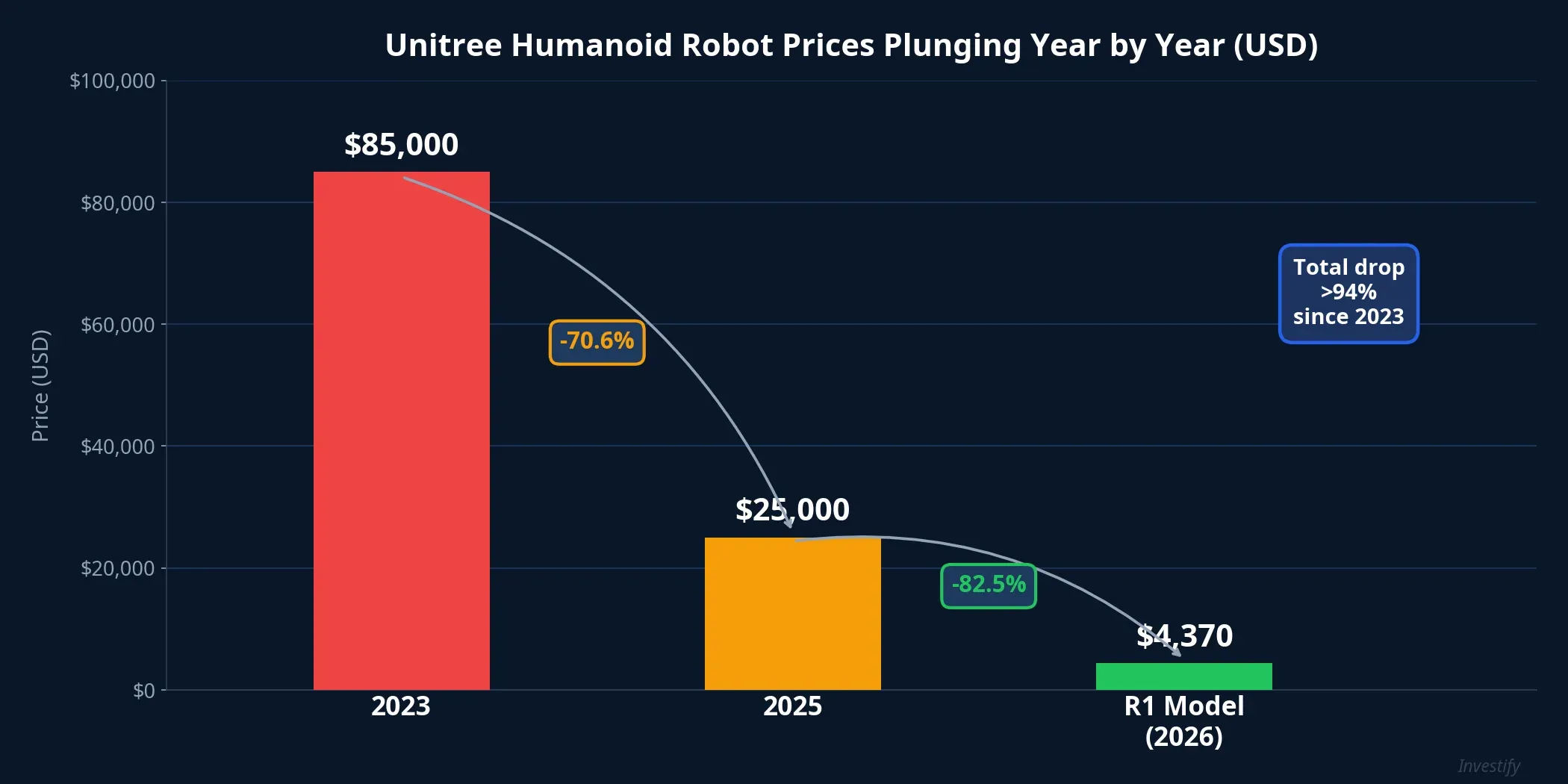
In 2023, a Unitree humanoid robot cost around $85,000. That was enough to buy a mid-range luxury car, and the machine you received was still clumsy, barely functional outside a lab setting. Nobody saw it as a production tool.Rest of World
Three years later, the same brand’s R1 model is on sale in China for a starting price of 29,900 yuan, equivalent to roughly $4,370. That is cheaper than the average used car in the United States. The average price per Unitree robot dropped from $85,000 to approximately $25,000 in 2025, and the newest models continue that descent.SCMP This is not the price curve of a product still years from mass adoption.
The big picture reveals something familiar repeating itself: the same cost-reduction mechanism China used to dominate electric vehicles and solar panels is now running in humanoid robotics. And the consequences do not stop at Chinese car factories.
Commercialization Ahead of Every Forecast
In 2025, Unitree delivered more than 5,500 humanoid robots and became the world’s largest manufacturer in this segment, surpassing the combined output of three names commonly cited in the United States: Tesla Optimus, Figure AI, and Agility Robotics.Rest of World But Unitree is not operating alone.
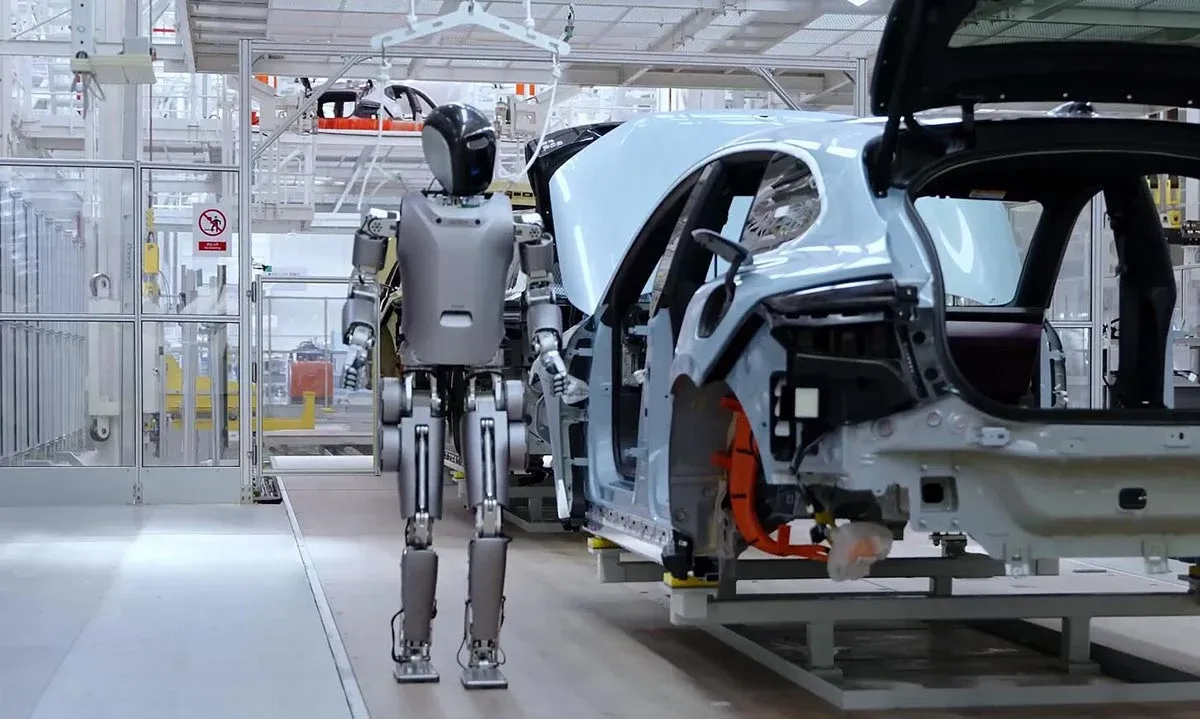
UBTECH, a Shenzhen-based robotics company, has deployed hundreds of units inside factories operated by BYD, Geely, FAW-Volkswagen, Dongfeng, and Foxconn. Orders for the Walker S2 model exceeded 800 million yuan, and in March 2026, a production line in Guangdong began operating at a capacity of up to 10,000 robots per year.PR NewswireInteresting Engineering BYD is expanding its humanoid robot fleet on assembly lines from approximately 1,500 units in 2025 to a target of 20,000 in 2026.WardsAuto
Critically, these are no longer demo robots at trade shows. They are performing real tasks on the floor: carrying components, handling internal logistics, running quality checks. In 2025, Chinese companies accounted for roughly 80% of humanoid robots delivered globally.KuCoin News
Financial confidence has shifted accordingly. Unitree filed for a Shanghai Stock Exchange listing in March 2026, aiming to raise approximately $610 million to expand R&D and manufacturing capacity. The company turned profitable for the first time in 2025, posting adjusted net income of around $90 million, up 674.3% year-on-year. Shareholders include Alibaba, Tencent, China Mobile, Geely, Ant Group, and a ByteDance investment fund.Rest of World
The Same Formula China Used with EVs
The last time something like this happened was with electric vehicles and solar panels. China did not win through superior technology. It won by making products far cheaper, leveraging existing supply chains and vertical integration.
The most expensive component of a humanoid robot is the actuator joints, which account for 40 to 50% of core component costs.Interesting Engineering This is precisely where China holds an overwhelming advantage: batteries, motors, sensors, and drive systems all draw from the massive supply chain already built for the EV industry. Battery costs fell to around $100 per kWh in 2026, down from $140 in 2024.Interesting Engineering Many manufacturers design their own control boards and motors in-house rather than buying them externally, eliminating supplier margins entirely.
When high production volume combines with rapid iteration, the per-unit cost drops along a now-familiar curve. Morgan Stanley forecasts Chinese humanoid robot sales of approximately 28,000 units in 2026, up 133% year-on-year, while material costs fall another 16% as consumer-electronics supply chain efficiencies transfer into robot production.SCMP
Two-Front Pressure on Vietnam’s Labor Advantage
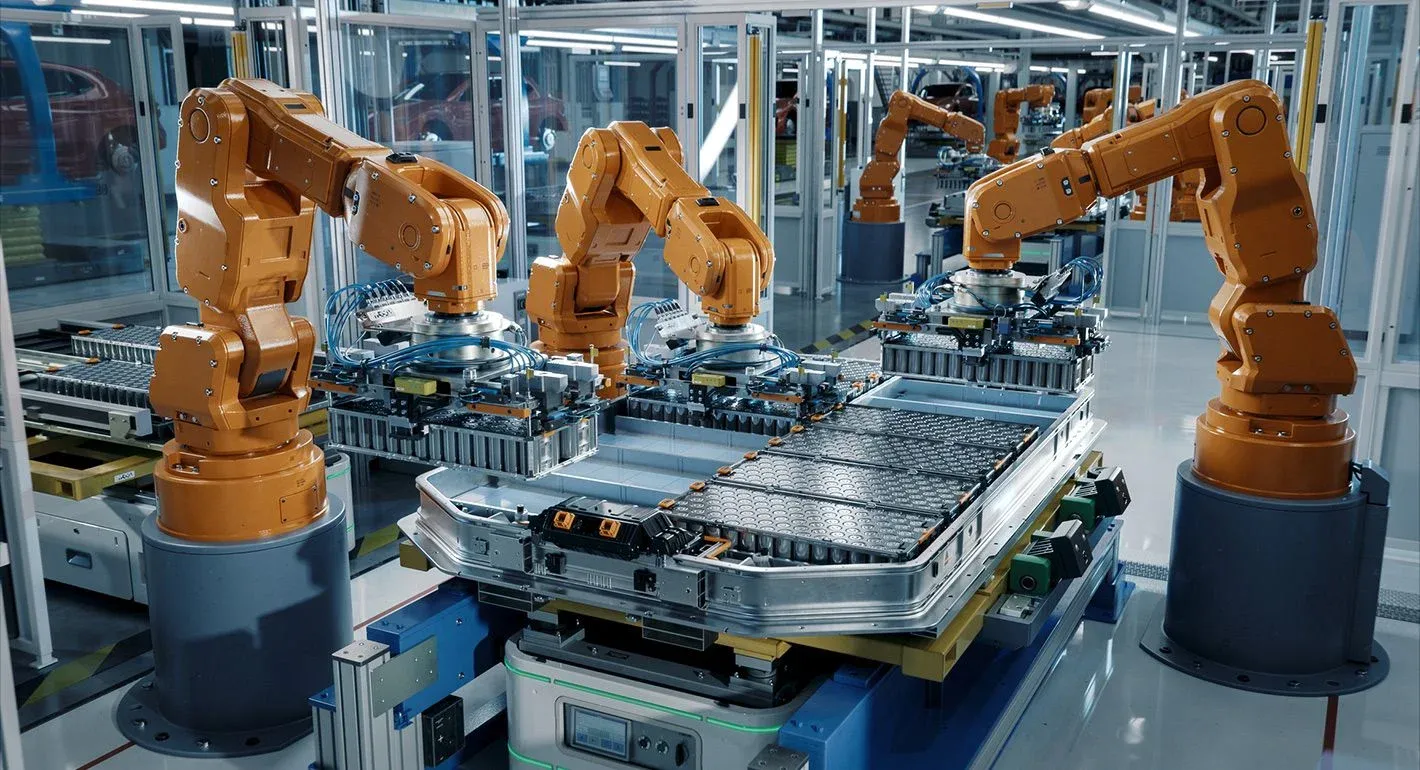
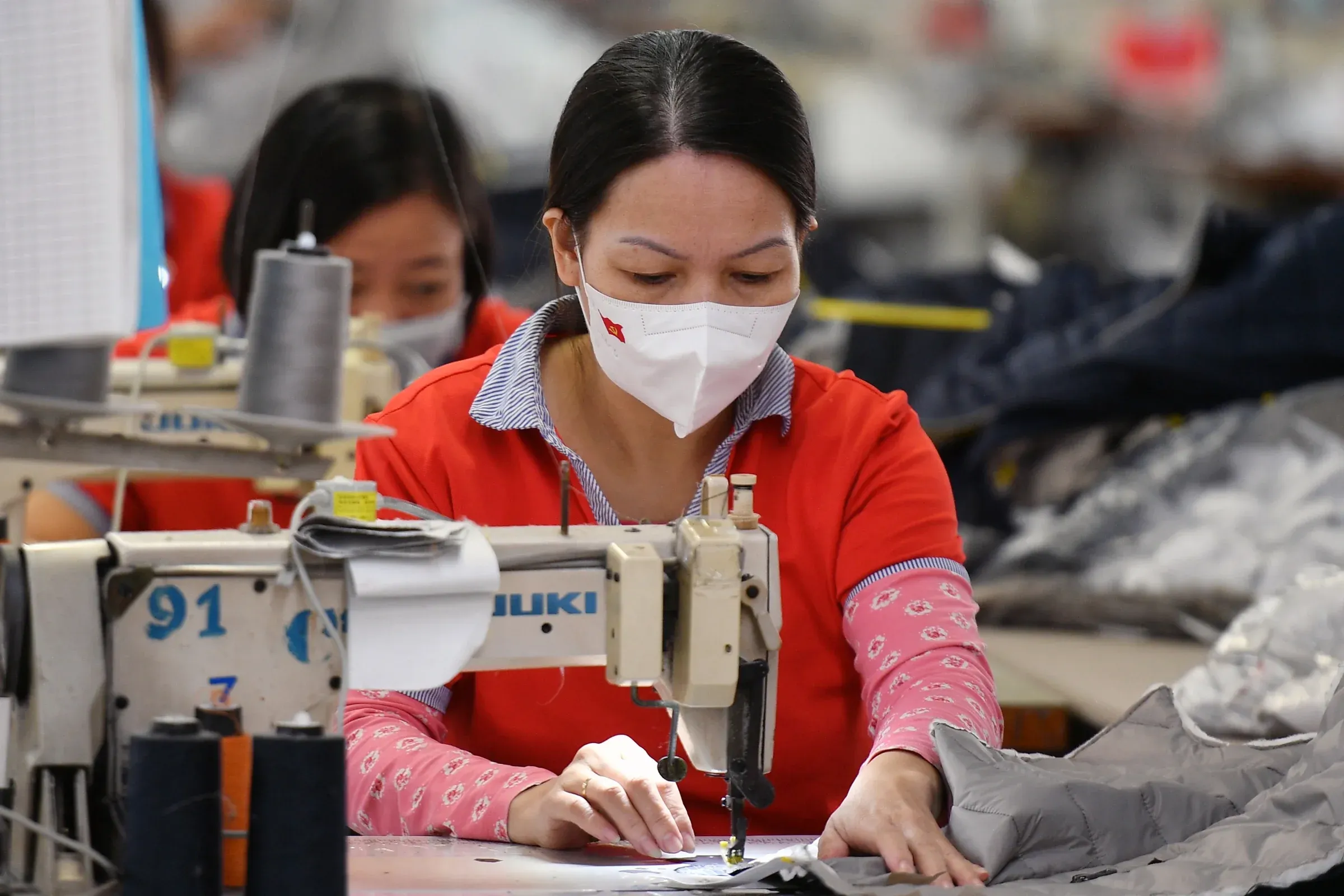
A fair assessment requires nuance. Humanoid robots cannot yet replace garment workers or shoemakers, whose work demands manual dexterity that machines still lack. The first places they are landing are capital-intensive factories such as auto assembly and electronics, handling lifting, transport, and inspection tasks. So the precise conclusion is not “robots are about to replace all workers”: the conclusion is more specific, and more concerning for Vietnam.
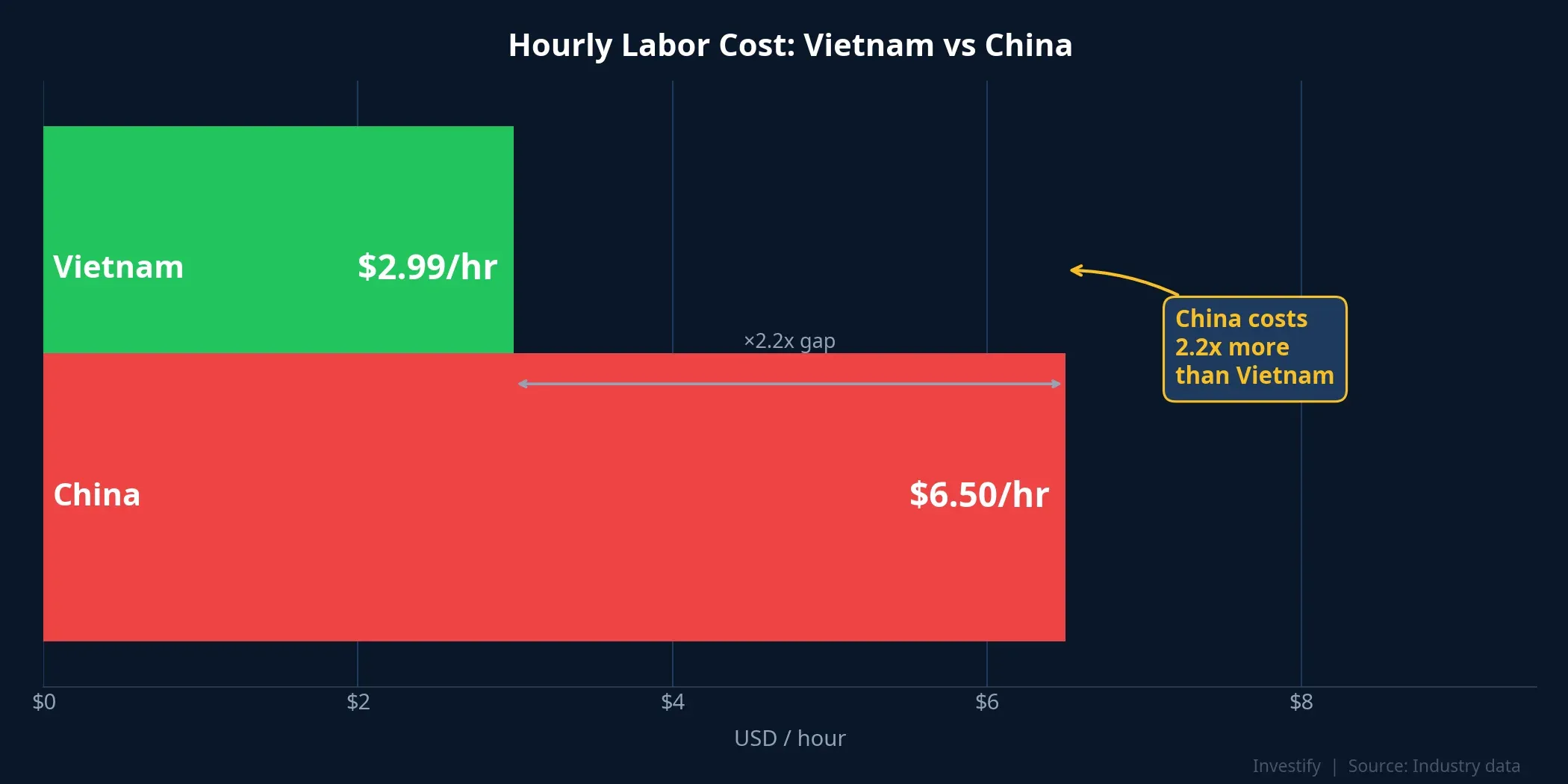
The core competitive advantage of a large portion of Vietnam’s manufacturing sector is cheap labor. Vietnamese workers cost approximately $2.99 per hour, less than half the $6.50 per hour in China.Heva Shoe Inc. This gap is the foundation that attracted global manufacturing investment: the garment industry contributed approximately $19 billion in H1 2025, footwear around $12 billion, and electronics around $72 billion.D-Source Vietnam Nike produces 51% of its global footwear in Vietnam, employing close to half a million workers.VinMake
The problem is that this advantage is now under pressure from two directions simultaneously. On one side, wages in Vietnam are rising faster than in China, gradually eroding the cost differential. On the other, China is eliminating the labor-cost equation through automation. As robot prices fall at Unitree’s rate, the crossover point where a robot is cheaper than a human for simple repetitive tasks will arrive earlier than most observers assume.
The most exposed segment is not garments or footwear but electronics assembly. This is exactly the sector Vietnam has been trying to move up in the value chain, and the precise area where humanoid robots are being deployed most aggressively in China. Most electronics assembly factories in Vietnam still rely on manual labor for many operations, while competitors across the northern border are substituting those same operations with machines.
A Structural Risk, Not a Short-Term Swing
This is a structural risk, not a one-session market fluctuation. The signals worth watching are not the price of a garment-sector stock this week. Two longer-horizon indicators matter more.
First, the industrial robot cost curve: every time Unitree or UBTECH announces a new model at a lower price point, it is a speed signal. If the price decline continues at the current rate, the cost crossover with human labor for repetitive tasks could arrive within less than a decade, not twenty years.
Second, the automation pace of regional competitors. Thailand, Indonesia, and Malaysia are all pushing industrial policy to attract electronics manufacturing. If they simultaneously deploy automation faster, Vietnam risks losing its advantage on both fronts.
The picture is not one of immediate alarm. Humanoid robots in 2026 are not yet dexterous enough for many of the operations that garment or footwear manufacturing requires. But that gap is closing, and the window for competing purely on labor cost is narrowing. The businesses that survive this transition will be those investing in productivity now, rather than waiting until the arithmetic no longer works in their favor.
Key indicators to monitor in the months ahead: robot pricing at major late-2026 industry expos, FDI incentive policies for electronics across Southeast Asia, and the pace of automation inside the supply chains that Samsung, LG, and Foxconn operate in Vietnam.