

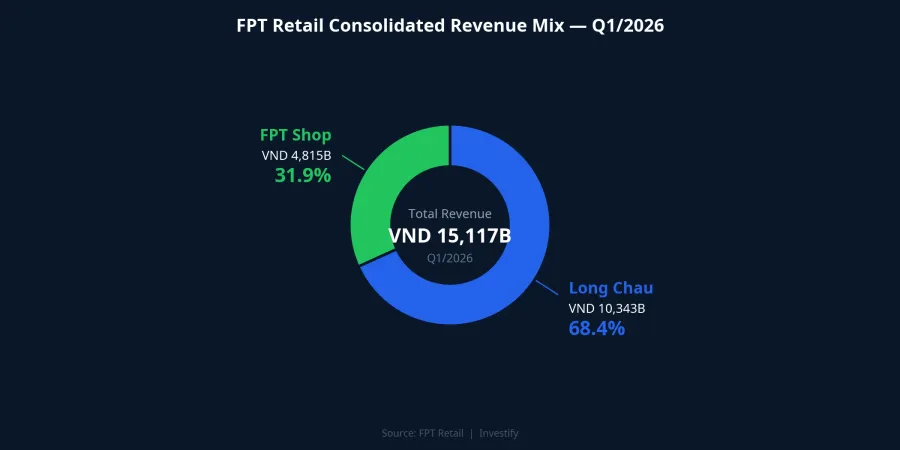
FPT Retail reported pre-tax profit of VND 472 billion in Q1/2026, up 73% year-over-year, completing 30% of its full-year plan in just three months.Thời báo Tài chính The profit number is striking. But the more important story in this earnings report is not the bottom line — it is how VND 15,117 billion in total revenue is being divided between two very different business segments. Look at that split and a structural shift becomes clear: FPT Retail is no longer a phone retailer.
Long Chau Now Carries 68% of Revenue
Of the VND 15,117 billion in consolidated Q1 revenue, the Long Chau pharmacy chain contributed VND 10,343 billion, equivalent to 68.4%.VietnamBiz FPT Shop accounted for just VND 4,815 billion, or 31.9%.Thời báo Tài chính Put simply: for every VND 10,000 FPT Retail earns today, VND 6,840 comes from selling medicine and healthcare services, and only VND 3,190 from the electronics chain that defined the company for over a decade.
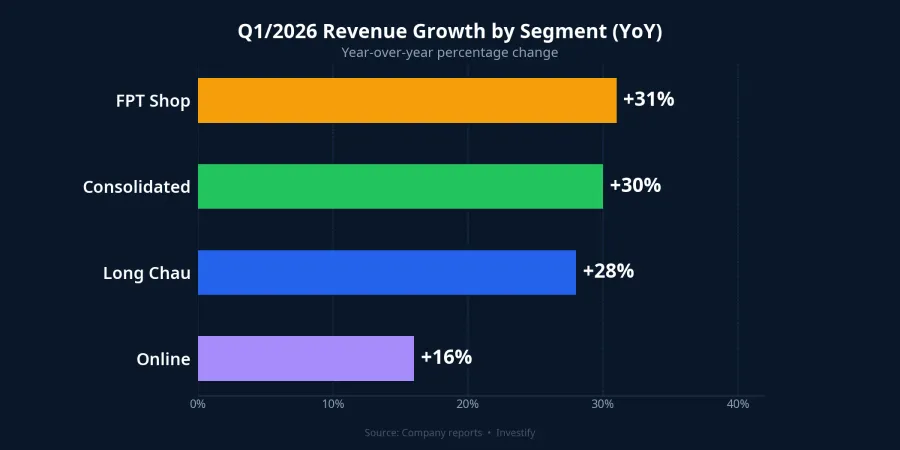
What stands out is that both segments are growing at similar rates: Long Chau up 28%, FPT Shop up 31%, consolidated revenue up 30%. But because the starting gap was already large, the absolute distance between the two segments continues to widen. The online channel also grew 16%, reaching VND 2,485 billion, reflecting the growing habit of ordering medicine and electronics through apps.
Long Chau's Expansion Pace
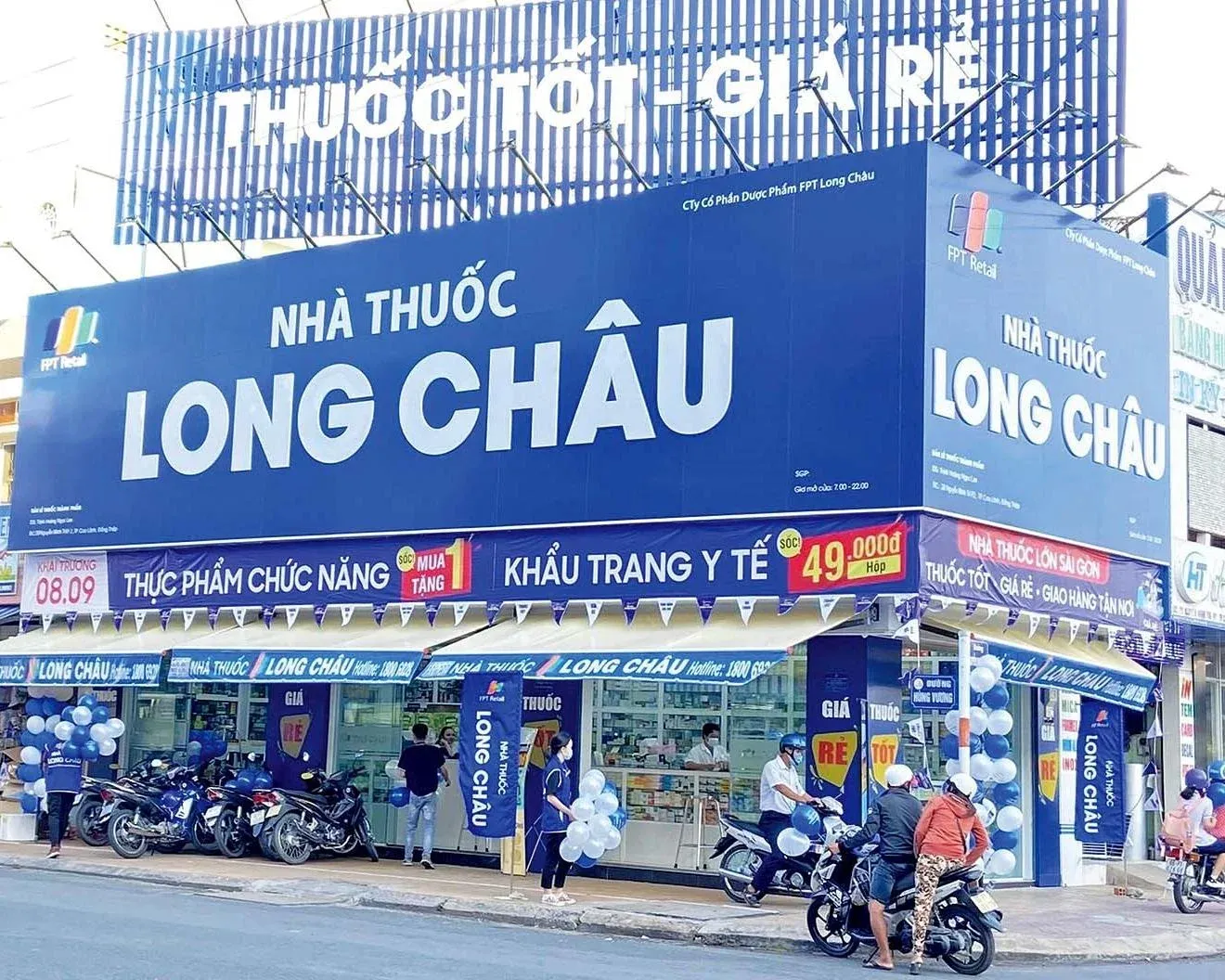
By the end of March 2026, Long Chau operated 2,517 pharmacies and 228 vaccination centers across Vietnam.Vietnam Business Insider In Q1 alone, the chain opened 100 new pharmacies and 5 vaccination centers.Nhà Đầu Tư Average revenue per pharmacy reached approximately VND 1.3 billion per month, edging up slightly from 2025 despite the network pushing into provinces outside major cities. This is a key indicator: when a chain aggressively expands into peripheral markets, average revenue per outlet typically declines. The fact that it held firm suggests pharmaceutical demand in the provinces has not yet hit saturation.
Why Does the Pharmacy Business Keep Growing?
Long Chau draws from three structurally stable demand pools. First, prescription drugs, supported by an aging population and expanding health insurance coverage. Second, functional foods and wellness products, which rise with average income levels. Third, vaccination services, driven by growing preventive health awareness.
This contrasts fundamentally with the electronics segment. Spending on smartphones and tech devices is tied to replacement cycles of two to three years and discretionary purchasing power. Healthcare spending, by contrast, is relatively income-inelastic in the short term: patients do not defer buying medicine because smartphone prices went up. That is why during 2023 and 2024, when discretionary consumption stalled across the economy, Long Chau maintained its expansion pace and remained profitable. Pharmaceuticals do not move counter-cyclically, but they are far less affected.
On the FPT Shop side, average revenue per store reached approximately VND 2.6 billion per month, up more than 30% year-over-year.VnBusiness This recovery is meaningful after several flat quarters, driven by new smartphone and laptop launches reviving the ICT market. Still, the distinction matters: FPT Shop's recovery is a positive tailwind, not the structural foundation. The current revenue composition means FPT Retail would not take a severe hit if electronics plateaus again for a few quarters.

Macro Backdrop Supports the Whole Sector
FPT Retail's story sits within a solid broader consumption picture. Total retail sales and consumer service revenues across Vietnam reached VND 1,902.8 trillion in Q1/2026, up 10.9% year-over-year.VietnamPlus March 2026 recorded the highest monthly growth of the quarter at 12.1% year-over-year.Thời báo Tài chính
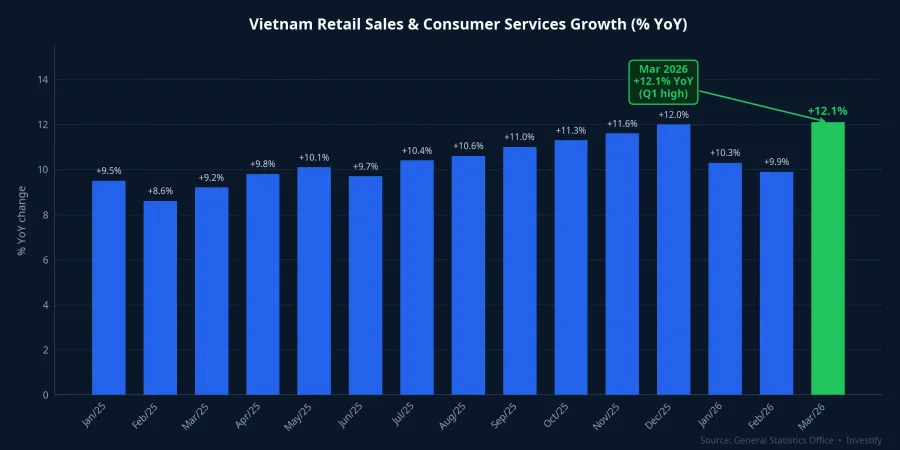
Stripping out roughly 7% price inflation, real growth still sits in the high single digits. This is not the explosive post-COVID rebound, but it is enough to provide a solid demand floor for well-positioned retail chains. An additional data point: combined gross merchandise value across Shopee, TikTok Shop, Lazada and Tiki in Q1 reached VND 148,600 billion, up 46.6% year-over-year.Metric Both electronics and pharmaceuticals benefit directly from this dual expansion of physical and online retail channels.
Session of May 28: Strong Results, Flat Stock
The retail sector led the market on the morning of May 28, gaining 1.48% as a group, but the dispersion within the sector was notable. KDC from Kido Group surged 5.38% to VND 50,900, driven by management registering to buy an additional 1.5 million shares and the board approving a buyback of nearly 14.5 million treasury shares.CafeF This is a transaction-driven catalyst linked to a company-specific event, not a signal about sector fundamentals.
FRT, meanwhile, fell 0.46% to VND 130,400, and MWG slipped 0.63%. The strong quarterly result did not generate buying pressure in the session, and several explanations are plausible. FRT has been trading near its yearly high, and the Q1 outperformance may have already been priced in before the official announcement. Additionally, Q1 always benefits from Tet-related electronics demand, so the market may be waiting to see whether Q2 sustains the momentum without the seasonal tailwind. There is also the structural question: investors may be repricing around the recognition that most of the growth is now coming from Long Chau, a segment with thinner short-term margins than electronics due to network expansion costs.
The broader observation is that the market is differentiating by earnings quality and forward expectations, not by sector-wide flows. A strong result at one company does not guarantee the rest of the sector follows suit.
What to Watch Next
The headline numbers from FPT Retail's Q1/2026 are solid and have depth. Revenue up 30%, pre-tax profit up 73%, both segments growing in double digits. More importantly, the revenue mix is shifting toward healthcare and daily essentials: categories that are less exposed to economic cycles than discretionary tech spending. That is a more durable foundation than a pure-play electronics retailer.
The key variable to monitor in coming quarters is average revenue per Long Chau pharmacy. At approximately VND 1.3 billion per month in Q1, this figure held even as the network expanded into peripheral markets. That is the reference point. If it holds or rises as the chain continues expanding into provincial areas, it signals that domestic pharmaceutical demand still has meaningful room to grow. If it drops below approximately VND 1.2 billion, it would suggest the network is approaching absorption limits in outer regions. Q2 and Q3 results will answer that question.
Vietnam's Q1/2026 retail data adds to the evidence that the domestic consumption structure is shifting toward healthcare and essentials. The companies best positioned in that current are those most likely to deliver durable growth in the quarters ahead.