


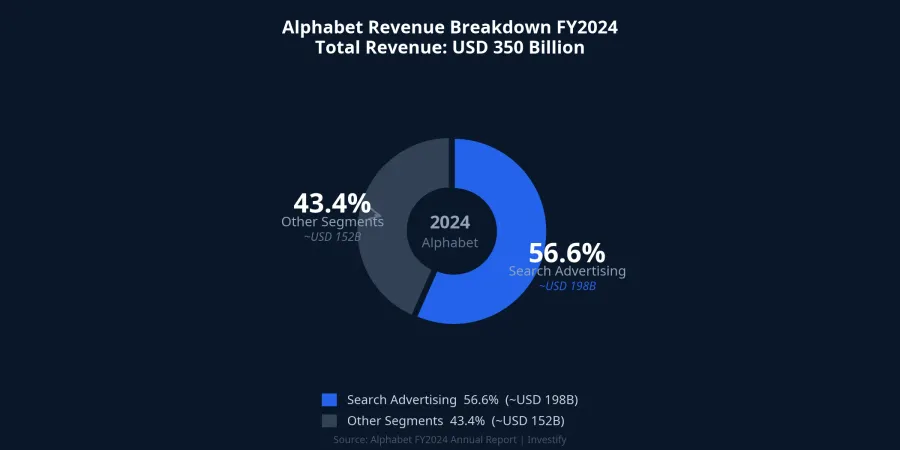
Alphabet closed fiscal year 2024 with total revenue of USD 350 billion, of which the search advertising segment alone contributed roughly USD 198 billion, or 56.6% of the group's entire revenue.CNBC This is the most profitable, most capital-efficient revenue machine the tech industry has ever produced, and it is the primary reason Alphabet's stock commands its current valuation. At Google I/O 2026 this week, Google announced it would replace the very mechanism that created it.
Placed side by side, these two facts sound like a contradiction: a company generating over half its revenue from a single model, voluntarily dismantling that model. Understanding why requires looking at three connected pieces: how the old model works, what just replaced it, and who is pushing Google into a position where it has no other choice.
How the Search Advertising Machine Works
For 25 years, the Google results page ran on one simple logic. A user types a query, Google returns a list of links, and advertisements are placed at the top of that list. Each search triggers a real-time auction in a fraction of a second: advertisers bid on keywords, and whoever scores highest on combined bid and relevance appears at the top. The critical point: advertisers only pay when a user actually clicks.
The click is the load-bearing wall of the entire machine. No click, no revenue. This model is so effective because it requires no inventory, no shipping cost, and scales almost without limit. Alphabet's operating income reached USD 112 billion in 2024, with an operating margin above 32%, driven largely by this structural advantage.CNBC For context, Google Cloud and YouTube combined still do not replicate the profitability that the search segment delivers on its own.
The Intelligent Search Box: What Just Replaced It
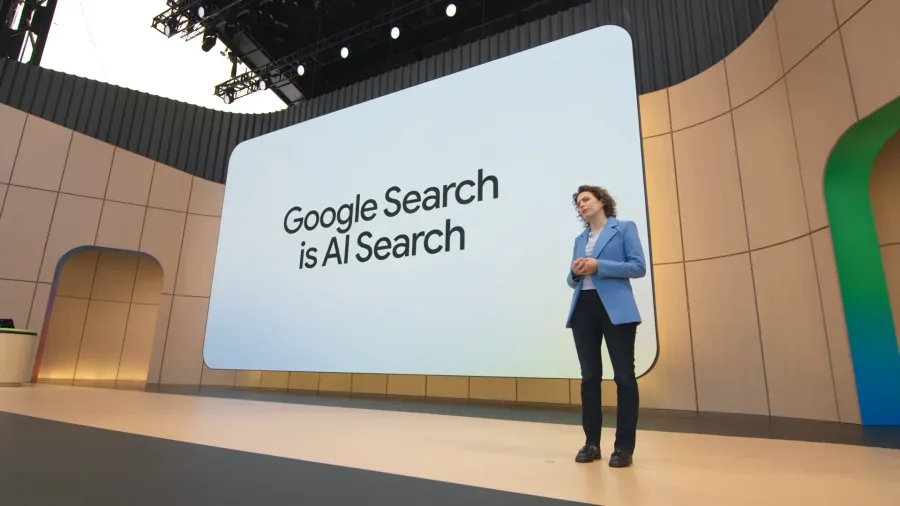
At Google I/O 2026, Google unveiled the "Intelligent Search Box," powered by the Gemini 3.5 Flash model. Liz Reid, Vice President of Google Search at Google, described it as "the biggest upgrade to the iconic search box since its creation more than 25 years ago."Google Blog
The new interface no longer accepts only typed queries. It processes images, files, videos, and even an open browser tab as input, then delivers a direct AI-generated answer rather than a list of links for the user to sift through.TechCrunch AI Mode, the conversational search interface launched a year earlier, has already surpassed 1 billion monthly users, with query volume more than doubling every quarter.Google Blog
The interface change sounds technical, but its impact on the revenue model is concrete and measurable.
Click-Through Rates Are Dropping
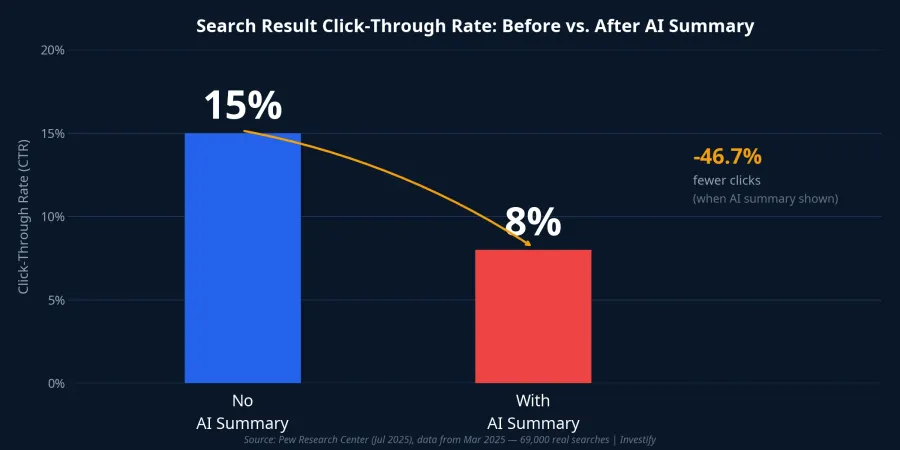
When AI answers a question directly, users have no reason to click on any link. The data confirms this. A study published by the Pew Research Center in July 2025, based on nearly 69,000 real searches conducted in March 2025, found that when Google displays an AI summary, the share of users who click on a traditional result drops from 15% to 8%, nearly half. Only 1% of users click on links embedded within the AI summary itself.Pew Research
The implication for investors is straightforward. If the click-through rate falls by half, each search generates less advertising revenue, even when total user volume stays flat. This is the central trade-off Google now faces, and what makes it particularly significant is that the decline is happening inside the very product Google is actively promoting.
Why Google Cannot Hold the Old Model Steady
If the old model is this profitable, the natural question is why not preserve it. The answer lies in competitive pressure, not strategic ambition.
User behavior is shifting clearly toward tools that answer questions directly. ChatGPT, developed by OpenAI, reached 900 million weekly active users as of February 2026, approaching the 1 billion mark.TechCrunch Google's own Gemini app reached 750 million monthly active users as of the same period, double the figure from a year earlier.TechCrunch Together, these figures indicate that demand for AI-driven conversational search is growing rapidly alongside traditional search.
Google has not actually lost market share in the traditional sense: the company still accounts for approximately 87.5% of global search referral traffic.TechnologyChecker But traditional market share no longer tells the full story. Users are not migrating away from Google to ChatGPT; they are using both simultaneously. As the "ask AI, get an answer" habit becomes more common than "search and browse links," the revenue generated per query begins to compress. This is fundamentally a defensive move: Google is restructuring its own product before competitors draw users away entirely.
Three Bets and an Unanswered Question
Based on announced strategy and disclosed financials, Google is placing three distinct bets to offset the revenue lost from declining clicks.
The first is inserting ads directly into AI-generated answers. The measurement and pricing mechanics here are entirely different from the traditional keyword auction model, and there is not yet enough data to know how effectively ads placed within AI Overviews perform compared with ads placed alongside ten blue links. The second is paid subscriptions for Gemini. A base of 750 million users is a significant asset, but converting free users into paying subscribers is a conversion problem that even Spotify and Netflix spent years optimizing. The third is Google Cloud, which grew approximately 31% in 2024 and is becoming an increasingly important revenue driver for the group.CNBC
All three directions have real foundations. The key observation from the overall picture is that none of them is yet large enough to substitute for the roughly USD 198 billion machine in the near term. This is a business model transition that will require multiple quarters, possibly years, to prove itself.

What to Track in Upcoming Earnings Reports
For investors following Alphabet stock or trying to place the global AI story in context, this is a practical illustration of how competitive advantage works in the AI era: the more profitable a business model, the more it becomes a target for disruption, and dominant market share does not protect revenue when user behavior has already shifted.
The thesis from current evidence is relatively clear: Google will almost certainly retain its user base, since the change is happening inside Google's own product rather than outside it. The open question is how much revenue each search will generate in the AI era compared with the era of ten blue links. Two figures worth tracking in Alphabet's upcoming financial reports are revenue per query and the share of advertisements displayed within AI Overviews. When those two numbers demonstrate that the new model is compensating for lost click revenue, the case for this transition will be complete.