

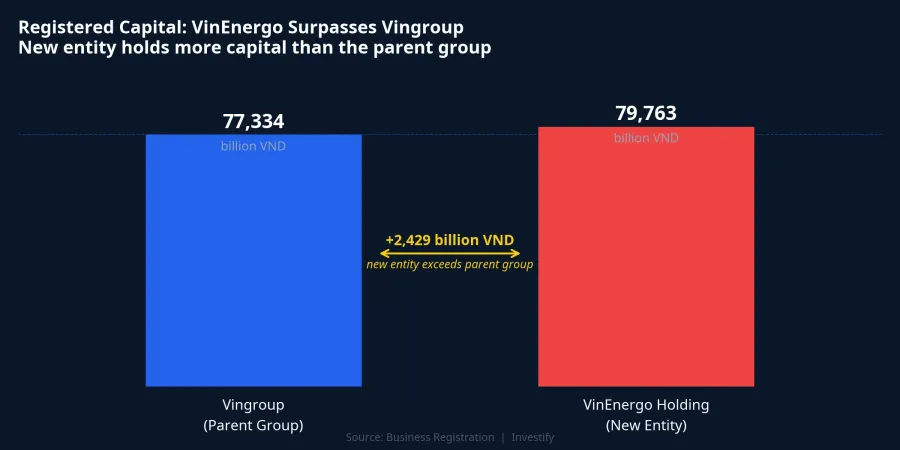
On May 20, 2026, Pham Nhat Vuong, Chairman of Vingroup (VIC), registered a new legal entity named VinEnergo Holding with VND 79,763 billion in registered capital, equivalent to over USD 3 billion.VnExpress That figure surpasses the registered capital of Vingroup itself, currently standing at VND 77,334 billion.Tuoi Tre What makes this notable is not just the scale, but the structural choice: the bulk of this committed capital comes from Vuong's personal account, not through the listed company.
Looking at the numbers, this marks the first time an individual has registered a capital commitment larger than Vietnam's biggest listed conglomerate, the very group that same individual chairs. That detail alone invites closer analysis, but the layers beneath the structure are even more instructive for investors.
Shareholder Structure: Who Contributed What
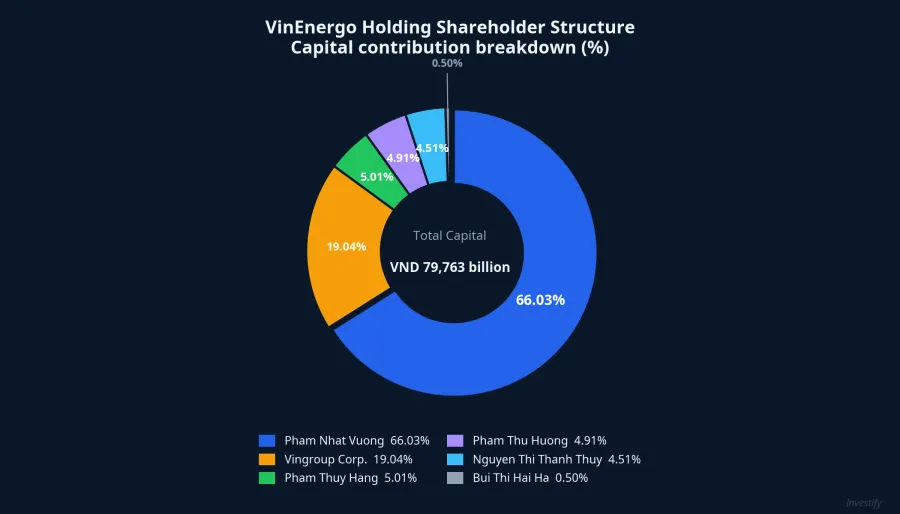
Per disclosures reported by CafeF and VnExpress, Pham Nhat Vuong is the largest individual shareholder, contributing VND 52,669 billion, or 66.03% of the registered capital. Vingroup itself participates at 19.04%, equivalent to approximately VND 15,185 billion. Two family members round out the core group: Pham Thuy Hang, Vice Chairwoman of Vingroup, contributed 5.01%; and Pham Thu Huong, also Vice Chairwoman of Vingroup, contributed 4.91%.CafeF
The two remaining shareholders stand outside the Vingroup ecosystem entirely. Nguyen Thi Thanh Thuy, Chairwoman of One Mount Group, contributed VND 3,596.5 billion, or 4.51%. Bui Thi Hai Ha, a founding shareholder of VinEnergo Holding, contributed VND 399.6 billion, or 0.5%.Nhip Song Nha Dat The appearance of Nguyen Thi Thanh Thuy is the most analytically significant element of the entire shareholder list, and will be examined in a dedicated section below.
Two Entities, One Name
The name VinEnergo immediately evokes the energy sector. Yet VinEnergo Holding's primary registered business line is management consulting, the category typically used by holding companies whose function is to own stakes and coordinate investments rather than directly operate plants or projects.Nhip Song Nha Dat
There is a reason to keep two entities distinct. Alongside the newly registered VinEnergo Holding, there already exists VinEnergo Energy Joint Stock Company (Cong ty CP Nang luong VinEnergo), established in March 2025 and operating in power generation. That company recently raised its capital from over VND 28,300 billion to nearly VND 80,000 billion.VnExpress Its CEO is Nguyen Anh Khoa, who previously led infrastructure investment at VinaCapital.VnExpress
The most coherent reading is that VinEnergo Holding functions as the capital-holding and financial coordination layer at the top, while actual power generation activity sits in the energy company below. The name and Vingroup's push into electric vehicles through VinFast make a renewable energy direction easy to picture. One important caveat: the specific project portfolio of the VinEnergo group has not been fully and officially announced, so any enumeration of projects at this point remains speculation.
Registered Capital vs. Cash Actually Contributed
VND 79,763 billion is registered capital on paper, not cash already sitting in a company account. Under the Law on Enterprises, shareholders have 90 days from the date of the business registration certificate to complete their committed contributions, and those contributions may take the form of cash or assets, including shares.
This is not a footnote. For the earlier VinEnergo Energy entity, Vuong has on multiple occasions contributed Vingroup shares (VIC) into subsidiaries rather than transferring cash. The figure of approximately VND 80,000 billion should therefore be understood as the scale of the capital commitment on paper. Whether the actual contributions will be in cash or VIC shares requires the detailed registration filing before it can be confirmed. Reading "VND 80,000 billion in fresh cash" is a misreading of how Vietnamese business registration works.
A Signal from the Techcombank Ecosystem
Among the six shareholders of VinEnergo Holding, the presence of Nguyen Thi Thanh Thuy, Chairwoman of One Mount Group, is the element that most interests analysts. She is the wife of Ho Hung Anh, Chairman of Techcombank (TCB), and personally holds more than 348 million TCB shares as a major individual shareholder.
The historical link between the two ecosystems adds context: Vingroup was once a founding shareholder holding 51.22% of One Mount Group before divesting in mid-2022.VietTimes Vietnam's two largest private business ecosystems separated at One Mount, and now they are sharing the same capitalization table at a VND 80,000 billion entity. That is a capital-tier signal at the personal level, carrying more weight than an ordinary financial transaction.
It is important to size the conclusion correctly: 4.51% is a minority stake that does not confer control or operational influence. The signal speaks to participation and confidence in the project, not automatically to a binding strategic alliance between the two conglomerates. What One Mount does next will be the more telling data point.
What VIC and VHM Shareholders Need to Know
The core implication for shareholders holding VIC or VHM is that the bulk of this capital structure is being built outside the listed company. When energy assets and opportunities are developed in a personal legal entity rather than inside VIC, public shareholders do not directly own that incremental value.
The structural choice is worth reading from multiple angles. First, offshore wind and gas-power projects require very large equity and long payback periods; keeping them off the listed company's balance sheet reduces financial ratio pressure and removes volatility from VIC's share price. Second, this could simply be a family asset consolidation around a new business line. Third, the structure creates a cleaner entry point for outside partners. The One Mount group's presence hints at exactly that. Available data leans toward the first and third readings, since both the capital scale and the shareholder composition point toward a major infrastructure project seeking external capital.
The issue investors should track closely is transparency of related-party transactions. An unlisted entity does not carry the same disclosure, audit, and governance obligations as VIC. If VinEnergo Holding and Vingroup later conduct joint transactions, VIC shareholders will need to scrutinize the terms of any related-party dealings to assess which direction value flows.
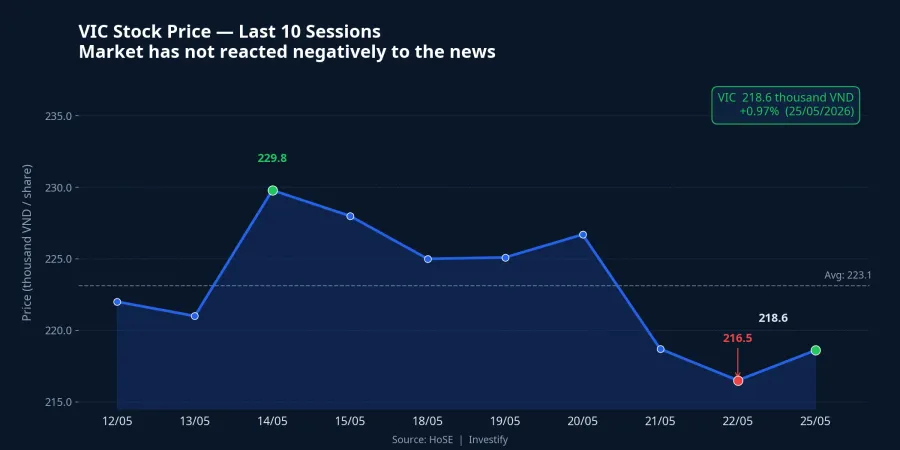
On May 25, VIC closed at VND 218,600, up 0.97%; VHM closed at VND 158,100, up 2.80%. The market has not reacted negatively to the news. The appropriate analytical posture at this stage is to monitor developments, not to act prematurely.
Three Milestones to Watch
Three developments will clarify the real picture of VinEnergo Holding in the weeks ahead.
The first is the detailed business registration filing, which will identify whether contributions are being made in cash or VIC shares, and therefore whether the capital is truly fresh or a restructuring of existing assets.
The second is Vingroup's related-party transaction disclosures, which will reveal at what level and on what terms VIC participates in the energy projects, allowing public shareholders to assess the value allocated to their side of the structure.
The third is One Mount's next move, which will clarify whether the 4.51% stake is a standalone investment or the opening step of a deeper link between the two ecosystems.
For now, this is a story about how one of Vietnam's wealthiest businesspeople is laying the groundwork for an energy ambition outside his listed company, with a notable outside shareholder at the table. The capital structure is becoming clearer; the actual project portfolio remains an open question pending formal announcement.