


On the weekend of May 22-23, Trương Việt Dũng, Deputy Chairman of the Hanoi People's Committee, outlined a new commercial housing policy proposal: buyers in multi-purpose urban development zones would be required to hold their units for at least 3 years from the date of full payment before being allowed to transfer them.Vietstock Anyone wanting to exit before that deadline would have only one option: sell back to the developer at the original contract price, with no markup. The stated goal is to curb speculation and bring prices back to a range more accessible to local income levels.Tiền Phong
This is a notable policy signal. But before examining what it means for portfolios, a prior legal question must be answered: does current law actually allow Hanoi to do this? The answer shapes everything else.
Multi-Purpose Urban Zones: Who Does This Affect?
The multi-purpose urban zone is a development model Hanoi is piloting, combining three layers of housing within a single large-scale project: resettlement housing at 40-50% of area, social housing at 20-25%, and commercial housing for the remainder. Individual zones typically span 600 to 700 hectares with projected populations of 200,000 to 240,000 residents each.
Two projects already in the frame are the Thu Lam - Dong Anh zone (roughly 700 hectares) and the Bac Thang Long - Me Linh zone (approximately 699 hectares). The proposal would cover all commercial products within these zones: apartments, townhouses, villas, and shophouses. On top of the 3-year holding period, Hanoi is also proposing to cap developer profit at 15% of construction costs for the commercial portion.
One crucial point to flag: the proposal currently targets commercial housing only within multi-purpose urban zones. Commercial housing in standard urban developments falls outside its scope.

The Legal Gap Is the Core Issue
This is the crux of the matter. The 2023 Housing Law places a minimum holding period solely on social housing, set at 5 years. For commercial housing, once a buyer fulfills payment obligations and ownership is established under Article 12, the right to transfer is a basic civil right. The 2023 Housing Law contains no provision granting local governments authority to impose additional holding periods on commercial property.
That means Hanoi's proposal cannot take effect automatically. Following the legal pathway, the city would need at least one of two foundations:
The first route: a standalone National Assembly resolution authorizing Hanoi to pilot a transfer restriction mechanism that goes beyond the Housing Law's framework, drawing on the Capital Law and National Assembly Resolution 258/2025/QH15. The Capital Law has already granted Hanoi's People's Council authority to apply special mechanisms to large-scale projects; this is a precedent the city can draw on.
The second route: a new government decree amending regulations on housing transactions, coupled with implementing guidelines from the Ministry of Construction and the Ministry of Natural Resources and Environment so that land registration agencies can record the 3-year restriction on property certificates, mirroring the approach used for social housing.
Industry pushback arrived quickly. The Chairman of the Ho Chi Minh City Real Estate Association (HoREA) argued that commercial housing is private property under lawful ownership: if the law does not prohibit it, it cannot be restricted. That argument rests on foundational property rights principles and will be a significant legal obstacle as the proposal moves through review.

Market Context: The Proposal Did Not Emerge in a Vacuum
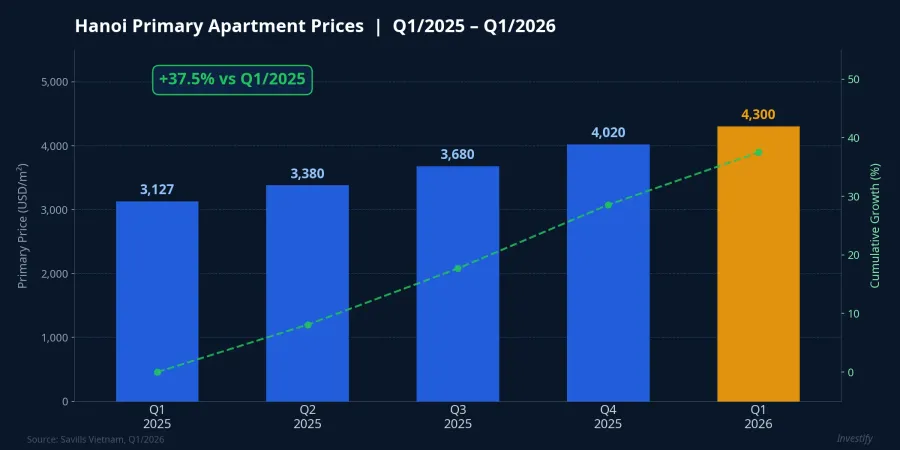
The proposal arrives at a moment of genuine market heat. According to Savills Vietnam's Q1/2026 report, primary market apartment prices in Hanoi reached approximately USD 4,300/m² in Q1/2026, up roughly 37.5% year-on-year.Savills Vietnam That environment is highly favorable for short-cycle trading: early buyers can sell to later buyers at significant markups. That is precisely the flow Hanoi wants to interrupt.
That said, using administrative restrictions on property rights is a tool with considerably higher legal and economic costs than, for instance, property transaction taxes. Many experts have pointed toward a graduated tax structure, either tiered by number of properties owned or imposed at higher rates on sales within the first one to two years of ownership, as a less legally contentious alternative. That path requires more time to build a collection infrastructure, but involves fewer conflicts with property rights.
Three Scenarios and the Triggers to Watch

From this proposal, three distinct scenarios can unfold, each with its own set of activation triggers.
Scenario 1: Pilot approved within Hanoi. Triggered when the National Assembly passes a standalone resolution authorizing the pilot, or the government issues a decree operationalizing it under the Capital Law framework. What changes for investors: liquidity in multi-purpose zone products contracts sharply. Buyers must recalibrate expected returns against a minimum 3-year holding period rather than the 6-to-18-month flip cycles common today. Primary prices in these projects may soften relative to standard commercial developments. Importantly, speculative capital may rotate into standard commercial projects outside the zone boundaries.
Scenario 2: The proposal stalls on legal grounds. Triggered when 6 to 9 months pass without any draft decree or resolution being released for public comment. What changes: the current transaction cycle remains structurally unchanged. However, the fact that the proposal appeared at all is itself a policy risk signal. Investors should add a policy risk premium to expected returns across all Hanoi real estate positions until the direction is clarified.
Scenario 3: Scaled to a nationwide policy. Triggered when the Hanoi pilot is deemed a communication success (prices in the pilot zone fall, owner-occupancy rates rise), and the mechanism is extended through an amendment to the Housing Law or a new National Assembly resolution. Realistic timeline: 18 to 36 months after the pilot takes effect, if Scenario 1 occurs first. The implications are structural: commercial housing across Vietnam loses its character as a short-cycle investment vehicle. Required holding periods lengthen, capital opportunity costs rise, flip-driven flows recede, and owner-occupant demand becomes dominant. This scenario has the largest impact but also the highest legal and political barriers, particularly given the nationwide property rights argument.
Three milestones worth tracking:
Watch for a draft resolution or decree within the next 6 to 9 months. The Ministry of Construction and Hanoi's People's Council are the most likely sources of an early document. If this window closes without any public consultation draft appearing, the probability of Scenario 2 rises significantly.
Monitor positions from HoREA and the Vietnam Real Estate Association. If the property rights debate intensifies and HoREA holds firm opposition, the resolution route will slow, though not necessarily stop, and the timeline extends.
Watch the property certificates at the first pilot project. When Thu Lam - Dong Anh begins selling (projected 2026-2029), whether the property certificate formally records the 3-year transfer restriction or not will be the real enforcement signal, not just a policy statement.
How Should Investors Read This?
The more important question is not "will this proposal succeed?" but "what legal signals appear in the next 6 to 9 months, and how do I adjust my position in each case?"
For those currently holding commercial property in Hanoi outside the multi-purpose zones: the proposal has no direct impact today. But a policy risk premium should be factored into expected returns across all Hanoi real estate positions, even if the regulation does not materialize this time. Asset pricing in a higher policy-risk environment will reflect that.
For those considering buying commercial housing in multi-purpose zones about to launch: read the contract terms carefully, particularly the transfer conditions and the developer buyback mechanism: response deadlines, buyback price, and activation conditions. If contracts already bind buyers to 3-year restrictions before any national-level legal framework is in place, this creates material legal risk for both buyers and developers.
For those approaching real estate as a long-term store of value with holding periods exceeding 5 years: none of the three scenarios conflict with that strategy. The one practical check is to review whether any portion of the portfolio currently assumes short-term liquidity that may not be available.
The larger picture is of a housing policy environment shifting toward more active administrative intervention after years dominated by credit and zoning tools. The Hanoi proposal, whether it succeeds or not, is an early signal of that shift. Investors who read policy signals early and adjust in advance are better positioned than those who wait for the decree to be signed.