

On the evening of May 20 in the US, two major AI headlines landed within hours of each other. Nvidia reported Q1 Fiscal Year 2027 revenue of $81.6 billion, up 85% year-over-year and well ahead of the $78.8 billion consensus estimate.Nvidia Newsroom That same evening, Meta began notifying approximately 8,000 employees of their termination, and Intuit confirmed it was cutting 17% of its workforce, more than 3,000 positions.Al Jazeera Three companies, one theme: AI. But what AI means for each of them is entirely different.
The numbers tell a structural story. During peak infrastructure investment cycles, profit concentrates where infrastructure is sold, not where it is consumed. This is not a single-quarter anomaly. It is a mechanism operating across consecutive cycles.
Data Center: The Only Engine That Matters
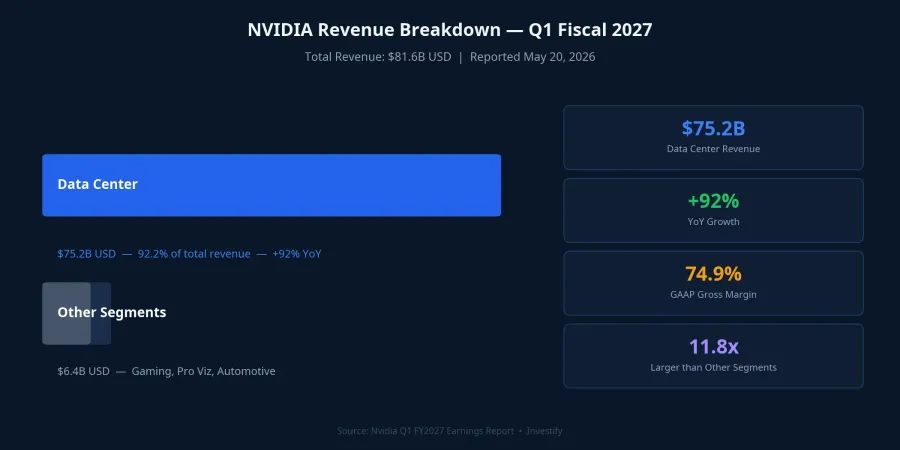
The $81.6 billion headline is just the top line. What matters more is inside: the Data Center segment contributed $75.2 billion, up 92% year-over-year, representing 92.2% of Nvidia's total revenue.Nvidia Newsroom All remaining segments combined — gaming, professional visualization, and automotive — added up to $6.4 billion. Structurally, Nvidia has become a data center company, with everything else as an appendage.
The Blackwell architecture is the primary driver. According to pre-earnings analysis, Blackwell contributed approximately 70% of Data Center compute revenue in the quarter, pulling along demand for InfiniBand and Spectrum-X networking.HeyGoTrade The speed of the transition from prior-generation chips to Blackwell outpaced most expectations, producing a significant revenue step-up in the very first quarter of the new fiscal year.
Revenue from governments and state institutions building national AI infrastructure, which Nvidia calls "sovereign AI," exceeded $30 billion in fiscal year 2026, more than tripling versus the prior year.HeyGoTrade This revenue stream is diversifying Nvidia's customer base well beyond US hyperscalers.
Gross Margins That Run Like Software
The structural story is not just about scale: it is about the profit architecture. Nvidia posted a GAAP gross margin of 74.9%. To put that in perspective: for every $100 of revenue, Nvidia retains nearly $75 after subtracting cost of goods sold.Nvidia Newsroom Most hardware technology companies run gross margins of 30 to 40%. Nvidia is operating with the margin profile of a top-tier software company, while physically shipping chips.
GAAP net income reached $58.3 billion, more than three times the year-ago figure. Q2 guidance points to $91 billion in revenue, plus or minus 2%, with GAAP gross margins maintained at 74.9%.Nvidia Newsroom If delivered, Nvidia's first half of fiscal 2027 would exceed $170 billion in revenue across just six months.
The $80 Billion Buyback: A Signal from Management
The board authorized a new $80 billion share repurchase program, the largest single authorization in Nvidia's history.Nvidia Newsroom Context matters here: the 2024 program was $50 billion, 2025 added another $60 billion, and now 2026 comes in at $80 billion. The scale escalates consistently each year.
This decision carries a clear signal about management's internal view. A company only authorizes buybacks at this scale when leadership believes free cash flow will continue to be so abundant that returning capital to shareholders is a more productive use than any available reinvestment opportunity. It is a confidence signal about cash generation capacity, not a signal of insufficient growth options.
The Application Layer: Cut People, Pour Capital into Compute
That same evening, Meta sent emails at 4 AM Singapore time notifying approximately 8,000 employees of their departure, the largest restructuring since 2023.The Bridge Chronicle Affected teams were concentrated in content integrity, cybersecurity, content design, and portions of AR/VR. At the same time, the company cancelled 6,000 open positions and redirected approximately 7,000 employees to new AI teams.
CEO Mark Zuckerberg described AI as "the most consequential technology" and committed more than $100 billion to AI infrastructure in the current fiscal year.Al Jazeera The majority of that budget will ultimately become chip orders sent to Nvidia. This is the mechanism that connects what appear to be two opposite headlines into a single coherent story.
On the same day, Intuit cut 17% of its workforce, shut down offices in Reno and Woodland Hills, and accrued $300 to $340 million in restructuring charges.CNBC The company simultaneously signed multi-year contracts with Anthropic and OpenAI to integrate language models into QuickBooks and TurboTax. INTU fell 11% in after-hours trading. The market's read was clear: the cuts signal pressure on core revenue, not a proactive strategic reset.
Why the Same Wave Produces Two Opposite Results
When Meta commits more than $100 billion and hyperscalers like Microsoft, Google, and Amazon place comparable orders, most of that budget ultimately converts into chip purchase orders for Nvidia. Capital flows from the application layer to the infrastructure layer in a fairly mechanical way.
At the application layer, AI is acting as a labor substitution tool: content integrity teams at Meta and operational support functions at Intuit are roles that large language models can now meaningfully cover. Wage cost savings flow into the income statement, but compute expenditure simultaneously flows up the chain to chip suppliers. Two cash flows move in opposite directions and converge at Nvidia.
One important note: not all of the application layer is losing. Meta still reported record revenue of $56 billion in the same quarter. But during peak infrastructure investment cycles, margin preferentially accumulates where infrastructure is sold. The equity markets are reflecting this dynamic.
Nasdaq +1.54%: What Vietnamese Investors Should Know
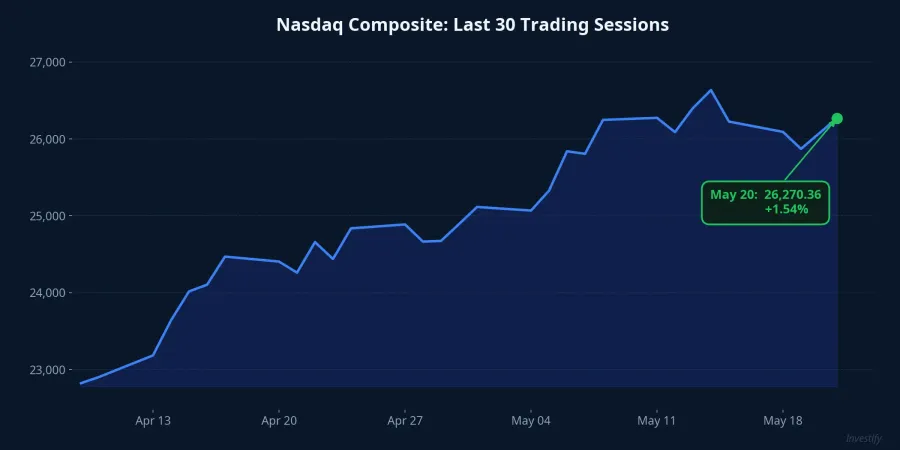
The Nasdaq Composite closed May 20 at 26,270.36, up 1.54% on the session, driven largely by Nvidia's gains on the day of its earnings announcement.
Vietnamese retail investors access this wave through two primary channels, with meaningfully different characteristics.
Domestic equity funds currently hold virtually zero Nvidia exposure. Leading domestic equity funds — VEOF, VESAF, VDEF, VCBF-BCF, DCDS — allocate 93 to 98% to Vietnamese equities. Regulatory constraints and product mandates explain the structure. Exposure to the AI chip investment cycle is indirect, through technology outsourcing orders, not through Nvidia's stock price.
International ETFs and global funds tracking the Nasdaq-100 or S&P 500, accessible via cross-border licensed distribution platforms, work differently. In the Nasdaq-100 index, Nvidia alone carries a double-digit weight. Buying a single Nasdaq-100 fund certificate means holding Nvidia, Microsoft, Apple, Meta, and Amazon simultaneously. This is the most straightforward way to capture both the infrastructure layer (Nvidia) and the application layer (Meta) in a single product.
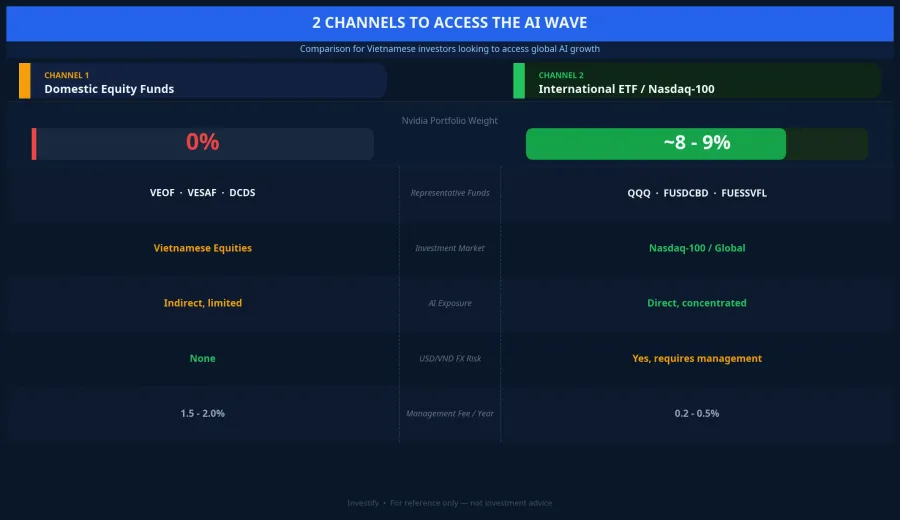
The practical implication: if your portfolio targets "the AI theme" through a broad global index fund, the allocation has already tilted toward the infrastructure layer through the mechanism described above. If you hold only domestic Vietnamese technology equities, actual exposure to the AI chip investment cycle is indirect and diffuse.
What to Watch Next
Nvidia's Q2 results, expected in late August 2026, will be the next meaningful test. If the $91 billion guidance is delivered and gross margins hold at 74 to 75%, the thesis that "the infrastructure layer continues to capture the majority of AI profits" remains intact. If gross margins compress or hyperscaler orders decelerate, that will be the first signal the infrastructure investment cycle is beginning to cool.
At the application layer, the central question is whether savings from AI-driven labor automation translate into new revenue growth, or whether they simply protect margins in an environment of slowing core revenue growth. INTU's 11% after-hours drop offers one early answer to how the market is interpreting the signal. Q2 results from major software companies will clarify whether this is a broad structural trend or an idiosyncratic case.
Key signals to monitor in the coming quarter: Nvidia Q2 gross margin, the pace of next-generation Blackwell deployment, and compute cost line items in results from Meta, Microsoft, and Alphabet.