


On the morning of May 18, 2026, a federal jury in Oakland took less than 90 minutes to unanimously reject the lawsuit brought by Elon Musk, CEO of Tesla, SpaceX, and xAI, against Sam Altman, CEO of OpenAI, Greg Brockman, Chairman and Co-founder of OpenAI, and the organization itself.CBS News U.S. District Judge Yvonne Gonzalez Rogers of the Northern District of California endorsed the verdict shortly after. Dozens of headlines followed with "Musk loses lawsuit," and many readers drew the same conclusion: Altman wins, OpenAI is clear of legal risk, the AI race is back to the old playbook.
The big picture is more complicated than that.
Yesterday's ruling did not adjudicate whether OpenAI was right or wrong on the substance of Musk's claims. It only confirmed that Musk had filed too late. The real power shift in the AI ecosystem happened three weeks prior, when Microsoft and OpenAI signed a revised partnership agreement on April 27 that dismantled the exclusivity provisions that had been in place since 2019.
A Ruling Based on Timing, Not on Substance
Musk had sued for $150 billion in damages and sought to force Altman and Brockman out of their leadership positions. The trial lasted three weeks. In the end, the jury did not answer the question "Did Altman breach his fiduciary duty to the nonprofit?" They only determined that Musk had failed to file within three years of 2021, the limitation period that OpenAI argued before the court.NBC News

Marc Toberoff, lead counsel at Toberoff & Associates representing Musk, announced an appeal immediately after the verdict. On X, Musk called the outcome a "technicality of timing" and insisted the court "has not ruled on the merits at all."CNBC That characterization is partly accurate: when a case is dismissed on statute of limitations grounds, the substantive allegations are not rejected; they simply have no avenue to be heard in this proceeding. The appeal to a federal circuit court is the next chapter.
What many news reports glossed over: yesterday's ruling strengthens the legal stability of OpenAI's current corporate structure, but it does not confirm that the governance narrative behind that structure is beyond reproach. The allegation that OpenAI violated its charitable trust obligations when it transitioned from nonprofit to for-profit remains unresolved in any court of law.
OpenAI Has Been a For-Profit Since October 2025
The story of "OpenAI as a nonprofit" ended before the trial began. In October 2025, OpenAI completed its conversion into OpenAI Group PBC, a Public Benefit Corporation. The post-conversion ownership structure breaks down as follows: the OpenAI Foundation holds approximately 26%, Microsoft holds approximately 27%,Engadget with the remaining 47% belonging to current and former employees and other investors.
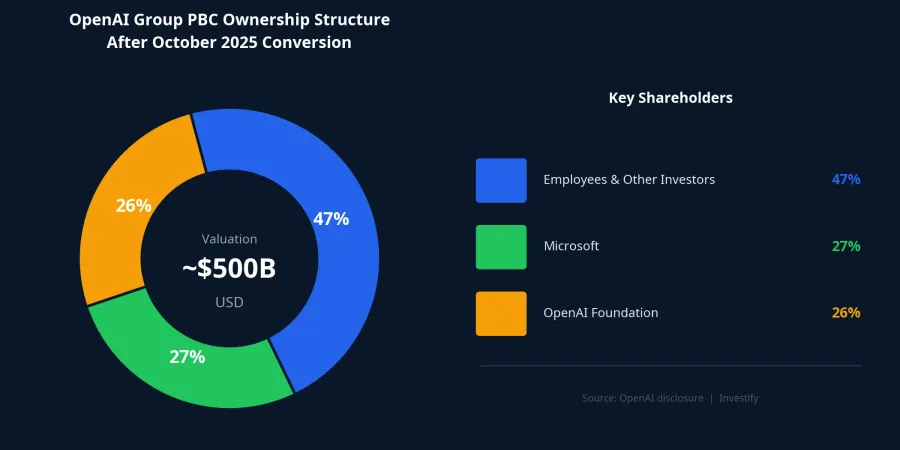
Two valuations are frequently cited side by side, and the distinction matters. The $500 billion figure is the valuation at the October 2025 restructuring round, confirmed by Microsoft and the other parties, with Microsoft's roughly 27% stake equating to approximately $135 billion. The $852 billion figure is the post-money valuation from a $122 billion funding round that closed on March 31, 2026, reflecting market expectations ahead of a planned IPO expected later this year.CNBC The jump from $500 billion to $852 billion in roughly two quarters suggests the market is pricing in an early IPO at a significantly higher entry point than the restructuring round. This remains a market expectation, not a transacted value.
Yesterday's ruling did not create this structure. It only removed a litigation risk that had been hanging over it.
The Real Inflection Point: The April 27 Agreement
On April 27, 2026, Microsoft and OpenAI signed a revised partnership agreement. The update removed the exclusivity clause that had anchored their relationship since 2019, with four core changes.
OpenAI is now permitted to supply models and products to any cloud partner, including Google Cloud, Amazon Web Services, and Oracle, rather than being contractually bound to run exclusively on Azure.TechCrunch OpenAI's intellectual property license converts from exclusive to non-exclusive through 2032. Azure retains a "first-of-market" right for new OpenAI products but with exceptions when Microsoft lacks the technical capacity to support them. On revenue: OpenAI shares 20% of revenue with Microsoft through 2030, subject to a cap, while Microsoft stops sharing revenue back to OpenAI.
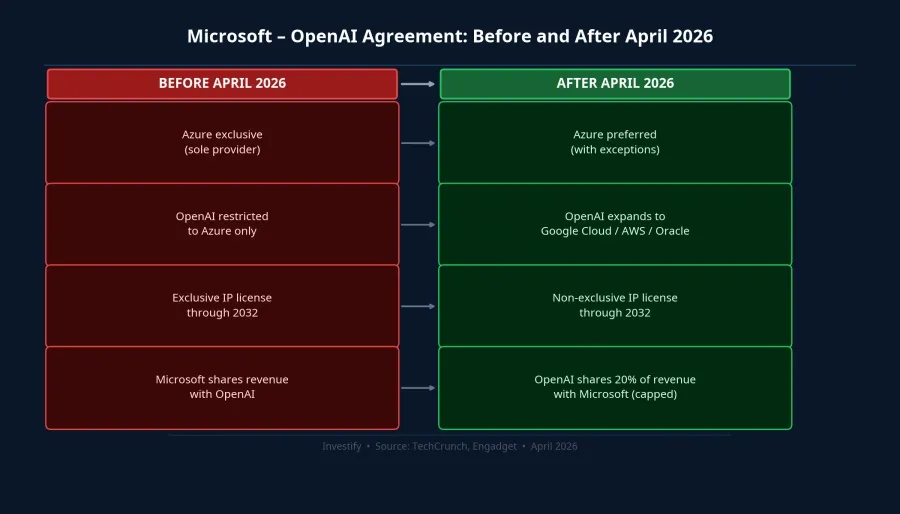
On a pure asset accounting basis, Microsoft wins: the approximately 27% stake in OpenAI Group PBC is a locked gain from October 2025.Engadget On a competitive landscape basis, the picture is more nuanced. Microsoft lost the exclusivity advantage that had been Azure's biggest structural edge in the enterprise AI cloud race. Google Cloud, AWS, and Oracle can now sell OpenAI-integrated services to enterprise customers across platforms. This was not possible 12 months ago.
The result is an AI race that is more distributed, not more concentrated. Anthropic, Google DeepMind, and Meta continue to compete directly with OpenAI at the model layer. And there is now an additional wrinkle: OpenAI itself becomes a supplier to the infrastructure of its former competitors. This is good news for cloud providers outside Microsoft, neutral news for OpenAI in terms of market expansion offset by reduced strategic protection, and bad news for anyone who had bet on AI consolidating exclusively through Azure.
Three Channels for Vietnamese Investors
Yesterday's verdict does not open any new investment channels. OpenAI remains a privately held company, inaccessible for direct investment by individual investors. The two practical channels remain U.S. tech stocks via international brokerage accounts and global technology ETFs distributed in Vietnam.
Looking at specific exposures: Microsoft (MSFT) remains the most directly and quantifiably AI-exposed stock, with approximately 27% equity in OpenAI, intellectual property licensing through 2032, and Azure serving as OpenAI's primary infrastructure platform. The risk to monitor is that AI revenue margins may compress as the exclusivity advantage erodes. Alphabet (GOOGL) and Meta benefit indirectly from the April agreement: Google Cloud can now integrate OpenAI models into enterprise offerings, and Meta gains from the competitive pressure that tends to lower model costs over time. Both maintain independent internal AI roadmaps. For investors who do not want to pick individual stocks, broad technology ETFs offer a natural risk-distributed entry point for long-term portfolios.
The Map Needs Updating
The May 18 ruling closes a legal risk that had been hanging over OpenAI's structure since Musk filed his lawsuit in 2022. That is good news for the structural stability of what exists today. But it is not a new inflection point for the AI competitive landscape. That inflection already happened on April 27, in the direction of greater distribution and less monopolization.
Anyone still reading the story through the formula "Microsoft owns OpenAI exclusively, therefore Microsoft wins everything" is working from a pre-April map. The updated map shows: Microsoft wins significantly on asset accounting with approximately 27% of OpenAI equity, but Azure is no longer the exclusive gateway to that ecosystem. And the governance question — whether OpenAI violated its charitable mission when it converted — will not be answered in Oakland this time around. The timeline to watch: when Toberoff files for a circuit court appeal; what the next round of earnings reports from Microsoft and Alphabet say about revenue impacts from the revised agreement; and any new partnership announcements between OpenAI and Google Cloud, AWS, or Oracle on model deployments.