


On May 18, the VN-Index closed at 1,927.94 points, up 6.34 points (+0.33%), breaking the previous record of 1,925.46 set just four days earlier. The headlines called it a new milestone. But behind that number was a different picture: 140 stocks rose while 180 fell, with more than 820 million shares changing hands.VnEconomy Most retail investors checking their portfolios would have seen red or no change, even as news outlets announced a historic peak.
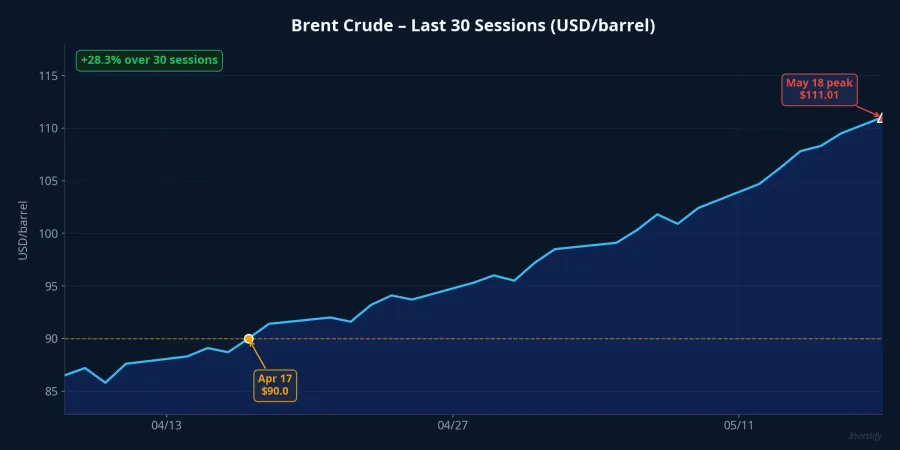
The bigger picture makes clear this was no coincidence. It was the direct result of a single external variable: Brent crude reaching approximately $111 per barrel, driven by escalating US-Iran tensions around the Strait of Hormuz.CafeF
How the Index Gets Pulled Up: Market Cap Weighting and the Anchor Stocks
The VN-Index uses a free-float market capitalization methodology. There is one key implication retail investors should understand: a large-cap stock that surges 5–7% will push the index far more than hundreds of small-caps declining combined. When a small cluster of heavyweight stocks rally in unison, the index can hit a record even as the broad market moves lower. That is precisely the dynamic that played out on May 18.
The sector breakdown makes the divergence concrete. The Oil and Gas sector led all sectors with a gain of +3.12%, while Forestry and Paper fell 3.49%, Fixed Telecom fell 2.46%, Retail fell 2.24%, and Personal Goods fell 1.89%.VnEconomy Capital was not flowing broadly. It was concentrating in oil-linked names while rotating out of consumer, retail, and manufacturing sectors.
Six Stocks, One Common Thread
The top gainers on May 18 clustered around a single theme: PLX (+6.99%), BVH (+6.86%), PVD (+6.23%), BID (+5.47%), BSR (+5.35%), and GAS (+4.03%). Four of the six belong to the oil and gas sector. The remaining two are insurance (BVH) and Vietnam's largest state-owned bank (BID).
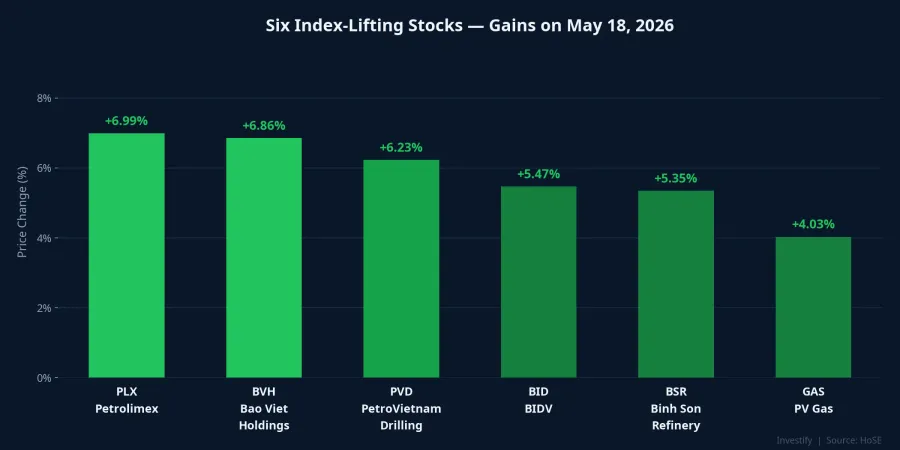
This group carries substantial weight in the VN-Index. BID accounts for approximately 3.58% of the index, GAS approximately 2.52%, and BSR approximately 1.89%. Together the six stocks represent about 9.46% of the index. When all six rally 4–7% in a single session, the resulting point contribution is more than enough to offset declines across 180 other stocks, yet still leave the index at a new high.
More importantly, none of these stocks moved on their own individual corporate story. BSR and PLX have refining and distribution margins that move directly with crude oil. GAS and PVD benefit as demand for exploration, extraction, and gas transport rises alongside oil prices. BVH holds a large bond portfolio: when oil-driven inflation expectations push bond yields higher, the carrying value of that portfolio improves. BID, as the heaviest single name in the index, functions as an institutional capital magnet whenever the market needs a headline uplift. All six are connected by the same variable: global crude oil prices.
Brent at $111: The Thread Running from Tehran to HoSE
Brent crude closed on May 18 at approximately $111 per barrel, up more than 1.60% on the day.Báo Pháp Luật Since April 17, when Brent was trading near $90, the approximately 17% rise in one month reflects concern about long-term supply disruption rather than ordinary short-term volatility.
The geopolitical driver is straightforward. US President Donald Trump issued warnings about potential conflict related to the Strait of Hormuz as nuclear talks between the US and Iran stalled. Tehran responded with hard-line statements. The Strait of Hormuz is the world's most critical oil shipping chokepoint, carrying approximately 20% of globally traded oil. Any signal of supply disruption gets priced in immediately.

With Brent above $110, earnings expectations for BSR, PLX, PVD, and GAS in Q2 keep getting revised upward. That is why capital is flowing heavily into this group. The corollary is equally important: if Brent reverses, the oil-and-gas group reverses with it, and the entire "anchor stocks carry the index" dynamic loses its foundation.
The Domestic Buyer: Who Is Bidding the Market to Records?
A practical question deserves a direct answer: who is actually buying, pushing the index to its third record in two weeks?
Foreign investors have been net sellers of approximately VND 53,000 billion year-to-date through May 18, equivalent to roughly $2.18 billion.BaoMoi Selling pressure has been concentrated in large-caps: FPT, VHM, VIC, VCB, and BID. Nearly all of the offsetting buying has come from domestic retail investors, who are shifting savings into equities as 12-month deposit rates at the major state banks hover around 5–5.5% per year.
The durability of this retail bid matters more than the index level in the short term. Domestic retail capital is now shouldering the market as foreign money continues to exit. Vietnam's potential FTSE upgrade would bring meaningful passive ETF inflows in the future, but that remains a conditional, future scenario. Today's market depends almost entirely on whether the domestic retail bid holds up.
Three Scenarios and the Signals to Watch
Where the VN-Index goes next depends on the interaction of three external variables. Historically, when the market has been in a similar divergent configuration — index at highs, breadth negative — the anchor-stock rally has typically lasted a few more sessions before either consolidating or distributing. Durability depends entirely on how geopolitics and global macro evolve.
Scenario A: Iran tensions escalate further. If President Trump holds a hard line and Iran does not concede on Hormuz access, Brent could stay above $110 or break above $115 if supply is actually disrupted. PLX, BSR, PVD, and GAS would continue to lead, and the index could stay near its highs or set new ones. The secondary effect: higher input costs compound pressure on manufacturing, transport, and retail. Broad market breadth likely stays negative even as the index "sets records."
Scenario B: US-Iran talks make progress. If a bilateral meeting produces traction or Iran accepts a new negotiation framework, Brent could retreat toward $95–100. The oil group loses short-term momentum and profit-taking kicks in. The interesting flip: the index could pull back modestly while consumer and manufacturing-heavy portfolios recover. This is the mirror image of today's session.
Scenario C: Global bond sell-off broadens. If 30-year US Treasury yields push above 5.2% and markets price in Fed rate hikes rather than cuts, the dollar strengthens, pressure on the VND increases, and foreign outflows from emerging markets accelerate. Even with Brent still elevated and oil stocks still supported, the foreign bid evaporates from banks and real estate. Domestic retail capital would need to absorb sharply more pressure than it is handling today.
Reading the Market Through Three Variables
A record close with 180 stocks declining is a divergence signal: the index says one thing, the money flow says another. The question worth tracking in coming sessions is not whether VN-Index holds 1,927. What matters is how three specific variables are moving.
First, Brent crude: does it hold above $110 or correct toward $100? This variable has the most direct link to the index's current anchor group. Second, the 30-year US Treasury yield: does it stay below 5.2% or push through? That threshold is the dividing line between continued risk appetite globally and a rotation out of emerging markets. Third, the pace of foreign selling on the VN30 basket: is it accelerating, stabilizing, or reversing? Monitoring all three simultaneously — rather than checking only the VN-Index closing price — gives a more accurate read of where the market is actually heading.