


On 16 May 2026, REE Corporation announced three simultaneous personnel changes. Ashok Ramachandran, CEO of REE Corporation (REE), submitted his resignation on 15 May, effective 31 May. Nguyen Ngoc Thai Binh, Deputy CEO of REE, was appointed to succeed him. And Nguyen Thi Mai Thanh, Chairwoman of REE's Board of Directors, tendered her resignation from the chairmanship, effective 10 July 2026.CafeF
These are not three separate events. They form a single chain of cause and effect, triggered by one provision of Vietnam's 2020 Enterprise Law. And the power structure that emerges is a model rarely seen at family-founded listed companies in Vietnam: three parties each controlling a distinct tier, with no one holding an outright majority.
How One Legal Clause Triggered a Chain of Changes
Vietnam's 2020 Enterprise Law prohibits the Board Chairman and the CEO of a public company from being immediate family members. The purpose is to separate oversight from operations and reduce conflicts of interest, a governance standard common in more developed markets.
When Nguyen Ngoc Thai Binh was appointed CEO, that clause was automatically triggered: he is Nguyen Thi Mai Thanh's son. One of the two had to vacate their position. REE chose this path: Thai Binh takes operations, Mai Thanh moves to Chair of the Board's Strategy Committee from 10 July, and the Board Chairman role transfers to Lee Liang Whye, a Board Member and representative of Platinum Victory Pte. Ltd.Tinnhanhchungkhoan
During the transition period from 1 June to 10 July, Mai Thanh temporarily serves as REE's legal representative. An extraordinary shareholders' meeting on 10 July will formally lock in the new structure.
Three Tiers of Power from 10 July 2026
The handover creates three distinct layers of influence, an unusual arrangement for a family-founded listed company in Vietnam.
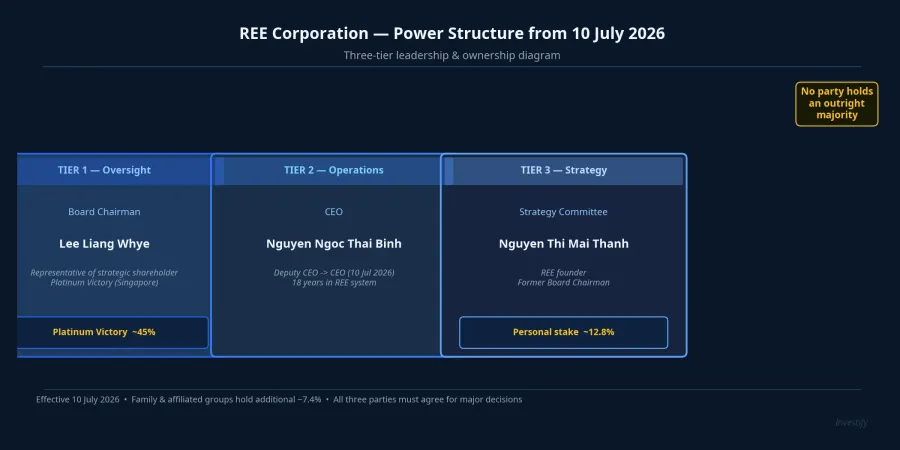
The oversight tier belongs to Lee Liang Whye as Board Chairman, representing Platinum Victory Pte. Ltd., REE's largest shareholder with close to 45% of shares. This is the first time a foreign shareholder has directly held REE's top board position, a role that has always belonged to the founder.Vietstock
The operational tier belongs to Nguyen Ngoc Thai Binh as CEO. He is not an outsider parachuted in: 18 years inside REE's system, rising from functional roles to Deputy CEO before this appointment. This is an internal succession, not a family succession in the narrow sense of placing someone purely on the basis of bloodline.
The strategic tier remains with Nguyen Thi Mai Thanh through the Strategy Committee. She is not leaving REE; she is stepping into a long-term direction role and stepping away from day-to-day management. Mai Thanh still holds approximately 12.8% in personal shares, with another approximately 7.4% held by family members and affiliated parties.
Combined: Platinum Victory at approximately 45%, the founding family group at approximately 20% in total. No party holds an outright majority. All three must agree to pass major decisions, creating a natural system of cross-checks within the governance structure.
Why the Market Barely Moved
Before the announcement, REE's stock had already drifted from around VND 61,900 per share down to VND 60,300 per share over the past three months, falling roughly 9% in the most recent month alone. After the 16 May announcement, shares closed at VND 60,300, essentially flat. Market capitalization held around VND 32,700 billion.
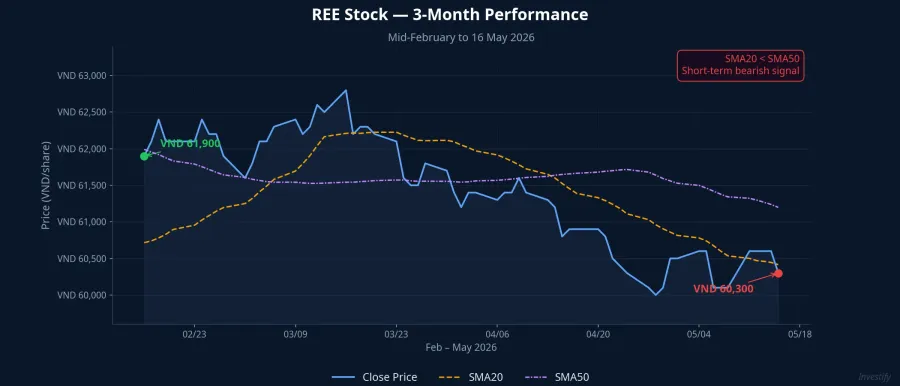
The muted reaction is not surprising. Investors read three signals from the same announcement: the leadership change was driven by legal compliance, not a crisis; the incoming CEO is an insider, not a newcomer; and the new Chairman represents a long-standing major shareholder, not an unexpected third party. When all three factors align, a leadership change becomes a routine governance event, not a risk event.
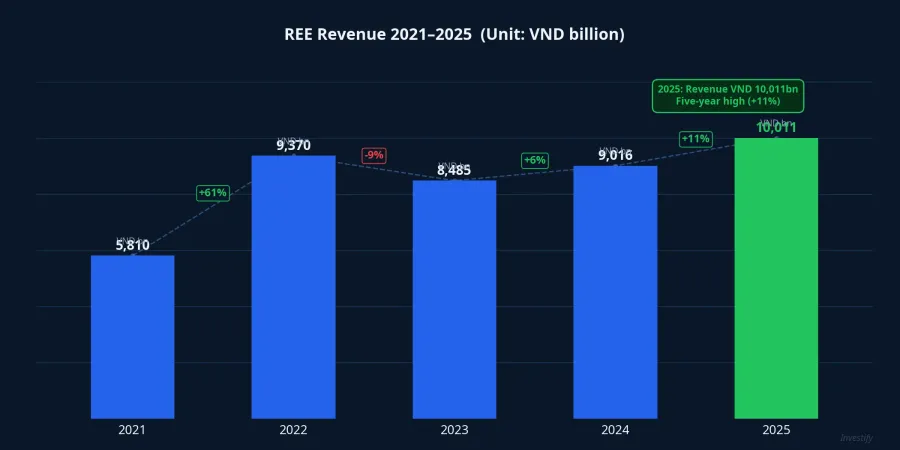
Underlying financial conditions reinforced that calm. REE's revenue recovered from approximately VND 5,810 billion in 2021 to over VND 10,011 billion in 2025, the highest in five years and up 11% from 2024.
REE's two core segments — power generation (hydro, wind, solar) and commercial real estate, anchored by the E.Town office campus in Ho Chi Minh City — continue to operate steadily.

No material shock is working its way into the earnings picture that would shift short-term valuation direction. That is why the headline reads big but the market barely moved.
Placed Alongside NovaGroup's Handover
For context, place this alongside NovaGroup's April 2026 transition: Bui Thanh Nhon transferred the Board Chairman role to his son Bui Cao Nhat Quan at the annual shareholders' meeting, while moving himself to a Strategy and ESG Committee role.CafeF
On the surface, the two events look identical: a founder passes the chairmanship to the family's next generation while retaining a strategic role. But the context runs in opposite directions.
NovaGroup's transition took place amid ongoing debt restructuring, bond swaps, and extended liquidity pressure. Every personnel decision there served a near-term purpose: maintaining the confidence of creditors and shareholders during a difficult recovery. It was a transition forced by financial circumstance.
REE's transition happened against a backdrop of rising revenue and recovering earnings. The decision to appoint Thai Binh was proactive, and Mai Thanh's departure from the chairmanship is a legal consequence of that proactive decision, not the product of a crisis. The two events carry similar headlines but very different risk profiles.
A Framework for Reading Leadership-Change Announcements
Individual investors tend to fall into one of two reflexes when they see a leadership-change headline: sell quickly out of fear of instability, or load up expecting a "new generation" catalyst. Both skip the most important question: under what conditions is this transition happening?
The REE case points to a practical three-question framework, applied in order of priority:
Question 1: Is the transition voluntary or forced? Legal compliance and a planned succession with a clear timeline are positive signals. A debt crisis, liquidity pressure, or governance dispute calls for a different and deeper analysis.
Question 2: Is the incoming CEO an insider or an outsider? Someone who has risen through the organization reduces the risk of cultural discontinuity and operational gaps. An outside hire brings both the potential for transformative change and the risk of a difficult transition period.
Question 3: Does the post-transition ownership structure create any power bottleneck? When no single party holds an outright majority, major decisions take longer but carry less risk of one-sided concentration. When one party gains absolute control after the handover, the dynamic reverses.
For REE, all three answers fall into the lower-risk group in the medium term: voluntary, insider, no outright majority. That does not mean there are no risks worth monitoring.
Signals to Watch Over the Next Two to Three Quarters
The real question is not where REE's stock price heads this week but how well the three new power tiers coordinate in practice. Specifically: can Lee Liang Whye's Board maintain decision-making pace and strategic continuity; can Thai Binh sustain margins in the power segment under variable hydrology and electricity pricing; and can Mai Thanh's Strategy Committee hold its defined role without encroaching on day-to-day operations.
The Q3 2026 earnings report will be the first checkpoint with real data. That is when the numbers will begin to answer whether the handover is working as designed or starting to show friction.