


Starting with the May 13 session, the portfolios of four VN30-tracking ETFs automatically add a new name: BSR. HOSE's decision to place DGC under special supervision — for filing its 2025 audited financial report more than 30 days late — pushed DGC out of the index and opened a spot for BSR, now operating as Vietnam Petroleum Corporation following its name change on May 10.Vietstock
For investors already holding VN30 ETF certificates, the switch happens automatically: the fund buys BSR and sells DGC without requiring any action on the investor's part. The more substantive question is what this means for one's money. This article examines the two distinct demand layers currently driving BSR's price — technical ETF demand and the Brent price cycle — because understanding the difference is what lets you know where you actually stand.
How ETF Mechanics Work: Who Buys What and When
Vietnam currently has four VN30-tracking ETFs: DCVFMVN30, SSIAM VN30, KIM VN30, and MAFM VN30 by Mirae Asset, along with several foreign funds tracking the same index. Passive funds operate under a strict mandate: the portfolio must replicate the index's exact composition. When HOSE adds BSR and removes DGC, each fund must execute the corresponding trades at the correct weights based on market capitalization and free float, regardless of the fund manager's views on the stock or macro environment.
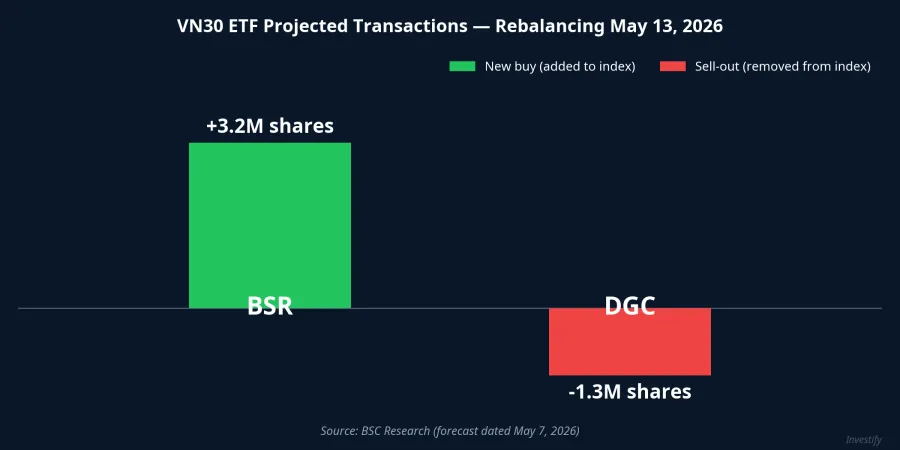
According to BSC Research's forecast published May 7, VN30-tracking ETFs are expected to buy approximately 3.2 million new shares of BSR.StockBiz On the other side, these funds will sell roughly 1.3 million shares of DGC.StockBiz This is purely technical demand: it has nothing to do with sector outlook or stock valuation. Most of the buying pressure typically clusters around the effective date and the few sessions immediately before it, as funds execute orders to hit their target weights. Once complete, this technical demand naturally fades.
BSR Climbs About 14% in the Four Sessions Before the Effective Date
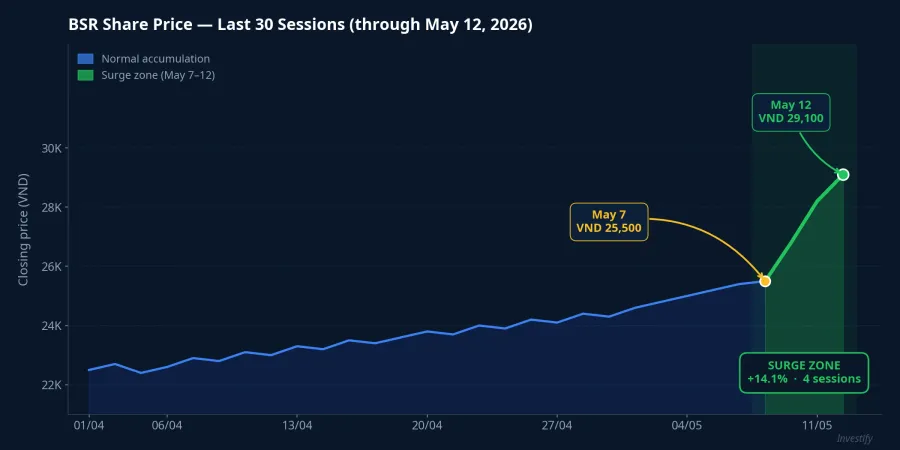
The market priced in the event in advance. From May 7 — when HOSE announced the index adjustment — through the May 12 close, BSR moved from VND 25,500 to VND 29,100, a roughly 14% gain over four sessions. Trading volume on May 11 and May 12 both exceeded 27 million shares, three times the April average. This signals institutional money positioning ahead of ETF demand.
Notably, the technical ETF buying has not been fully priced in yet: a portion of the actual fund purchases falls on May 13 when funds complete execution. However, the bulk of the pre-effective rally reflects institutional positioning anticipating that demand, not the ETF funds themselves buying. After the funds finish rebalancing, the technical demand exhausts itself and price reverts to what fundamentals support. This is why separating the two demand layers matters before drawing any conclusions.
Fundamentals: Brent Is the Deciding Variable
The Dung Quat Refinery in Quang Ngai province is BSR's core asset. In 2025, consolidated revenue exceeded VND 143,500 billion, beating the annual target by 25%, with net profit of VND 5,217 billion. Full-year throughput reached nearly 7.94 million tonnes, averaging 120% of nameplate capacity, with the second half touching 122% at times.Thanh Tra
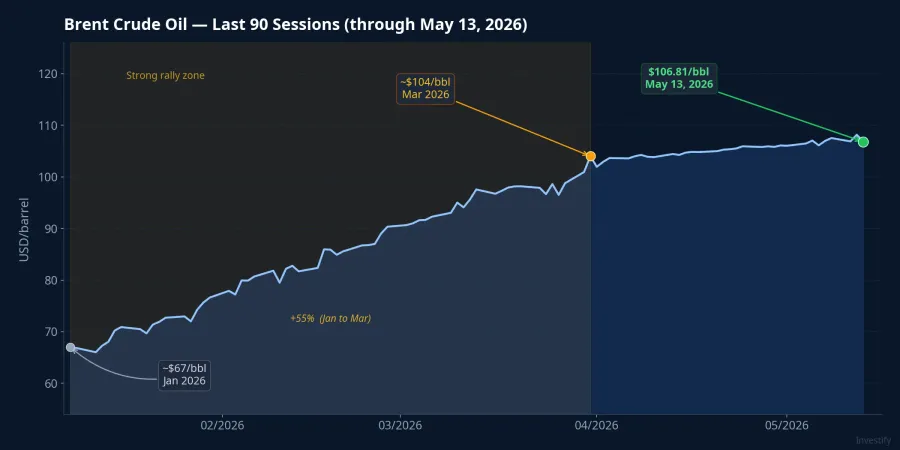
Q1 2026 reveals the real operating leverage of this business model. The numbers: revenue of VND 46,462 billion and net profit of VND 8,265 billion, 20 times the same period a year earlier and the highest quarterly profit in four years.Báo Văn Hóa During the quarter, Brent crude moved from around $67/barrel in January to near $104/barrel by March.Pháp Luật The mechanism: a refinery buys crude oil as input and sells gasoline, diesel, and jet fuel as output. When crude rises rapidly, inventory purchased at lower prices gets sold at new higher prices, widening gross margins. When Brent holds flat at elevated levels, margins remain more stable than they would in the $60–80 range.
Management also built strategic inventory. As of March 31, 2026, total inventory exceeded VND 21,500 billion, with goods in transit alone reaching nearly VND 9,100 billion. This stockpile secures crude supply through approximately July 2026, acting as a buffer against any Middle East disruptions that could crimp supply.

Brent stands at $106.81/barrel on the May 13 session, down a modest 0.89% after three consecutive gains. Last week Brent rebounded roughly 5.5% as hopes for a US-Iran peace deal faded.Tuổi Trẻ Earlier in May, just a single news item about a possible memorandum of understanding pulled Brent down 9% across a handful of sessions. This is a variable BSR cannot control, and it is the direct determinant of Q2 gross margins.
Three Perspectives by Investment Position
Investors already holding VN30 ETF certificates need not take any action. The fund carries out the rebalancing automatically. What is worth checking once rebalancing is complete is BSR's weight in the fund's NAV, information each fund publishes weekly on its website. A newly added constituent typically accounts for around 1–3% of NAV depending on market cap and free float. BSR's price movements from here will affect a small but real portion of portfolio value.
Investors considering buying BSR directly need to distinguish clearly between the two price layers. The technical layer from ETF demand has largely priced into the roughly 14% move over the past five sessions and will fade after the funds complete rebalancing. Chasing the stock at this stage means entering at the short-term peak of technical demand. The fundamental layer tied to the Brent cycle is the longer story: BSR is a cyclical stock with earnings closely coupled to oil prices. An accumulation zone after the technical demand clears, when Brent has an established price floor, is a more meaningful entry point to evaluate. The $100/barrel level is the psychological threshold to watch: whether Brent holds above or falls below it will determine Q2 margin scenarios.
Investors with no existing energy exposure have no reason to treat this event as an urgent signal. This is an index mechanics adjustment, not a fundamental rating on the sector. For those wanting indirect exposure to the market without picking individual names, VN30 ETF certificates through a fund distribution app offer the simplest path: starting from VND 100,000, no separate brokerage account required, and immediate allocation across 30 large-cap stocks.
Signals to Watch in the Coming Two Weeks
Two variables will determine how BSR performs once ETF demand clears. The first is the trajectory of US-Iran talks: a genuine de-escalation signal could pull Brent back toward $90/barrel and materially compress refining margins. Escalating tensions, by contrast, keep oil elevated. The second is the first post-rebalancing NAV report from the VN30 ETFs, which reveals where BSR's weight has settled and whether any residual technical demand remains.
Today's event is also a reminder of a basic index feature: VN30 is not a static portfolio. Index composition changes at each periodic review according to HOSE rules. That is the strength of passive investing: the index automatically removes constituents that no longer qualify and admits those that do. It also means that the fund portfolio you hold today is not identical to the portfolio with the same name three years ago. Understanding this mechanism leads to more grounded expectations for long-term holding, rather than surprise at each rebalancing.
Signals worth tracking over the next two weeks: US-Iran negotiation updates, first post-rebalancing NAV report from the VN30 ETFs, and Brent's level at the end of each week as the market reassesses the Middle East situation.