
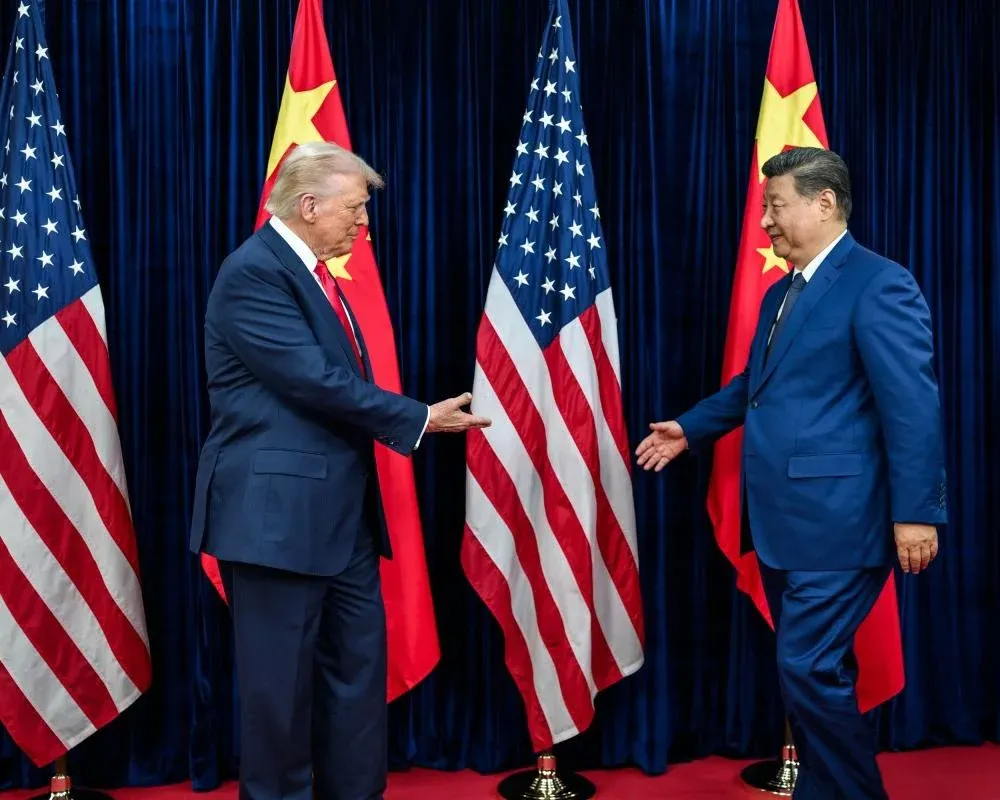

On May 14, 2026, U.S. President Donald Trump arrived in Beijing for a summit with Chinese President Xi Jinping. Accompanying him were 17 top U.S. business leaders, including Elon Musk, CEO of Tesla; Tim Cook, CEO of Apple; Larry Fink, CEO of BlackRock; along with the heads of Goldman Sachs, Boeing, Cisco, Micron, and Qualcomm.CNBC According to the South China Morning Post, the agenda covers trade, artificial intelligence, semiconductor export controls, and Taiwan.SCMP
The natural question for Vietnam investors: if the U.S. and China move closer together, does Vietnam's position as an electronics manufacturing hub come under threat? To answer that properly, you need to rewind eight years — and separate two very different zones.
Eight Years of Hard Capital
In July 2018, the U.S. imposed a 25% tariff on USD 34 billion worth of Chinese goods. That was the opening shot of the "China Plus One" wave: multinationals began diversifying manufacturing away from the Chinese mainland, and Vietnam — with competitive labor costs, proximity to Guangdong, and a stable investment environment — became the first and largest destination.
Samsung is the clearest example. The South Korean conglomerate has invested a cumulative USD 23.2 billion in Vietnam, operating six factories and an R&D center. In 2024, Samsung Vietnam posted revenue of USD 62.5 billion and export turnover of USD 54.4 billion, equivalent to roughly 13% of the country's GDP.The Investor The vast majority of Samsung smartphones assembled globally are made in Bac Ninh and Thai Nguyen.
Apple's supplier ecosystem followed Samsung in. Foxconn, Luxshare, and Goertek opened factories across Bac Ninh, Bac Giang, and Nghe An, producing AirPods, iPhone display modules, and MacBook components. Intel maintains its largest chip assembly and testing plant in the world in Ho Chi Minh City. LG Display built OLED panel production capacity in Hai Phong.
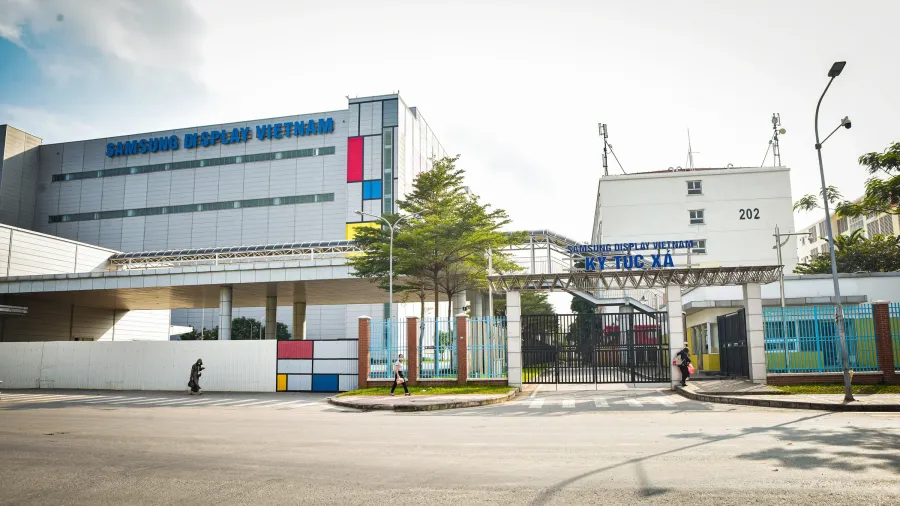
The cumulative result is striking: in 2025, Vietnam's exports of computers, electronics, and components crossed USD 100 billion for the first time, representing roughly 22.6% of the country's total export value.Cong Ly This is not accidental — it is the product of eight years of factory construction, production line installation, and a second- and third-tier supplier ecosystem forming around industrial parks.
The 46% Tariff Test: FDI Held Firm
In April 2025, the U.S. announced a 46% reciprocal tariff on Vietnamese goods. The VN-Index fell more than 18% over four sessions. Foreign investors sold heavily. Sentiment was terrible. But the bigger picture told a different story.
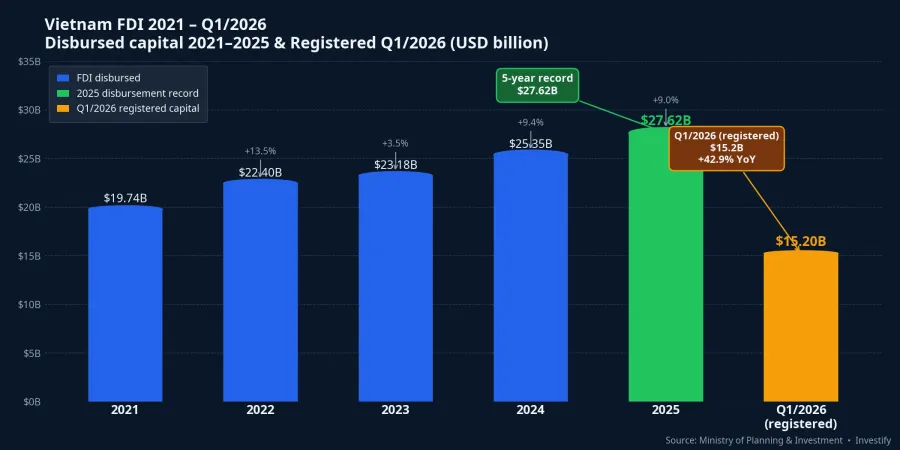
FDI disbursements for the full year 2025 reached USD 27.62 billion, the highest level in five years.VOV In Q1 2026, newly registered FDI inflows reached USD 15.2 billion, up 42.9% year-on-year.VnEconomy Two months after the tariff shock, multinationals were not pulling projects. They were writing new checks.
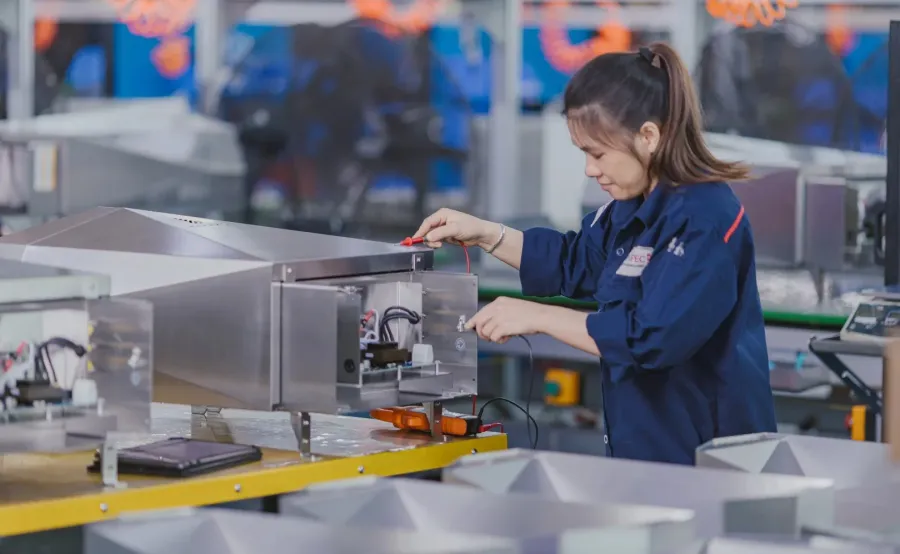
The reason is straightforward: this is hard capital. Factories have been built, production lines have been installed, Vietnamese engineering talent has been trained over years. Nobody dismantles a USD 500 million factory over a negotiation that might last a few months. Critically, smartphones, computers, and electronics components were excluded from the reciprocal tariff list: the largest export channel of the electronics FDI cluster faced no direct impact.
Two Zones to Separate Before the May 14 Summit
Understanding that backdrop is what lets you read the Trump-Xi meeting correctly. There are two fundamentally different zones.
The entrenched zone. Smartphone assembly, AirPods, OLED panels, standard chip packaging, and the entire operating network of electronics components. This is hard capital already deployed: factories running multiple shifts, a supplier ecosystem already embedded around industrial parks in Bac Ninh, Bac Giang, Thai Nguyen, and Hai Phong. A two-day bilateral agreement does not reverse years of accumulated investment. Multinationals will not relocate factories back to China: the cost of relocation far exceeds the geopolitical risk they are managing.
The contested zone. Advanced chip packaging and semiconductor manufacturing: this is the territory China wants to reclaim, and where companies like Micron, Qualcomm, and Intel are actively allocating resources across multiple countries. The presence of the Micron and Qualcomm CEOs in the May 14 delegation signals that semiconductors are a central topic at the table. If Beijing wins relief from semiconductor equipment export controls and greater market access for U.S. AI and chip companies, some expansion projects under consideration could be split toward China rather than into Vietnam.
The big picture shows these two zones react to the Beijing meeting very differently: the entrenched zone is largely immune to any deal struck in a few days, while the advanced semiconductor zone is genuinely sensitive to the specific content of what is agreed.
What It Means for Investors: KBC, GMD, and Three Scenarios
Separating the two zones helps identify which stock groups actually need watching.
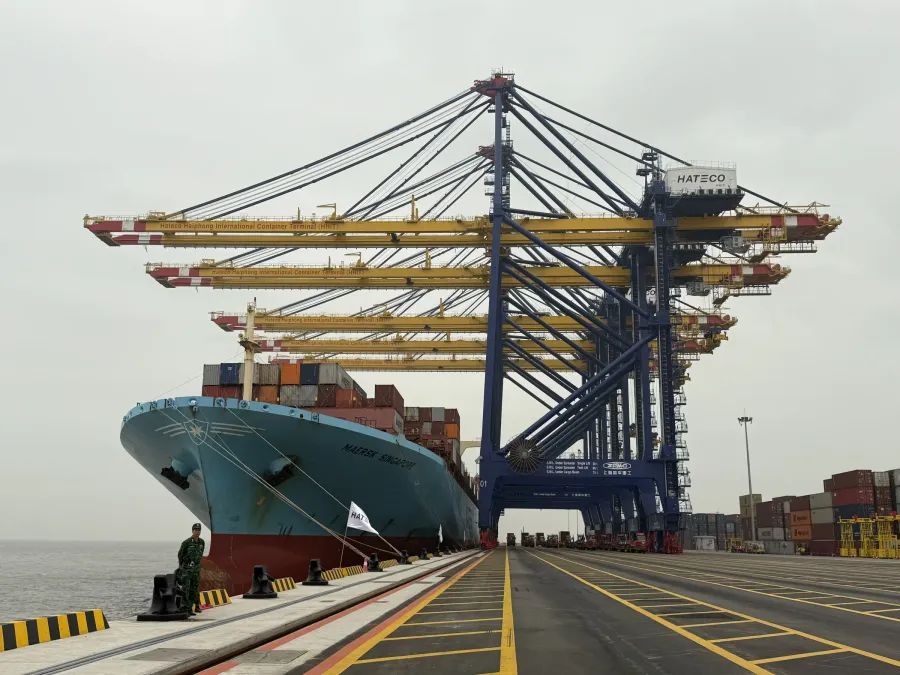
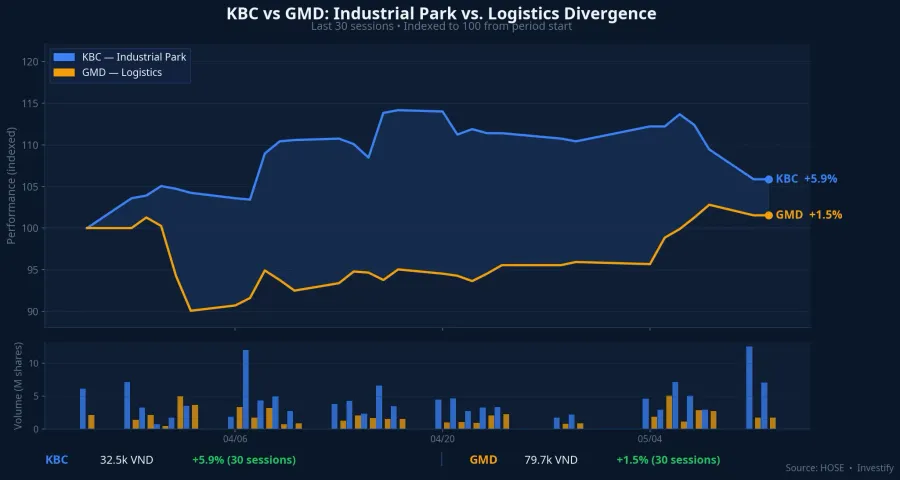
Industrial park developers that attract FDI — KBC, IDC, SIP, BCM, SZC, VGC — are directly tied to decisions to expand into new factory space. Export logistics operators — GMD and TCL — measure actual cargo flows. KBC closed the May 12 session at VND 32,500 per share, down 5.8% from April 20. GMD traded at VND 79,700 per share, up 7.4% from April 20.
This divergence reflects the underlying mechanics accurately: export cargo flows (logistics) remain steady, while new project capital (industrial parks) has slowed as multinationals wait for clearer policy signals before committing to new facilities.
The analytical framework for the May 14–18 window breaks into three scenarios:
Scenario one: The agreement focuses on Boeing orders, agricultural goods, and energy. This is the interest zone of the Boeing and Cargill CEOs. For Vietnam, this outcome is essentially neutral: no impact on the electronics supply chain.
Scenario two: The agreement touches semiconductors, specifically loosening export controls on chip manufacturing equipment and opening China's AI and chip market to U.S. companies. Vietnam's industrial park stocks may face short-term pressure through the expectations channel, as some semiconductor expansion projects could be redirected.
Scenario three: The summit produces no substantive agreement, only a commitment to continue negotiations. This is the highest-probability outcome for a two-day meeting. In this case, the largest risk (renewed escalation) is off the table, and Vietnam's market may recover alongside the S&P 500 and KOSPI.
Eight Years Don't Dissolve in Two Days
Capital flows are shifting but not retreating. Eight years of electronics FDI has created anchors too deep to be dislodged by any deal signed at a single summit. The manufacturing layer — from Bac Ninh to Hai Phong — is simply too embedded.
That said, the advanced semiconductor zone remains genuinely contested, and the specific content of any chip and semiconductor agreement is what matters after May 15. The signal to read: the joint communiqué and the list of deals actually signed. If the list is heavy on Boeing and LNG, Vietnam is unaffected. If it carries commitments on semiconductor equipment controls, that is when a reassessment of industrial park sector weighting becomes warranted.
The decisive factor is not whether the summit happens — it is whether the semiconductor content makes it into a signed agreement. That distinction separates the neutral scenario from the one that requires a portfolio response.