


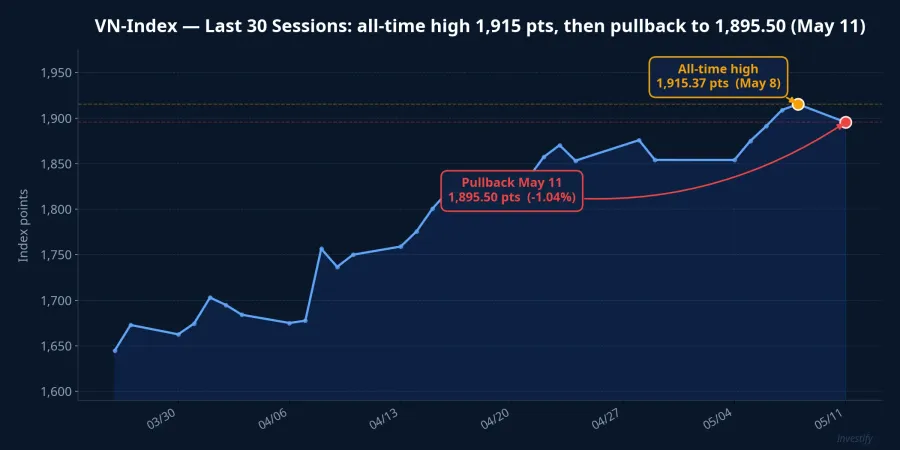
The VN-Index just set an all-time high of 1,915.37 points on May 8 before pulling back 1.04% to 1,895.50 today, May 11.HSX With more than 12.6 million securities accounts open as of Q1/2026, the question "should I take some profits now?" is top of mind for a lot of investors.Nhân Dân
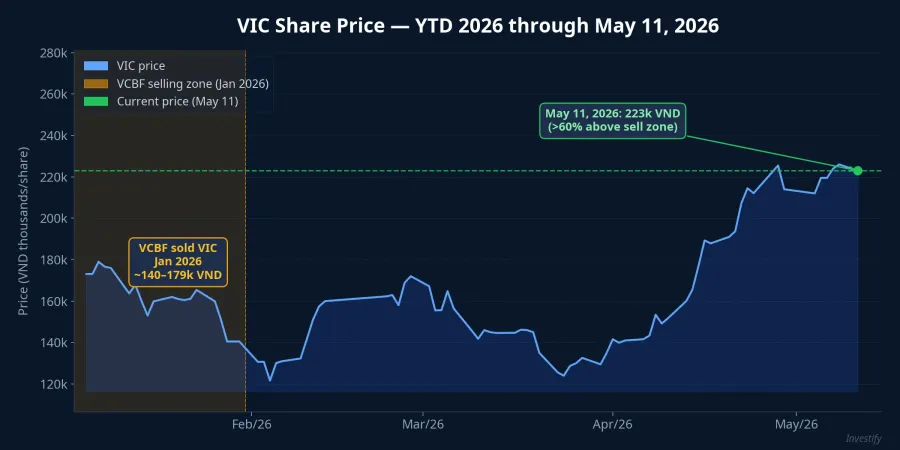
At an investor meeting held today, the leadership of VCBF faced a harder version of that same question. The fund had sold its entire VIC position back in January 2026. Since then, Vingroup's flagship stock has risen more than 60%. Was that a mistake? The answer from Nguyen Trieu Vinh, Deputy Investment Director and Head of Equity Investments at Vietcombank Fund Management (VCBF), was honest and direct: selling by the process is not the same as selling at the peak.VietStock
Where VCBF sold VIC, and where VIC went next
VCBF is one of Vietnam's most established fund managers, backed by Vietcombank and its strategic partner Franklin Templeton. The firm runs five open-ended funds with total assets under management of approximately VND 4,443 billion, spanning equity, balanced, and fixed-income strategies.VCBF
In January 2026, VCBF closed out its full VIC position within a trading range of VND 121,600 to VND 179,000 per share. By May 11, VIC was trading at approximately VND 223,000. On paper, the timing looks like a missed opportunity of the first order. But Vinh's explanation reframes what "a good decision" even means in professional fund management.
Target price: the map you draw before the journey begins
Think of it this way: before a long road trip, you mark a destination on the map. When you arrive, you stop, not because the weather is nice or the scenery is tempting, but because you have reached the agreed endpoint. That is exactly how a professional fund runs its sell decisions, anchored by a concept called the target price.
Before allocating to any stock, VCBF's analysts build a three-to-five-year cash flow model for the business, discount it back to a fair-value range, and set a target. Shares are bought when the market price sits far enough below that target to create a margin of safety. When the price approaches or crosses into the target zone, the fund reduces its position according to a predetermined rule, regardless of short-term headlines.
With VIC, the crux was the growth expectations baked into the VinFast electric-vehicle story. As VIC's price climbed toward a level that already reflected most of the upside from that narrative, the margin of safety shrank. The sell process activated. Not because anyone on the team "felt" the stock was expensive, but because the framework said so. The proceeds were redeployed into higher-yielding, more attractively valued names including ACB, BWE, DPR, PHR, GAS, TCB, and VPB.
The question most retail investors ask is: "Did the stock go up after I sold?" The question a professional fund asks is: "When I bought, what price range did I expect in three years: has that range been reached?" Both questions can be answered from the same trade; they almost always give different verdicts.
Same framework, opposite conclusion on FPT
The identical methodology led VCBF to a completely opposite conclusion on FPT. The stock remains a significant position across all four of VCBF's equity and balanced funds, sitting in the top holdings alongside MBB, HPG, STB, and MWG.VCBF
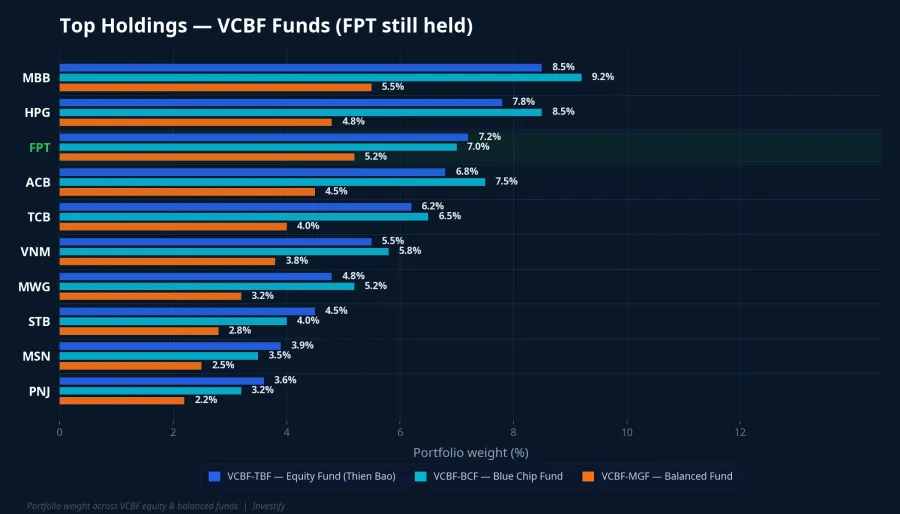
Vinh gave three reasons for keeping FPT. First, the forward P/E on FPT stands at roughly 12x, which the team considers attractive relative to the company's earnings quality and growth trajectory. Second, a clean balance sheet with strong cash reserves gives FPT the staying power to navigate downturns in global tech demand. Third, VCBF's investment philosophy is to hold for three to five years after thorough analysis, and FPT is one of the fund's long-standing core names.
The nuance worth noting: FPT is not in an uptrend right now. The stock has corrected from its early-year peak of approximately VND 106,100 to VND 70,000 by May 11, a drawdown of around 34% from the top. Several other funds have been trimming exposure. VCBF is holding because its valuation framework has not generated a sell signal yet.VietStock
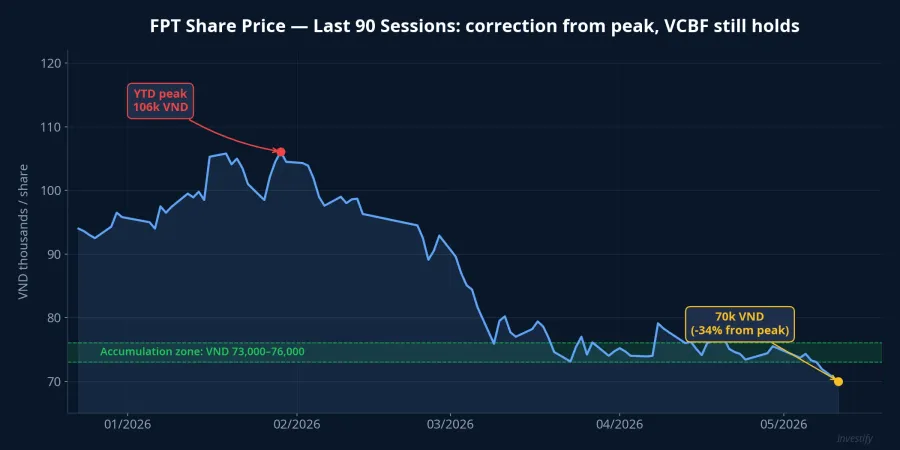
This is the flip side of the VIC decision: two opposite positions, both flowing from the same consistent framework. Sell VIC when the price has fully priced in expectations. Hold FPT when the price corrects but the long-term valuation still has room. Neither decision depends on whether the board is green or red that afternoon.
Four things retail investors can take away right now
The VN-Index is sitting just below its all-time high. For the millions of investors who opened accounts in the past two years, "should I sell now?" is almost a reflex question when portfolios look healthy.
VCBF does not have better market-timing abilities than retail investors. What they have is a process written before emotion enters the room. The VIC and FPT story points to four practical habits that any investor can adopt without a research team.
Write your sell conditions before you buy, not after. Before entering any position, note the price level or set of conditions under which you will reduce your weight. When those conditions arrive, act on the written plan rather than the mood of the session. This preparation step matters more than stock selection.
Separate an attractive story from an attractive valuation. Stories drive short-term price action; valuation drives long-term returns. The two run on different clocks. VIC in January 2026 had a compelling VinFast story, but the story may already have been priced in. FPT in May 2026 has no hot short-term narrative, but the long-term valuation still has room, in VCBF's assessment.
Accept that some stocks will keep rising after you sell. That is not evidence of a broken process. Measure performance across the whole portfolio over several years, not case by case. If you evaluate every sell decision by whether the price went higher afterward, you will never be able to exit at a rational level.
Do not concentrate too heavily in one stock. VCBF's funds spread across dozens of names; no single fund puts 30% of assets into one position. The larger the concentration, the more expensive each mistake becomes. This is the simplest practice, and it is the one most retail investors ignore when markets are rising.
The right question to ask near the top
When the VN-Index is less than 1% below its all-time high and everything in your portfolio is in the green, the question worth asking is not "should I sell today?" It is "where are the sell conditions I wrote when I bought?"
If you have never written them down, now is the best moment: while the market is calm and your thinking is clear, before the volatile sessions begin and emotion becomes the only input. VCBF's experience with VIC shows that selling by the process, even when the short-term outcome looks like a miss, is the foundation of a portfolio built to last.