

A 6% Milestone and a VND 192 Billion Transaction
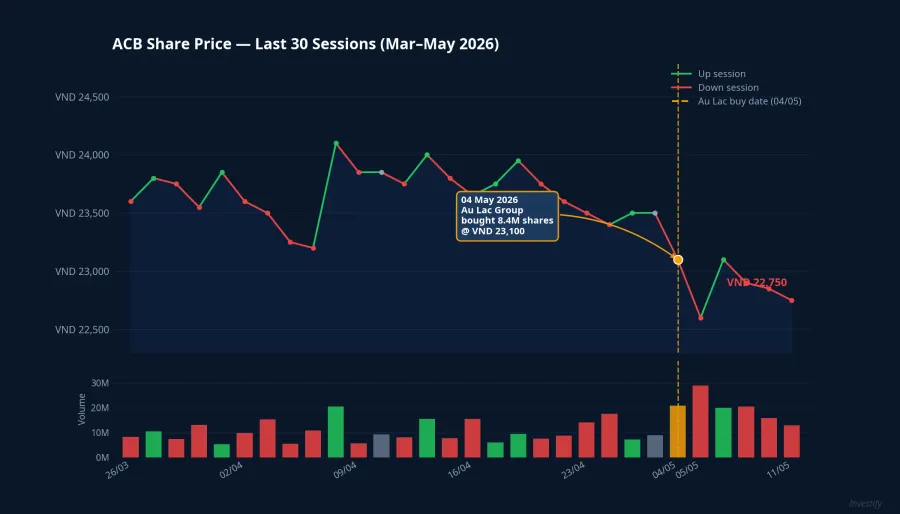
On May 4, 2026, Ms. Nguyen Thien Huong Jenny — an individual shareholder of Asia Commercial Bank (ACB) and the daughter of Ms. Ngo Thu Thuy, Chairwoman of Au Lac Joint Stock Company — purchased an additional 8.4 million ACB shares on the open market.Dantri Her personal stake increased from approximately 109.8 million shares to over 118.2 million, representing 2.3% of charter capital. At ACB's closing price of VND 23,100 on that day, the transaction was worth approximately VND 192 billion.
The more significant figure, however, is what happened at the group level: following this purchase, the Au Lac shareholder group's total holding in ACB reached approximately 308.3 million shares, equivalent to 6% of charter capital.CafeF Against ACB's market capitalization of roughly VND 117 trillion, this is a substantial position. What stands out even more is the pace: from below the 5% major-shareholder threshold in early April, the group crossed 5% and pushed to 6% in under two months.
Who Is Au Lac? Two Decades at ACB, Mostly Under the Radar
The Au Lac name is not new to Vietnam's financial community, but it rarely makes headlines. Ms. Ngo Thu Thuy — Chairwoman of Au Lac Joint Stock Company, a maritime transport firm — has been a shareholder of ACB for over 20 years.BaoMoi For most of that time, the group kept a low profile: no seats on the bank's board, no transactions large enough to trigger mandatory disclosure.
The Au Lac shareholder group consists of one family and two related legal entities. Ms. Ngo Thu Thuy holds 1.122% of ACB; Mr. Nguyen Duc Hinh (her husband) holds 0.95%; Mr. Nguyen Duc Hieu Johnny (her son) holds 1.142%; and Ms. Nguyen Thien Huong Jenny (her daughter) holds 2.3% following the May 4 transaction. Two legal entities (Thien Huong International Education Village JSC and ICON JSC), along with Ms. Mai Phi Lan, account for the remainder, bringing the group's combined total to 6%.
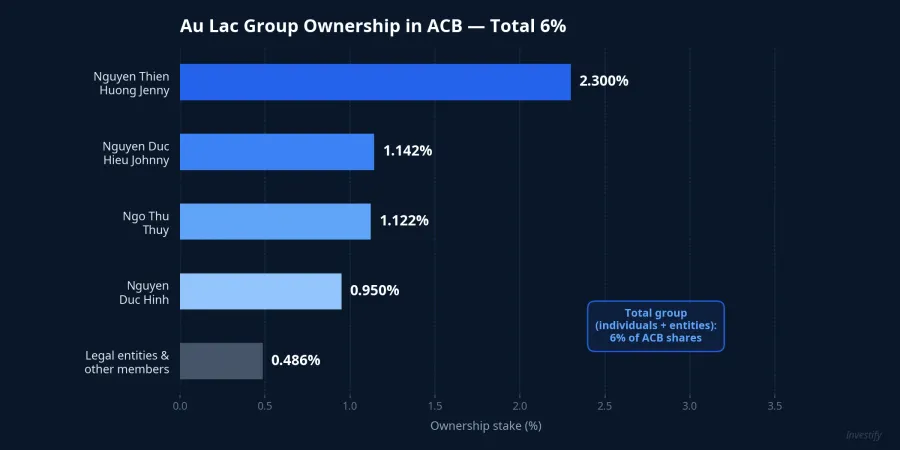
In April 2026, the group crossed the 5% threshold and for the first time became a formal major shareholder of ACB under mandatory disclosure rules.BaoMoi After more than 20 years, the actual scale of their position was now visible to the public. One month later, the chairwoman's daughter bought again, pushing the total to 6%.
ACB's Upcoming 667-Million-Share Issuance
The Au Lac group's accumulation is playing out against a backdrop of significant capital activity at ACB. Under a resolution passed at the Annual General Meeting in February 2026, ACB will distribute a total dividend of 20%: 13% in shares and 7% in cash.CafeF The 13% stock dividend corresponds to approximately 667 million new shares, lifting charter capital from VND 51,366 billion to an estimated VND 58,000 billion. The timeline: cash dividends expected by end of May, bonus shares by mid-June 2026.
The business fundamentals support this plan. In Q1/2026, ACB recorded pre-tax profit of approximately VND 5,368 billion, up 17% year on year.CafeF The full-year 2026 target stands at VND 22,338 billion, a 14% increase over 2025. ACB has also set a credit growth target of 16%, above the industry average at a time when the yield curve is under pressure. This is the business picture that the Au Lac group — after 20 years of watching from within — has clearly chosen to back.
Stock Dividends and Dilution: A Common Misconception
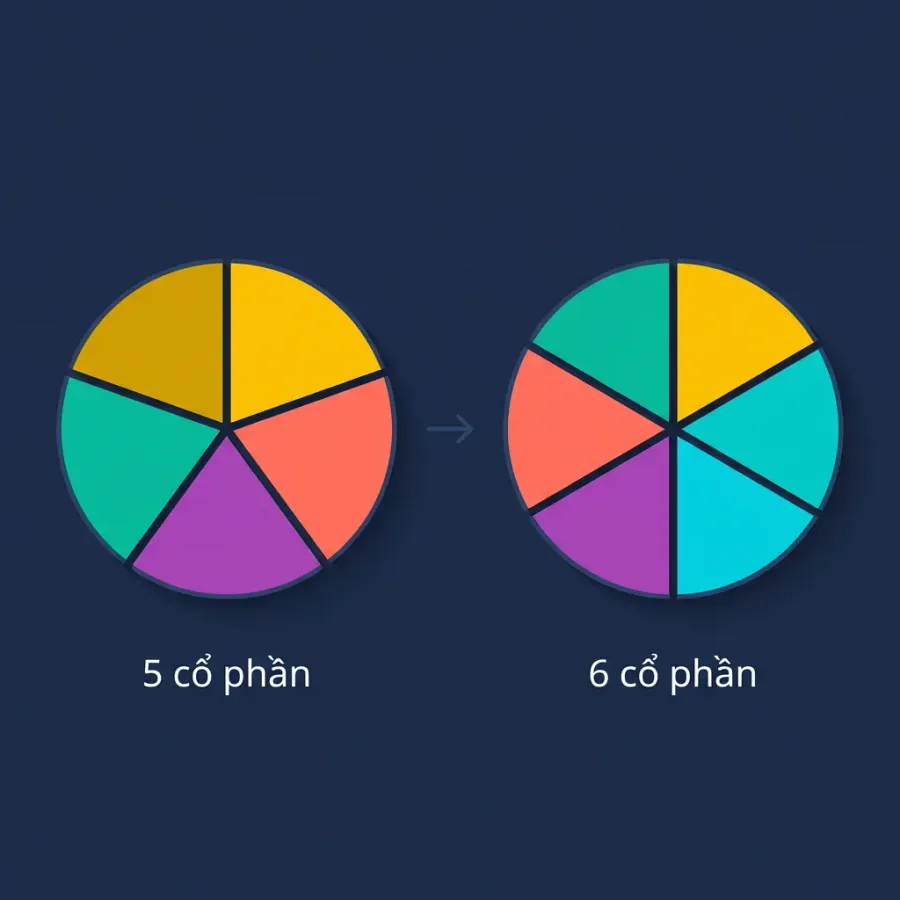
New investors often get this wrong. A stock dividend does not dilute the ownership percentage of existing shareholders. Every shareholder receives an additional 13% in shares on top of what they already hold, in exact proportion to their current stake. After the issuance, the Au Lac group will still own exactly 6% of ACB: their absolute share count will rise from around 308 million to approximately 348 million, but total shares outstanding will grow by the same proportion.
What actually changes ownership percentages is when a company issues shares selectively to outside parties: private placements, preferential ESOP grants, or strategic investor issuances where existing shareholders do not participate proportionally. ACB has not announced any plans of this type for 2026. The Au Lac group's open-market purchases are therefore not a defensive move against dilution. They are actively building a larger stake — a fundamentally different decision from simply holding one's ground.
The Legal Framework: A 15% Ceiling and Regulatory Approval
The Law on Credit Institutions 2024 (No. 32/2024/QH15), effective from July 1, 2024, tightened ownership limits compared to the previous law.LuatVietNam Individuals may not hold more than 5% of a credit institution's charter capital; legal entities may not hold more than 10% (reduced from 15% under the prior law); and a shareholder together with related parties may not exceed 15% in aggregate.
The Au Lac group falls under the third category. Their aggregate ceiling is 15% of ACB's charter capital. At the current 6% level, the remaining headroom on paper is 9 percentage points. In practice, however, any transaction that materially changes a credit institution's ownership structure requires prior approval from the State Bank of Vietnam (SBV), with a processing time of up to 45 days. Room on paper comes with administrative process attached. At the individual level, Ms. Nguyen Thien Huong Jenny sits at 2.3%, Ms. Ngo Thu Thuy at 1.122%, and the other members are all below 1.2%. Each individual remains well below the 5% personal cap, meaning open-market purchases can still proceed without additional regulatory steps.

Reading the Signals Correctly
When a shareholder group that has been invested for two decades moves from quiet accumulation to crossing a public disclosure threshold and keeps buying, the signal is a long-term directional bet on fundamentals, not a short-term trade. They are accepting recurring disclosure obligations and closer SBV scrutiny in exchange for a larger position before ACB's 2026 story (the VND 22,338 billion pre-tax profit target and the path to VND 58,000 billion in charter capital) becomes final numbers on a results page.
Two distinctions matter for individual investors. First, ownership dilution only occurs when a company issues shares to parties outside the existing shareholder base: private placements, discounted ESOP grants, strategic investors. Stock dividends and stock splits do not belong in this category. Second, insider accumulation signals are only meaningful when read alongside the underlying business fundamentals and the history of the relationship. A 20-year shareholder building a position is a qualitatively different signal from a newcomer chasing market talk. The analysis framework has to reflect that difference.
ACB's share price in the near term will depend more on the broad performance of the banking sector and overall market flows. But the shareholder structure is shifting toward greater concentration, and that shift is worth tracking as ACB makes governance decisions in the quarters ahead.
Three Milestones to Watch
Looking forward, three specific developments are worth monitoring. Periodic ownership reports from the Au Lac group in coming quarters: continued accumulation would bring SBV procedural requirements into play sooner than expected. The exact record date for the 667-million-share issuance, which ACB had not publicly announced at the time of writing. And the potential appearance of an Au Lac representative on ACB's board of directors at future annual general meetings, a transition from shareholder to active governance participant. When all three converge, the picture of ACB's ownership will be substantially clearer than it is today.