


On the night of May 5 (U.S. time), President Donald Trump announced a pause of "Project Freedom" — the U.S. escort campaign for tankers transiting the Strait of Hormuz — citing progress in negotiations with Iran. From a single statement, two markets moved in opposite directions: the S&P 500 broke its all-time record at 7,259 points with a gain of approximately 0.8%, while Brent crude fell to $111.46 per barrel, dropping 2.6% in a single session.MarketWatch
On the surface, this looks like a contradiction. It is not. These are two entirely independent pricing mechanisms, both triggered by the same de-escalation signal.

Two Mechanisms, One Signal
The big picture of May 5 night is about the simultaneous unwinding of two different risk premiums.
For global equities, the Hormuz news reduced the war risk premium embedded in valuations. When the probability of wider conflict drops, investors require less compensation for worst-case scenarios. Acceptable valuations rise, capital flows into stocks. The S&P 500 set an all-time record at 7,259, and the VIX retreated to 17.38, down 28.1% for May to date. A VIX in this range signals clearly risk-on sentiment prevailing in U.S. markets.
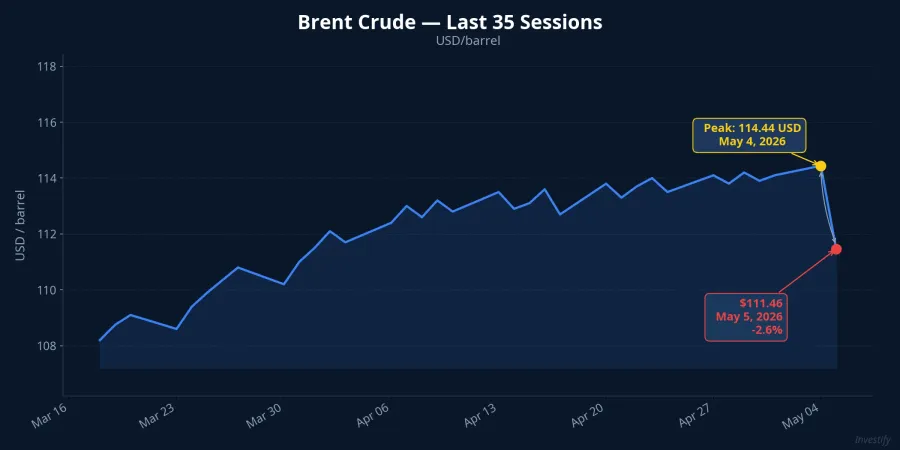
For oil prices, the same signal unwound the supply disruption premium. Hormuz handles roughly 20% of the world's oil. In recent weeks, each dollar of Brent's price carried a portion reflecting the probability of tankers being interdicted or attacked. When Washington signaled a drawdown of its escort operations due to negotiating progress, that probability fell and the premium was withdrawn. Brent dropped from $114.44 on May 4 to $111.46 on May 5.
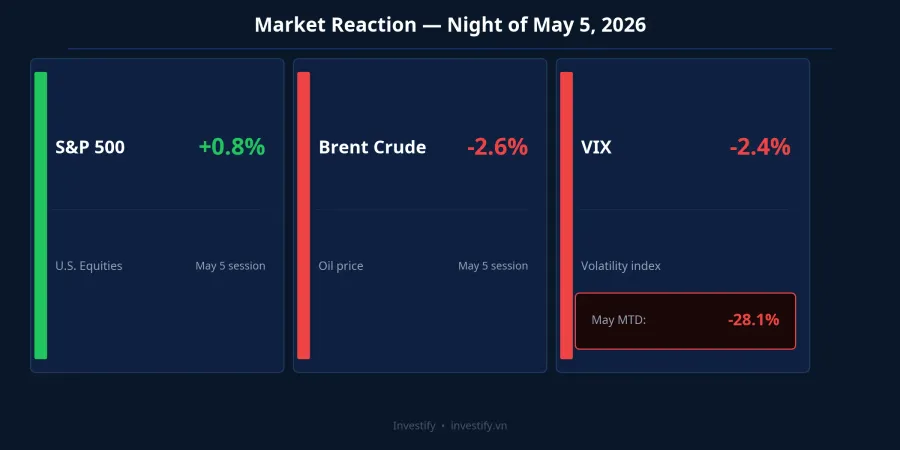
Both responses are fully consistent within a single framework: geopolitical risk declined. Equities benefited as risk premiums contracted. Oil fell as the supply disruption premium was removed. This is not a contradiction. It is the market reading two sides of the same signal correctly.
How Much Premium Has Been Withdrawn?
Context matters here. At the end of April, Brent was trading around approximately $104 per barrel.EIA During the first week of May, it climbed to $114.44, driven largely by a Hormuz risk premium built up after a series of escalations, including Iran's attack on the port of Fujairah on the night of May 4.
In one session on May 5, $2.98 was unwound after Trump's statement. If negotiations continue to progress, the $104–108 per barrel range — where Brent stood before the Hormuz escalation cycle — is a reasonable reference for the remaining premium still to be priced out.
One important caveat: the geopolitical premium is not a fixed number. It will continue to fluctuate with each development in the talks. A positive development from Vienna or Tehran could pull it further. A new incident in the Gulf could push it back in. The $104–108 range is a reference anchor, not a guaranteed destination.
Why Vietnamese Oil Stocks Rose on May 5
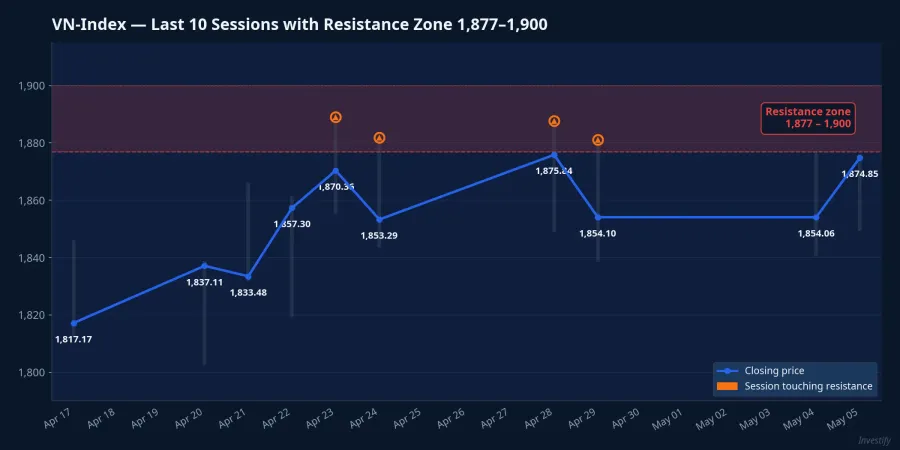
The oil and gas equipment and services sector rose 2.66% on May 5, leading all sectors on the Vietnamese exchange. BSR closed at VND 26,750, up 5.94%, with volume of 24.54 million units.HSX PVT gained 6.74% to VND 23,750, on volume of 12.5 million units. ASP added 6.90%. The VN-Index closed at 1,874.85 points, up 1.12%, on total volume of 766.75 million units.CafeF
The obvious question: why did Vietnamese oil stocks surge on the same session Brent fell 2.6% globally?
The answer lies in the sequence of events. The Vietnamese market closes at 15:00 local time on May 5, before Trump made his announcement later that evening U.S. time. When BSR and PVT were actively trading, Vietnamese investors were still pricing the Hormuz escalation scenario following the Fujairah incident. Capital flowed into oil stocks on expectations of sustained high Brent prices, not on a de-escalation scenario. The apparent paradox dissolves once the timeline is laid out.
The VN-Index finished May 5 just 25 points below the psychologically significant 1,900 resistance level. Throughout April and early May, the index approached the 1,877–1,878 zone multiple times without breaking through. The May 5 close at 1,874.85 was the highest point in May up to that date.
Three Forces Acting on May 6
Investors holding Vietnamese oil names from May 5 face a concrete problem heading into May 6: the driver that pushed prices up was the Hormuz risk premium, and that premium was withdrawn overnight. Three forces are now in play simultaneously.
Support from global risk-on sentiment. With the S&P 500 at an all-time high, VIX at 17.38, and U.S. futures positive, risk appetite is elevated. This sentiment typically flows into Vietnamese markets through foreign buying and domestic risk-seeking capital, which could push the VN-Index toward the 1,900 resistance with adequate volume.
Pressure from the oil premium unwind. For the oil sector specifically, the pricing catalyst from the past week — Brent in the $110–114 range — is now contracting. BSR's inventory profit mechanism, which generated strong Q1 earnings, reverses when Brent falls: crude purchased at higher prices is marked down.
Anchor from intrinsic fundamentals. BSR reported strong Q1 profits, and PVT holds oil transport contracts that provide ongoing revenue. Intrinsic value does not shift entirely with a few sessions of Brent movement, though short-term price momentum does.
Signals to Watch
Capital is moving with each negotiating headline. Key signals to monitor during the May 6 session:
Brent futures in the morning: If Brent continues falling below $110, selling pressure on Vietnamese oil stocks will widen from the open. If Brent recovers toward $113–114, part of the unwound premium could be rebuilt and oil sector sentiment may hold.
VN-Index volume at the 1,880–1,900 level: If trading volume exceeds the May 5 level (766.75 million units) as the index approaches 1,890–1,900, the probability of a resistance break rises meaningfully. If volume falls below 600 million on approach, distribution selling is more likely.
BSR and PVT in the first 30 minutes: Do these stocks hold their May 5 reference prices, or do they gap down and distribute at the open? The 9:00–9:30 a.m. reaction typically sets the tone for the full session when there has been an overnight reversal in the driving factor.
The S&P record and the Brent selloff are not contradictory signals. They are two independent mechanisms from one de-escalation headline, each read correctly by its respective market. The challenge for Vietnamese oil investors on May 6 is separating what was geopolitical premium — now being unwound — from genuine fundamental value that remains. The bullish scenario depends on global risk-on sentiment crossing into Vietnam and Brent holding above $110. The cautious scenario plays out if oil continues sliding and overall market volume cannot clear the 1,900 resistance. The deciding factor is the pace of U.S.-Iran negotiations and where Brent futures open on the morning of May 6.