


April 2026 ended with a rare divergence across the most familiar asset classes for Vietnamese retail investors. Equity holders, savings depositors, and SJC gold owners each crossed into May with vastly different outcomes, all watching the same news cycle throughout the month. The gap between the top and bottom performers in this everyday investor basket reached nearly 14 percentage points.
The big picture shows a month where global risk appetite surged at the same time a countervailing dynamic played out domestically. Understanding both sides of that picture is the foundation for adjusting a portfolio sensibly before May.
Full Scorecard: Who Won, Who Lost in April
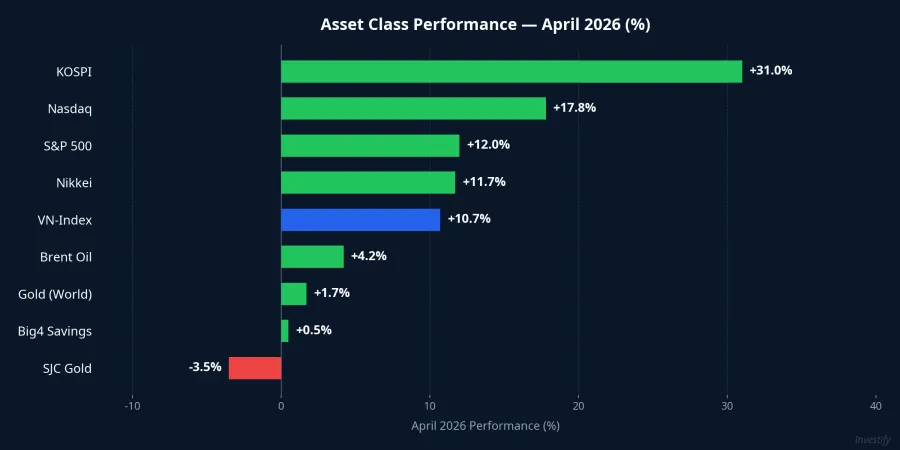
The VN-Index closed April 30 at 1,854.10 points, up 10.73% from 1,674.49 at end-March. Globally, KOSPI led the pack with a 31% gain in April — the best month since January 1998 — as SK Hynix rose 60% and Samsung Electronics gained 35% in just four weeks.CNBC The Nasdaq gained 17.8%, S&P 500 rose 12%, and the Nikkei climbed 11.7%. The VIX volatility index fell 36.2% during the month, reflecting broadly positive global market sentiment.
Brent crude rose 4.2%, landing in the middle of the basket. World gold edged up 1.7%. Big4 12-month savings rates at 5.9% per annum translated to roughly 0.5% for the month. SJC gold was the only asset class in the group that declined: down approximately 3.5% from the start of the month, with the selling price settling around approximately VND 168.8 million per tael by end-April.VietnamNet
VN-Index Rallied Despite Heavy Foreign Outflows
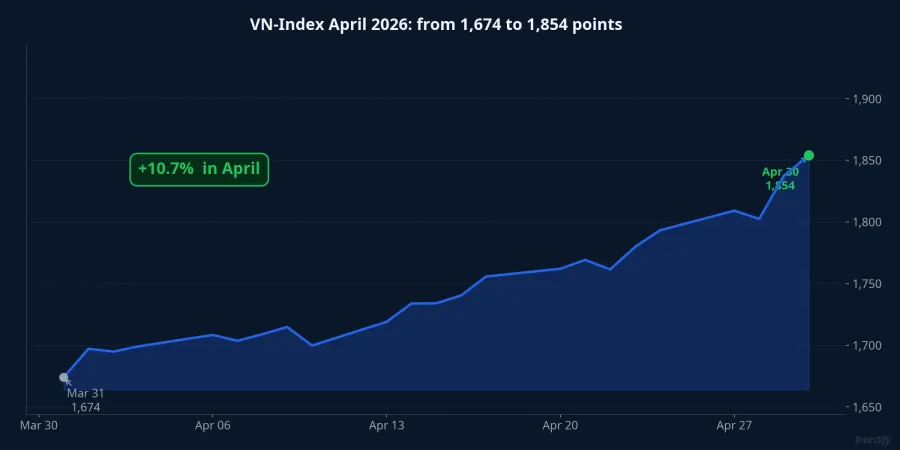
The most striking domestic story of April: the VN-Index gained 10.73% while foreign investors sold a net VND 13,800 billion on HOSE in a single month.Tin Nhanh Chứng Khoán A double-digit market gain against that volume of foreign net selling is not a common setup, and it requires three specific explanations.
First, margin debt at securities firms ended Q1/2026 at approximately VND 405–415 trillion. That leverage level was large enough for domestic money flows to amplify buying across the leading stock groups and absorb most of the foreign selling. Second, banking, securities, and residential real estate — the three largest-cap sectors most sensitive to the interest-rate cycle — rallied in sync as Big4 deposit rates fell to the 5.9–6.0% annual range. Third, market expectations around FTSE's upgrade decision on September 21, 2026 continued to be priced in on a session-by-session basis by retail investors.
That said, the risk embedded in this setup deserves a clear-eyed look. A rally driven by high leverage is a two-sided outcome. It enabled the market to absorb April's foreign outflows, but it also means the safety margin before the next correction is thinner than it was at the start of the quarter. The final session of the month — April 30 — saw the VN-Index fall 21.74 points ahead of the public holiday, a signal worth monitoring when trading resumes on May 4.

SJC Gold Moves Against World Gold: The Premium Compression Story
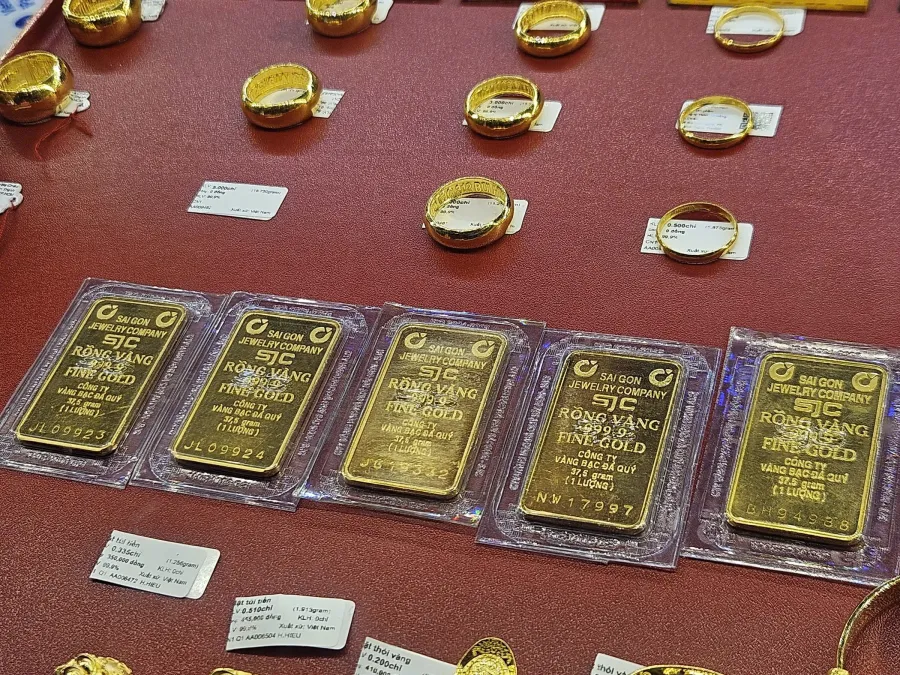
SJC gold fell approximately 3.5% while world gold rose 1.7%. It looks like a paradox on the surface, but it is a direct consequence of policy. Decree 232/2025 abolished the SJC monopoly on gold bar production, opening the market to additional qualified participants. Import quotas on raw gold remain controlled, so domestic supply has not expanded quickly in practice. However, the expectation of competition was enough to compress the SJC premium against spot gold from its early-April peak toward month-end.
Buyers who purchased SJC gold at the early April peak of approximately VND 175 million per tael were sitting on an unrealized loss of around VND 6 million per tael as of April 28. That is a large enough gap to prompt a reassessment of the unconditional "gold as safe haven" assumption, at least in the current environment where regulation is actively reshaping the domestic-international price spread. This is not a signal that gold has lost its hedging role: it is a signal that the domestic premium is being repriced, and that process may not be over by May.
KOSPI +31%: The Lesson from the AI Chip Cycle

KOSPI's 31% April gain was not a speculation story. Samsung Electronics reported Q1/2026 operating profit up more than 8 times year-on-year, to approximately KRW 57.2 trillion, driven by the HBM3E and HBM4 chip cycle for AI workloads.CNBC This is a move with genuine business fundamentals, not pure sentiment. SK Hynix — the competing memory chip maker — also rose 60% over the same period, reinforcing the case that the entire AI chip supply chain is in a cyclical upswing with real depth behind it.
A practical note for Vietnamese investors: after a 31% surge, KOSPI's near-term correction risk has accumulated considerably. The longer-term lesson, however, remains relevant. For those who want exposure to the global AI chip growth cycle without direct access to the Korean market, internationally diversified mutual funds or technology-themed ETFs are the most practical indirect channel currently available in Vietnam.
Portfolio Adjustments Heading into May: Three Practical Questions
The April 2026 scorecard raises three concrete questions for different investor profiles.
For those with a heavy SJC gold allocation: the assumption that "gold is an unconditional safe haven" deserves review in light of Decree 232/2025 actively repricing the domestic-to-international spread. Gold still serves a hedging function, but the premium paid versus world gold is shrinking and could continue to shrink.
For pure savings depositors: a return of approximately 0.5% in April, against Vietnamese equities rising 10.73%, represents a clear opportunity cost for anyone with an investment horizon beyond 12 months. This is not an argument for abandoning savings entirely — cash and deposits remain an important liquidity layer in any portfolio — but rather for examining whether the current allocation still makes sense.
For those who want diversification but lack the time to track daily trading sessions: equity mutual funds and balanced funds are the most natural framework. A single product wraps exposure to many tickers and sectors, and some funds include international equities in their basket, enabling participation in growth cycles without concentrating the entire portfolio in the volatility of individual stocks.
Capital flows in April told a clear directional story: out of SJC gold, partially out of short-term deposits, and into higher-volatility asset classes. May will answer three specific questions: whether margin debt can continue expanding with the VN-Index in the 1,850-point range; whether the SJC-to-world gold spread continues to compress after Decree 232/2025; and whether foreign net selling eases as the domestic Q1 earnings season hits its peak. The first trading session to answer those questions is May 4.