
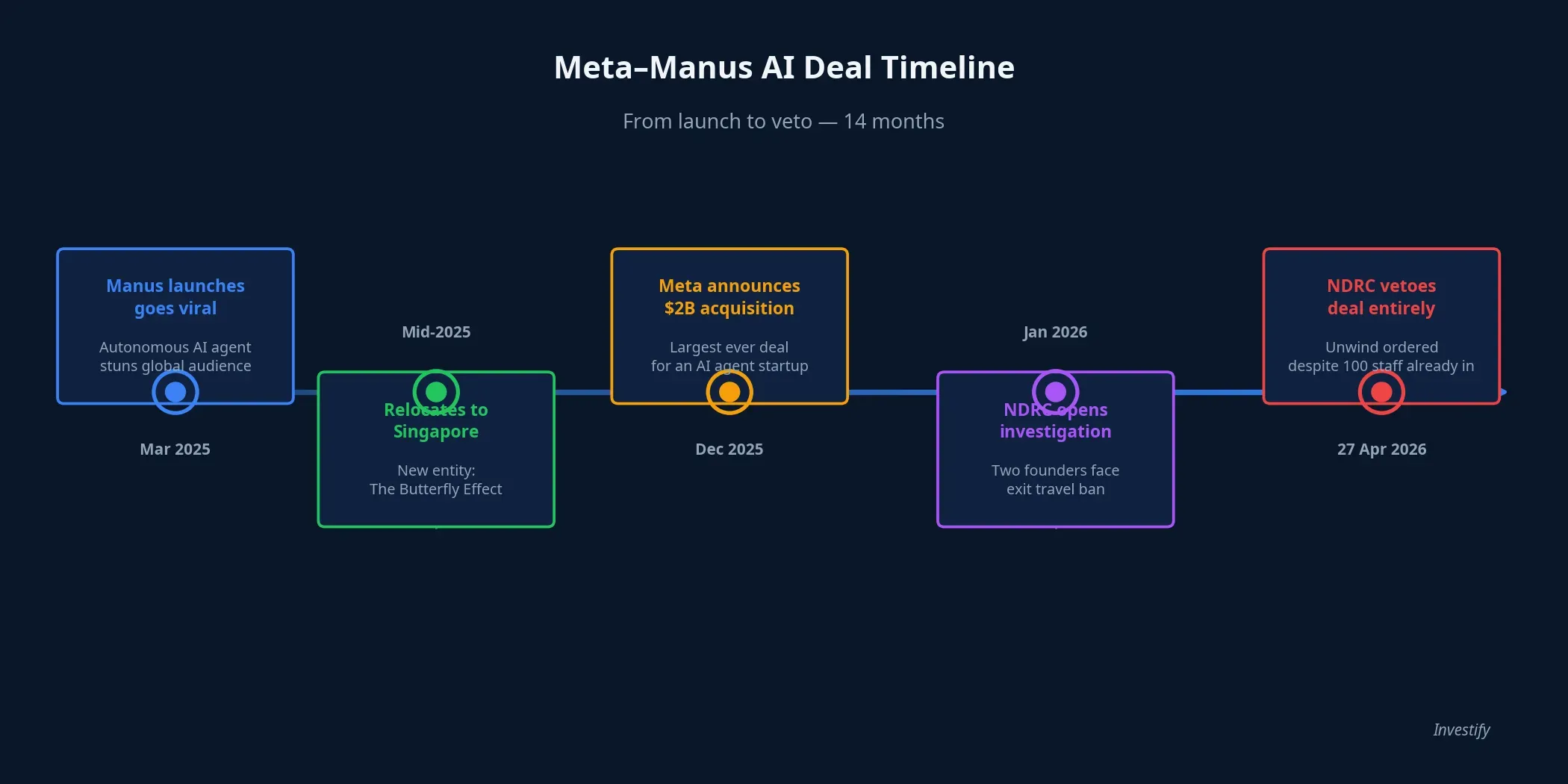
On April 27, 2026, China’s National Development and Reform Commission (NDRC) formally vetoed Meta’s approximately $2 billion acquisition of Manus AI.Bloomberg What sets this apart from every prior M&A block: the order came after the deal was effectively done. Around 100 Manus employees had already relocated to Meta’s Singapore office, the founding team held operational roles inside Meta’s AI agent project, and source code was already flowing between the two sides.CNBC The real risk here isn’t the specific deal — it’s the precedent. Relocating a company’s legal entity out of China no longer insulates an M&A transaction from Beijing’s reach.
Why Meta Paid $2 Billion for Manus
Manus was founded in 2022 by Xiao Hong and Tao Zhang (Co-founders of Manus AI), alongside Yichao “Peak” Ji, Co-founder and Technical Lead of Manus AI (The Butterfly Effect/Monica, Singapore). The core product is a general-purpose AI agent capable of independently planning and executing multi-step tasks: building websites from scratch, writing business plans, analyzing listed company financials, scheduling complex itineraries. No human intervention required at each step.
When Manus launched publicly in March 2025, the demo videos posted by Yichao Ji spread rapidly, drawing direct comparisons to OpenAI’s Deep Research.CNN For Meta, the acquisition was a way to compress a generation of AI agent research into a single transaction and plug the technology directly into WhatsApp, Instagram, and its advertising infrastructure.
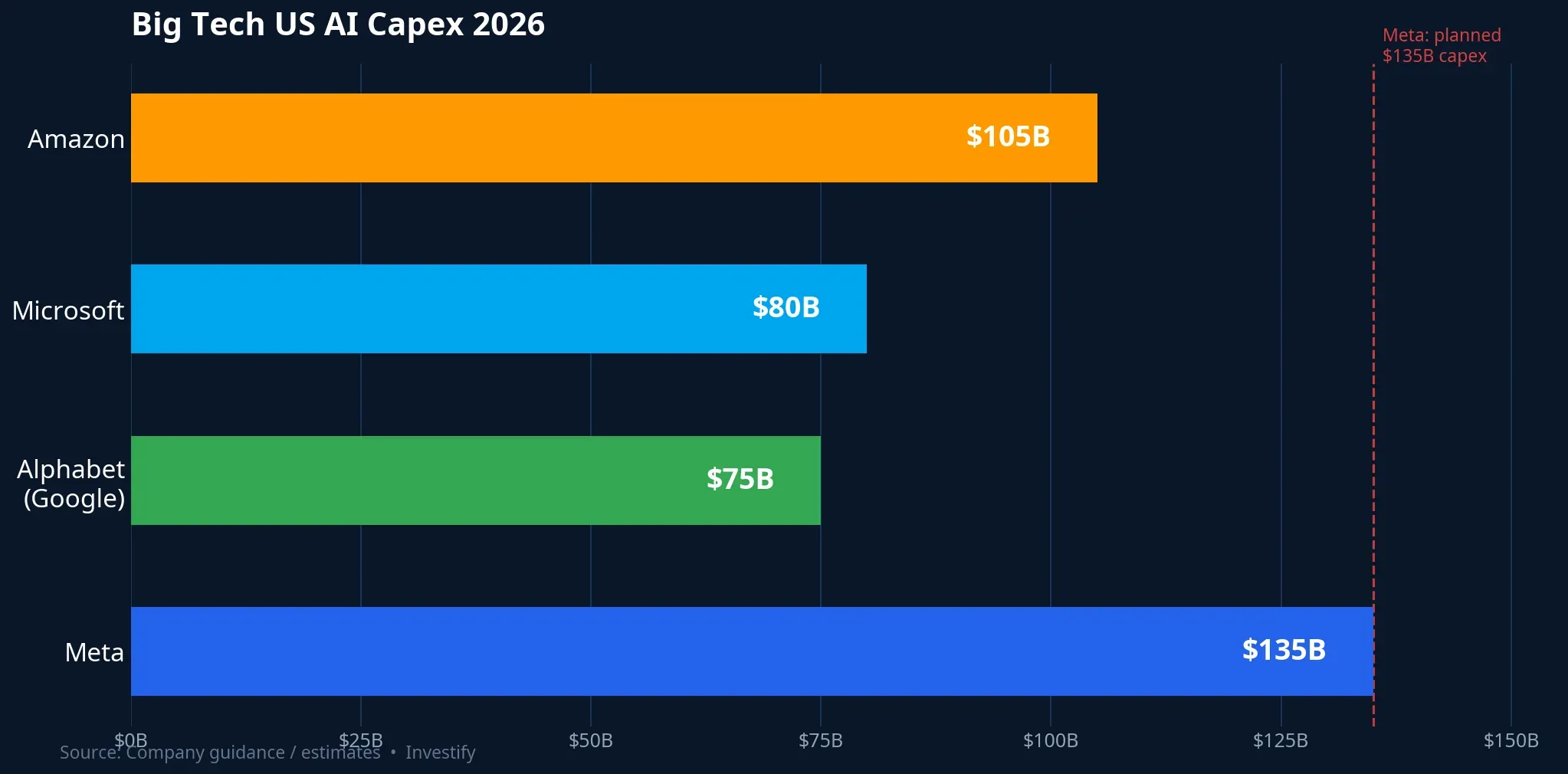
Meta is set to report Q1/2026 earnings this week, with consensus expecting approximately $55.5 billion in revenue and EPS of $6.69. Against a plan to spend approximately $135 billion on capital expenditures in 2026, Manus was meant to be the missing piece that turns raw infrastructure spending into deployable AI products for end users.TradingKey
What Legal Grounds Did NDRC Actually Have?
This is the critical question for investors tracking geopolitical risk. Manus had relocated its legal entity to Singapore in mid-2025 — meaning that when Meta announced the deal in December 2025, the acquisition target was formally a Singapore company.TechCrunch So how did NDRC claim jurisdiction?
The regulator applied two legal arguments simultaneously. First, it invoked the foreign investment security review mechanism covering projects involving sensitive technologies, and AI agent technology squarely qualifies.Concurrences Second, regardless of where the legal entity sat, the underlying technology was developed in China, the founding team is Chinese, and early R&D was conducted in China. NDRC drew on technology transfer controls to extend its jurisdiction to entities that are “Chinese in origin but relocated.”
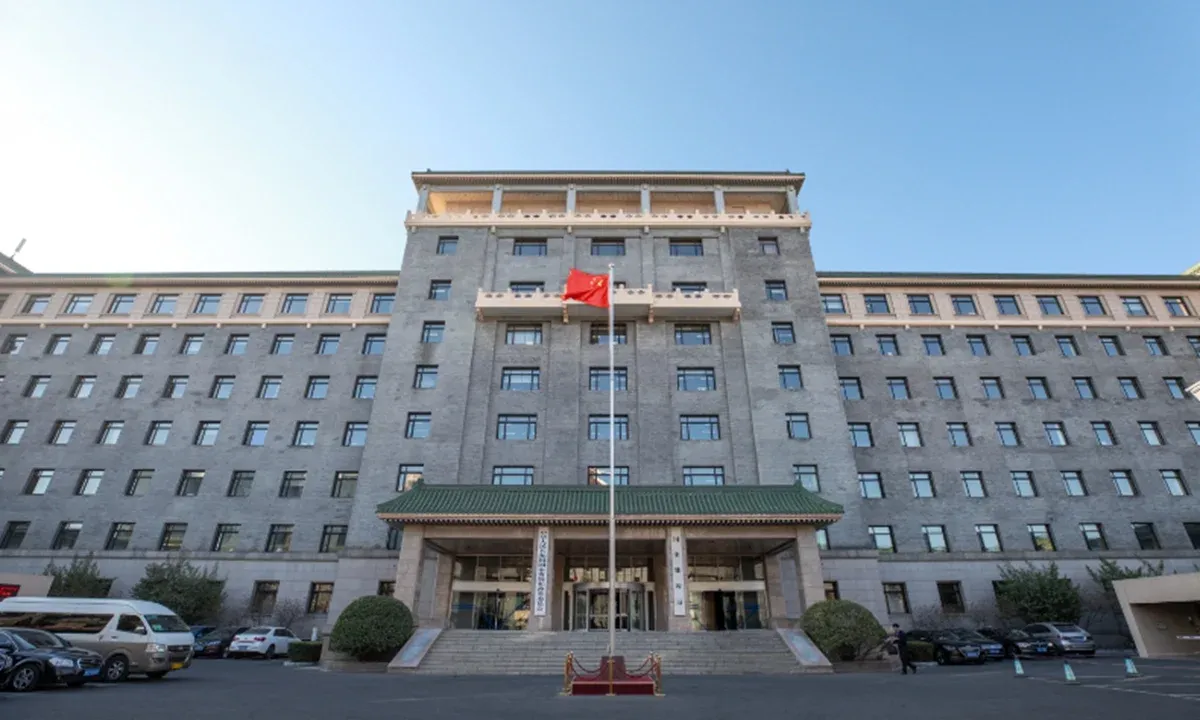
The investigation opened in January 2026. During that period, Xiao Hong and Yichao Ji faced exit travel bans from China — an administrative measure that signals Beijing treated this as a security matter, not a routine competition review.CNBC The final veto statement was terse: NDRC had “decided to prohibit foreign investment in the Manus project in accordance with laws and regulations, requiring the relevant parties to withdraw the acquisition.”
Why Unwinding Is Harder Than It Sounds
The “full withdrawal” order is not a paper exercise. At the time of the veto, approximately 100 Manus staff were working inside Meta’s Singapore office, with the founding team reporting directly to Meta leadership on the AI agent initiative.CNBC Source code, AI models, and intellectual property had already been shared between the two engineering teams during joint development.
But who exactly bears the cost of this unwind? Each layer of integration opens an unanswered operational question: what happens to Manus employees who already signed Meta contracts; how do you cleanly extract source code that’s been merged into Meta’s systems; who owns IP filed under the newly structured entity. Two of the three founders remain in China under exit travel bans while the rest of the team has moved to Singapore under Meta’s umbrella. This is not a standard break-up fee scenario — it is months of legal and compliance work with uncertain outcomes.

Three Structural Shifts for AI M&A Globally
The Meta–Manus case differs from prior M&A blocks in a fundamental way. What most legal commentary doesn’t spell out plainly: NDRC has now asserted extraterritorial jurisdiction based on the origin of the technology and the nationality of the founders — not the registered address of the legal entity.
Pre-deal due diligence gets more expensive. Any transaction involving a startup with Chinese co-founders, technology initially developed in China, or ongoing R&D staffed by Chinese nationals must now account for potential NDRC intervention, regardless of where the current legal entity is incorporated. Deal timelines lengthen, legal fees increase, and buyer liability exposure widens.
Deal structure shifts toward staged closing. The “sign and immediately integrate” model that Meta followed with Manus creates enormous operational risk if a regulatory block arrives late. Future deals may need clean separation between the legal closing phase and the operational integration phase, with all relevant regulatory approvals — not just US ones — in hand before integration begins.
Capital may increasingly avoid “Chinese-origin” AI profiles. For US Big Tech, deals like Manus now carry a strategic risk layer beyond pure legal exposure. Venture funds may exit earlier from AI startups where the majority of core IP or engineering talent remains China-based, anticipating that cross-border M&A will be harder to complete cleanly.Al Jazeera
What to Watch Next
For investors tracking global tech equities, this is a structural change in how geopolitical risk must be priced into AI valuations — not a one-off headline. META shares closed around $674 on April 27 in muted, wait-and-see trading, with the announcement arriving after US market hours.Yahoo Finance
When Meta reports Q1/2026 earnings this week, two questions deserve close attention: (1) How does management frame the plan B for AI agents: internal development, partnership with Western players, or a hybrid path? (2) How are legal and integration-unwind costs being accounted for in coming quarters?
The broader signal is clear: the US-China tech war has moved well beyond tariffs and chip export controls. It now includes the ability to block cross-border M&A on the basis of technology origin, with jurisdiction that follows the IP rather than the registered legal entity. Investors pricing global technology stocks need to add a new variable to their framework: where a company’s core IP and founding engineering talent originally came from.
Key signals to monitor: Meta’s official statement on the unwind timeline; any NDRC guidance clarifying where the technology-transfer perimeter sits for AI; whether future Big Tech AI deals adopt structurally different closing mechanisms; and Washington’s response to what amounts to an assertion of extraterritorial regulatory reach.