
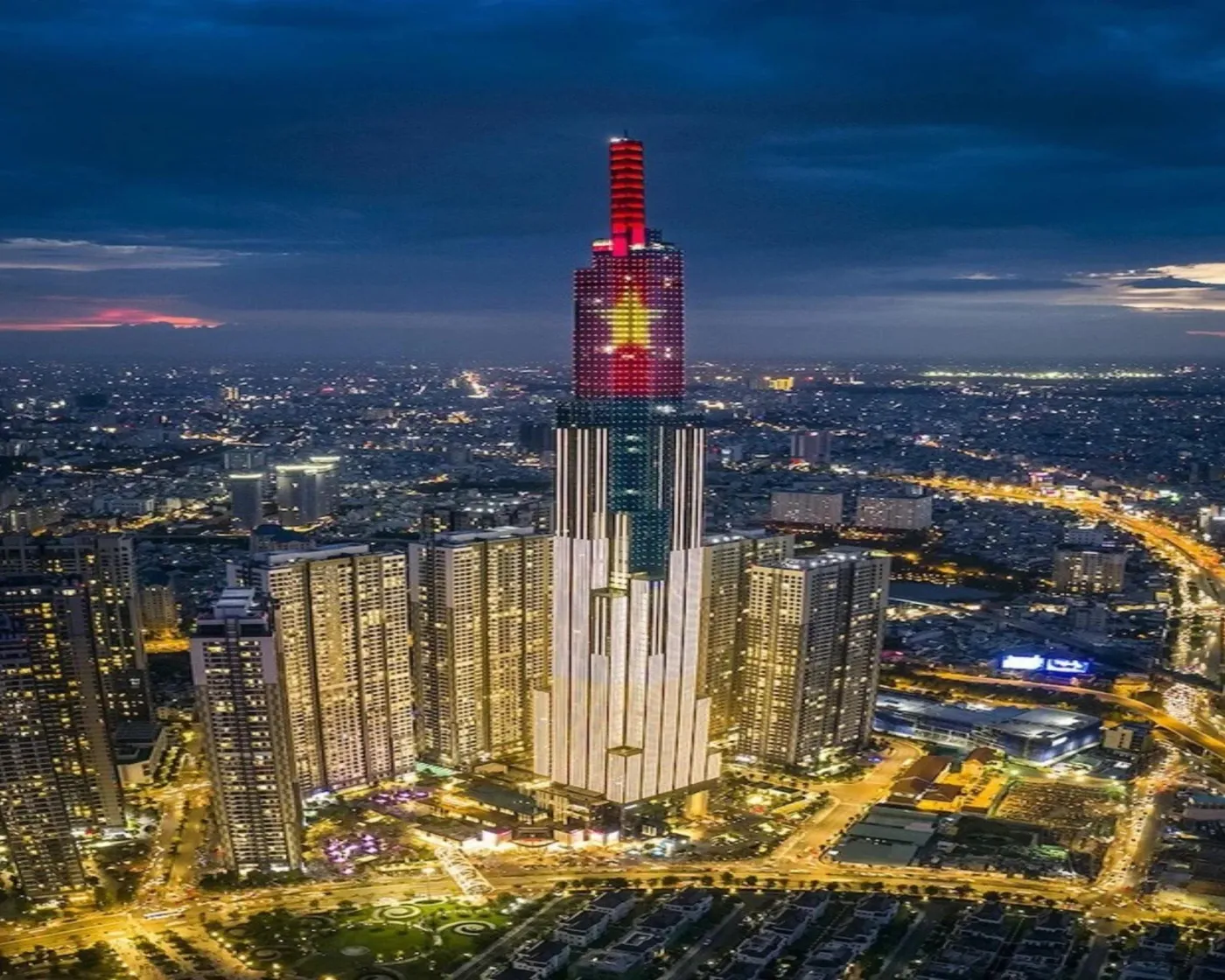

VN-Index closed the April 17, 2026 morning session at 1,825.72 points, up 5.89 points (+0.32%) on 351 million units of volume. At headline level, the market extended last week's recovery. Inside the real-estate sector, the picture is very different: three of Vingroup's largest pillars reversed together while VIC alone held green. Behind the calm index reading are three mechanical layers that matter for investors.
Divergence inside Vingroup itself
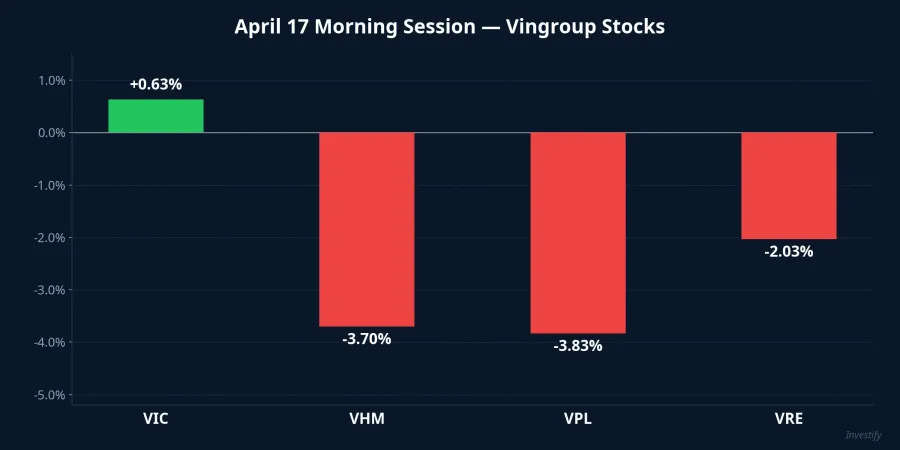
Start with the numbers. VIC rose only 0.63% to 190,500 VND on 3.38 million units — far softer than the +6.95% ceiling moves posted on both April 15 and April 16. VHM fell 3.70% to 137,800 VND, VPL dropped 3.83% to 82,800 VND, and VRE — the remaining member of the Vingroup ecosystem — slipped 2.03% to 29,000 VND.
In other words, every Vingroup pillar lost momentum; only VIC managed to hold near reference. Combined listed market cap of the four at April 17 morning prices is around 2,248 trillion VND — large enough for profit-taking to spill across the board if it hit all four at once. Yet VN-Index stayed green. The first question for investors: who is propping up the index, and why is it VIC specifically that did not fall in line?
Layer 1: Selective profit-taking on a hot streak
This is the easiest layer to read on the 5-session chart. Over April 13-16, VIC rose from 160,000 to 189,300 VND — +18.3%, including two consecutive ceiling sessions. VHM climbed from 122,900 to 143,100 VND, +16.4%. VPL moved from 80,200 to 86,100 VND.
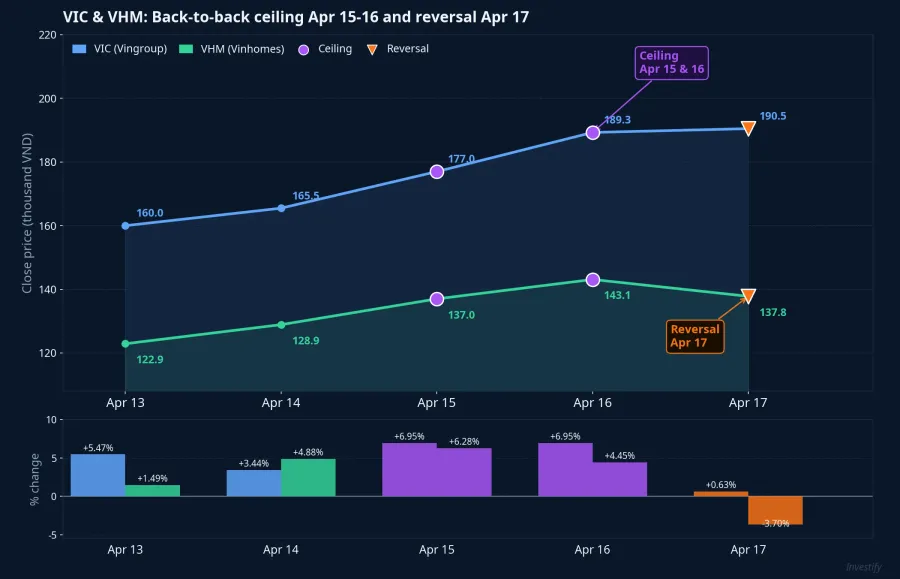
When a blue-chip runs up 16-18% in five sessions, profit-taking is a technical reflex — no bad news is needed to create supply. What stands out is that the selling was selective: VHM and VPL took the hardest hits, while VIC merely paused. That order mirrors each name's marginal pace in the final sessions — VHM and VPL ran faster at the top, so they saw the first-out-first-hit pattern.
That said, this is not yet a structural reversal signal. Matched volume on VHM at the April 17 morning session was only 4.31 million units, well below 33.5 million on April 15 and 11.37 million on April 16. Selling pressure was not paired with heavy volume — supply is hesitant, sellers are not rushing the door.
Layer 2: Mid/small flows pick catalysts, not a broad rotation
This is the layer most quick reads compress into "rotation to mid/small". Looking name by name, money is not rotating uniformly — it is picking specific storylines within specific sub-groups.
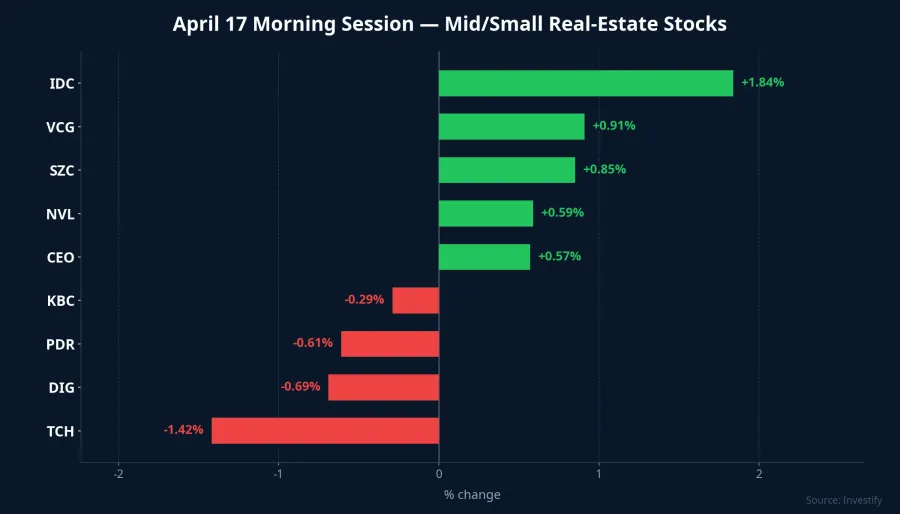
Names bought harder than the index are where flow is actually anchored. IDC rose 1.84% to 49,700 VND, its second straight up-session after +1.88% on April 16; SZC added 0.85% to 29,500 VND, also a second consecutive gain. Both ride the same logic — industrial-park leasing stays stable as FDI demand and supply-chain relocation remain dominant themes. VCG gained 0.91% on the infrastructure story. NVL added 0.59% to 17,100 VND — after April 16's -2.86% drop on 28.1 million units, bargain-hunting flow is emerging based on the view that restructuring is entering its final phase.
Names drifting sideways or down slightly need context. KBC lost 0.29% to 34,850 VND, but the stock had risen +4.95% on 6.6 million units on April 16 — this morning is technical cooling, not a sell-off. PDR fell 0.61% to 16,300 VND despite the 2026 AGM approving a plan to issue nearly 200 million shares to raise approximately 2,000 billion VND for projects in Da Nang and Ho Chi Minh City.Thuong Truong The 10,000 VND/share offer price sits well below the 16,300 VND market price, which typically creates short-term dilution pressure. SJS was almost flat at 53,000 VND on just 9,800 units — even though it benefits from the SJ Group AGM approving continued sales of the Nam An Khanh project, volume is too thin to confirm real flow.Tin Nhanh Chung Khoan TCH fell 1.42% after gaining 3.24% on April 16; DIG -0.69%, KDH -0.19%, HDC -0.53% — all consistent with technical cooling.
The real picture is not "mid/small rally offsetting Vingroup". More accurately, flow is picking specific catalysts — industrial parks via IDC/SZC, restructuring via NVL, infrastructure via VCG — while cooling names that ran hot one or two sessions earlier. This is selective flow, not broad-based rotation.
Layer 3: Orderly cooling, not a phase change
Stacked together, the three layers make the picture clearer. First, VN-Index held +0.32% not because of strong rotation into mid/small, but mainly because VIC did not decline. With a market cap near 1,468 trillion VND, VIC alone is capable of offsetting VHM and VPL pressure. If VIC turns down in the afternoon, the index script changes entirely — this is the most fragile point of the current structure.
Second, flow inside the real-estate sector is filtering by catalyst. Industrial parks are the most consistent bright spot; NVL is drawing bargain-hunting flow on the restructuring thesis; PDR and SJS have capital-raising narratives but prices are not responding, reflecting dilution concerns and thin liquidity.
Third, this is orderly cooling, not a sell-off. Selling volume at VHM (4.31 million units) and VPL (412 thousand units) dropped sharply versus the prior buy sessions. Weak demand means weak supply too — the market is pausing to breathe after the hot streak, not entering a real distribution phase.
Three signals to watch in the afternoon session
Three reads will separate "just a pause" from "an actual reversal":
- Can VIC hold green? If VIC slides below reference (the 189,300 - 190,500 VND zone), its point contribution is large enough to flip VN-Index color quickly in the afternoon.
- Does volume on NVL, IDC and SZC keep expanding? If volume contracts alongside rising prices, mid/small flow is also just "breathing". If volume keeps building, the catalyst thesis is getting confirmed.
- Does selling pressure on VHM and VPL intensify? If afternoon sell volume exceeds the morning while prices keep falling, technical profit-taking may have converted into structural supply — this is the key test to tell "pause" from "reversal".
In short, the April 17 morning is not yet a Vingroup reversal signal, nor a phase-2 rally rotating to mid/small real estate. It is a typical divergence session after a hot streak — where flow locks in local profits while probing the next storyline. The afternoon will make clearer who actually holds momentum and who was just a technical bounce. For investors, this is a moment to read volume more carefully than price — because volume is what validates flow conviction, not the headline point reading on the board.