
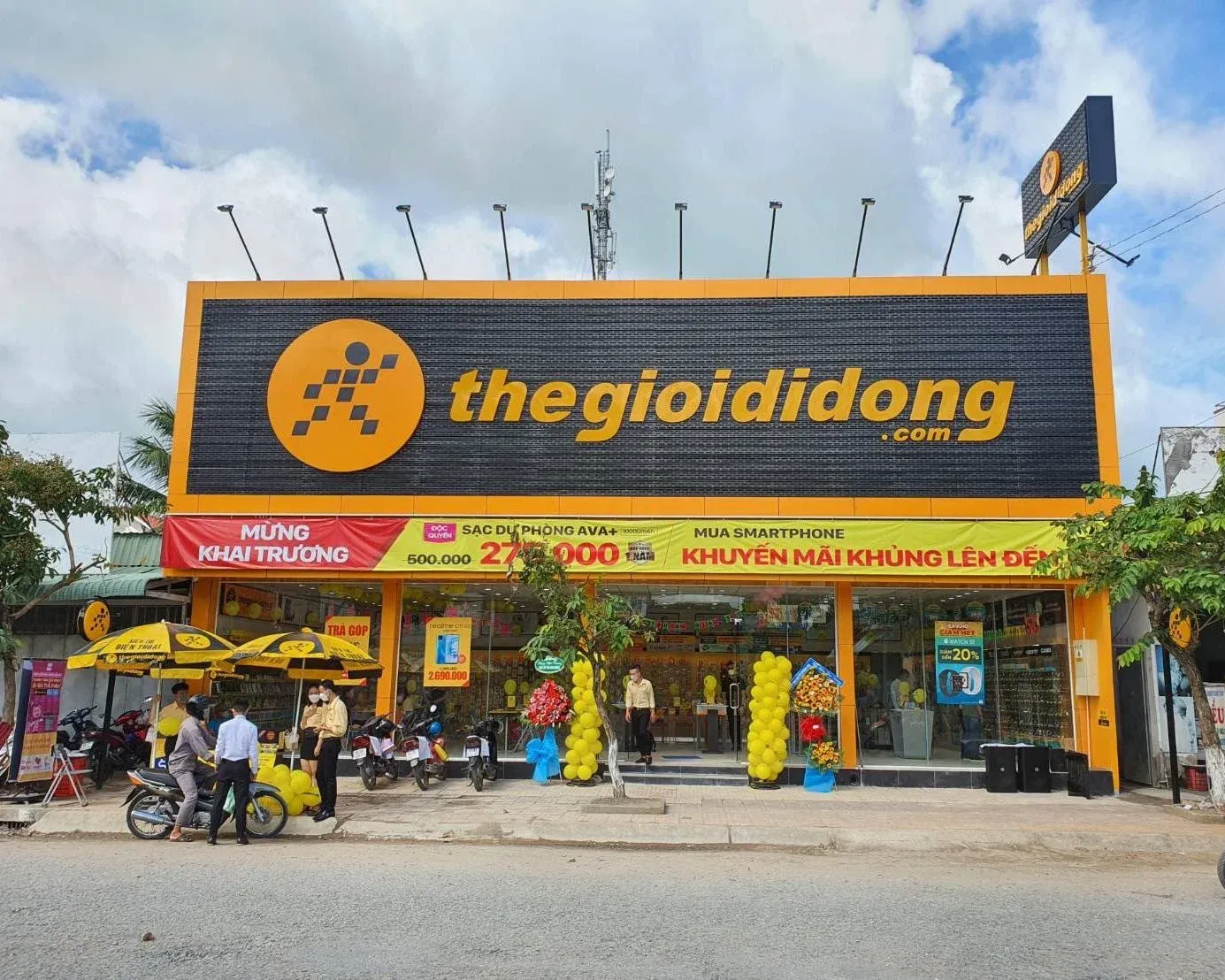

At the 17/4/2026 close, the HOSE retail sector index gained 1.27% — enough for many end-of-day dashboards to list the sector among the leaders on the buy side. A familiar reflex appeared in trading chats: consumption is returning, so spread orders across FRT, DGW, PET, PNJ to catch the wave. But unpacking the 22 stocks in the General Retailers basket reveals a different number: only 5 stocks up, 3 down, and 14 flat with no meaningful trading. That entire 1.27% came mostly from one stock.
A green index with unusually thin breadth
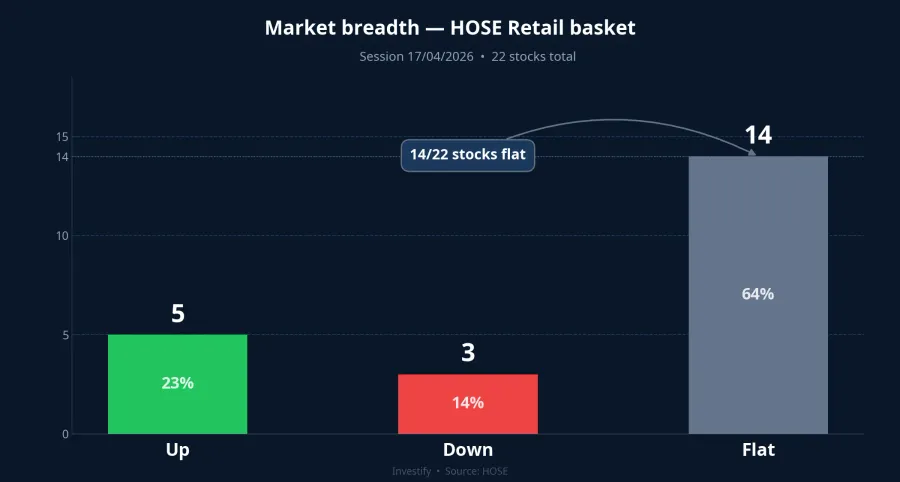
5 out of 22 stocks up — roughly 23% — is very thin for a sector being described as a "buy-side leader." Most of the HOSE retail basket on 17/4 was composed of 14 stocks flat without enough volume to move prices. This is not a picture of money flowing broadly into an entire sector; it is a picture of one stock being heavily bought while the rest had no participants.
In the same session, the VN-Index closed at 1,817.17 points, down 2.66 points (-0.15%) on turnover of 742 million shares. Meaning: the retail sector's green close was not pulled up by the broader market — money was picking individual names, not a basket.
MWG commands ~62% of sector market cap — enough to carry it alone
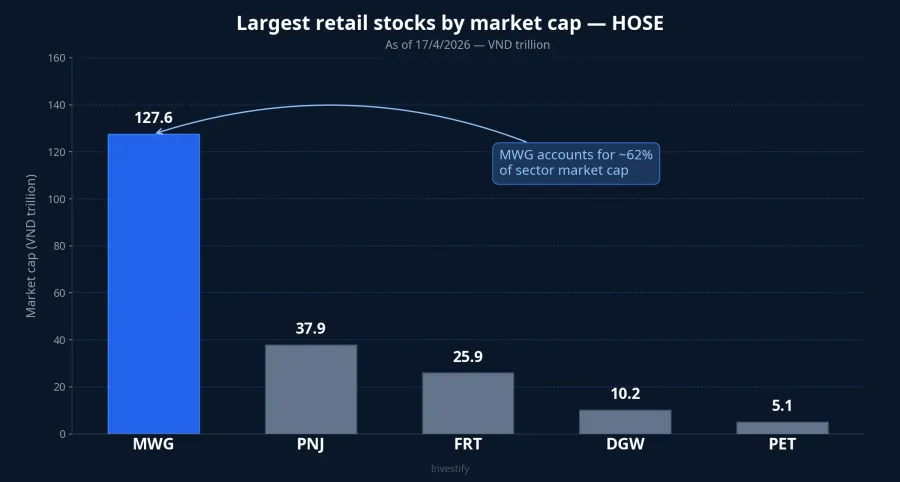
The market cap figures show why a single stock can carry the whole basket. As of 17/4/2026, MWG's market cap was around VND 127.6 trillion — larger than the combined market cap of FRT (VND 25.9 trillion), DGW (VND 10.2 trillion), and PET (VND 5.1 trillion), and 3.4x that of PNJ (VND 37.9 trillion). MWG alone accounts for roughly 62% of the market cap among the largest stocks in this sub-sector.
With that size gap, a single session where MWG hits the ceiling at +6.89% to VND 86,900 on volume of 15.09 million shares (about 3x the prior 4-session average) is enough to push the sector index green by more than 1% — even when the other four large retail names barely move.
Per-stock detail among the leaders:
| Ticker | Price 17/4 | % session | Volume (shares) | vs 4-session avg |
|---|---|---|---|---|
| MWG | 86,900 | +6.89% | 15.09 million | ~3.0x |
| PNJ | 111,000 | +1.93% | 1.37 million | ~2.3x |
| PET | 48,000 | +2.02% | 457 thousand | ~0.5x |
| DGW | 45,950 | +1.66% | 3.74 million | ~3.0x |
| FRT | 152,100 | +0.73% | 814 thousand | ~3.4x |
Worth noting: apart from MWG, no stock rose more than 2.1%. FRT — the third-largest by market cap — gained just 0.73%. Volumes on FRT, DGW, and PNJ did tick above their prior averages, but the price moves remained thin — money is probing, not strong enough yet to drive prices clearly.
Why MWG alone broke out: single-name catalysts, not a sector story
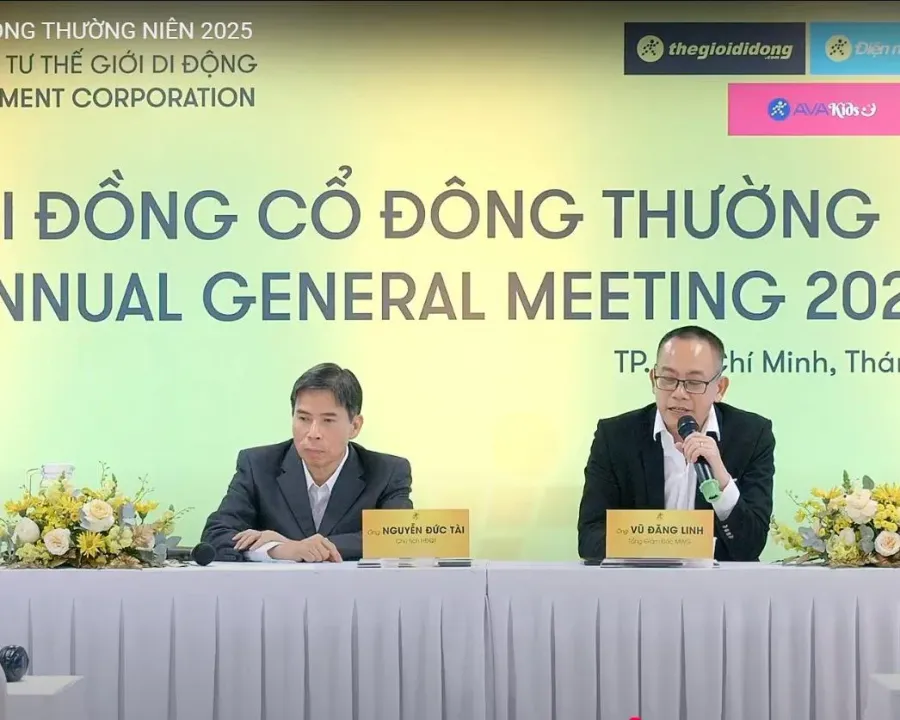
Over the past two weeks, MWG has had more single-name catalysts than any other stock in the basket. The Board-approved 2026 business plan targets net revenue of VND 185,000 billion and after-tax profit of VND 9,200 billion — up 30% versus 2025, with roughly 1,000 new store openings planned for the year.CafeF Alongside that sit a planned 20% cash dividend for 2025 and the revived discussion of an IPO for Dien May Xanh at the AGM.VnEconomy
Beyond the plan, MWG also has an infrastructure story few retail names can match: the cooperation with VinFast's V-Green has completed installation of more than 3,000 charging stations and battery-swap cabinets at Thế Giới Di Động and Điện Máy Xanh stores, turning store footprints into a new revenue stream.Nguoiquansat
The key point: these catalysts are MWG's own story, not the sector's. FRT is trading at a rich valuation with trailing P/E above 20x, DGW is a thin-margin distribution model, PET leans more toward multi-sector services than pure retail, and PNJ sells jewelry tied to the gold cycle. Each name has its own driver and tends not to run in phase with MWG.
Same macro, very different margins
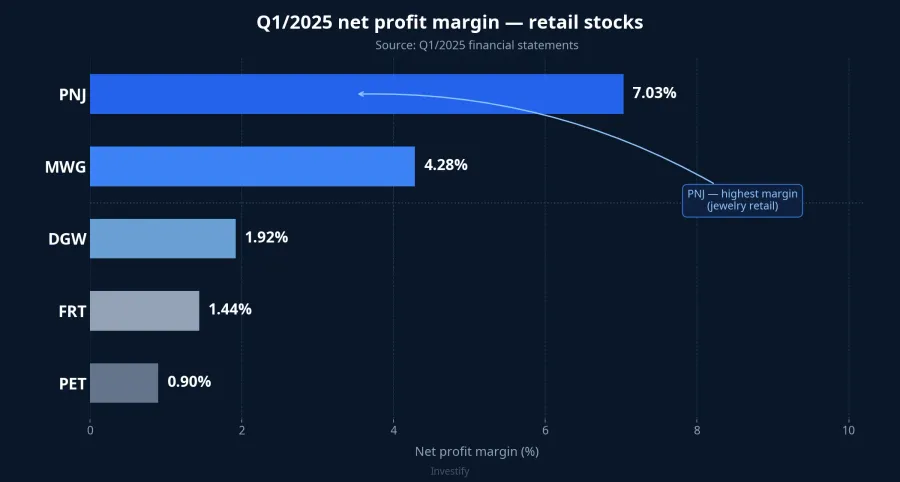
Q1/2025 data already showed a wide efficiency gap across retail models. PNJ led the group with a 7.03% net margin thanks to the nature of the jewelry business; MWG followed at 4.28%. Below that sits a clearly thinner-margin cluster: DGW 1.92%, FRT 1.44%, PET 0.90%.
When input costs are high — Q1/2026 CPI of 4.65% YoY and core CPI of 3.96% are squeezing margins for many businesses — names with larger scale, longer chains, and stronger brands (MWG, PNJ, FRT) tend to negotiate better with suppliers, pass costs into retail prices more easily, and defend margins. Names running on thin distribution margins get squeezed from both ends: rising costs without the ability to raise prices.
Q1/2025 revenue figures add another angle on scale: MWG VND 36,135 billion, FRT VND 11,670 billion, PNJ VND 9,635 billion, DGW VND 5,519 billion, PET VND 4,017 billion. MWG's revenue is roughly 3x the second-largest name in the basket — a gap wide enough that single-name catalysts can easily create independent price action.
Q1/2026 consumption is growing, but not flowing evenly
At the macro level, the data supports a differentiation story more than a uniform sector wave. In Q1/2026, Vietnam's total retail sales of goods and consumer services rose 12.1% year-over-year — a double-digit figure and above the 2020-2024 average. In theory, that is a supportive backdrop for listed retail.
In practice, the 12.1% figure does not flow evenly to every business. Q1/2026 consumption is splitting by segment: electronics, high-end jewelry, and essential pharma have more headroom; component distribution and multi-sector services face margin pressure. The money that picked MWG on 17/4 was not picking "retail" in the abstract — it was picking a name that bundles scale, a string of single-name catalysts, and a re-rating narrative after the AGM.
Three data points to watch over the next 3-5 sessions
Reading 1.27% on the sector index and concluding "a retail wave is here" is misreading the signal. The right question — is this a real sector wave or just MWG's own story — lives in three specific data points over the next 3-5 trading sessions:
- Do FRT, DGW, PET, PNJ rally together on volume above their 20-session averages? Synchronized → money is broadening and the wave is real. Not synchronized → MWG remains a standalone story.
- Does MWG hold above 85,000 VND after its ceiling session? A single ceiling-tapping move on 3x average volume needs confirmation from subsequent closes. If it fades back below the prior base, this is more likely to have been a short-term bid around AGM news.
- Does the count of rising names in the retail basket expand from 5/22 above 10/22? This is the most direct breadth gauge. A real sector signal only earns trust once breadth widens.
The most important takeaway from 17/4: a green sector index does not automatically mean "a sector wave is here." When breadth is 5/22, the sector index is telling the story of one or two large-cap stocks, not the whole basket. At VN-Index 1,800 — where differentiation is sharp and "fake waves" around a single pillar are easy to create — reading breadth alongside the headline index is a necessary skill before acting.