

On April 15, 2026, the Silver Institute and Metals Focus released the World Silver Survey 2026, confirming that the global silver market has entered its sixth consecutive year of supply deficit.Silver Institute This is no longer a speculative price wave — it is a re-pricing cycle built on a supply-demand foundation. In simple terms: when above-ground silver stockpiles are steadily drawn down for six straight years to cover the gap, each passing year leaves the market with less cushion to absorb the next shock.
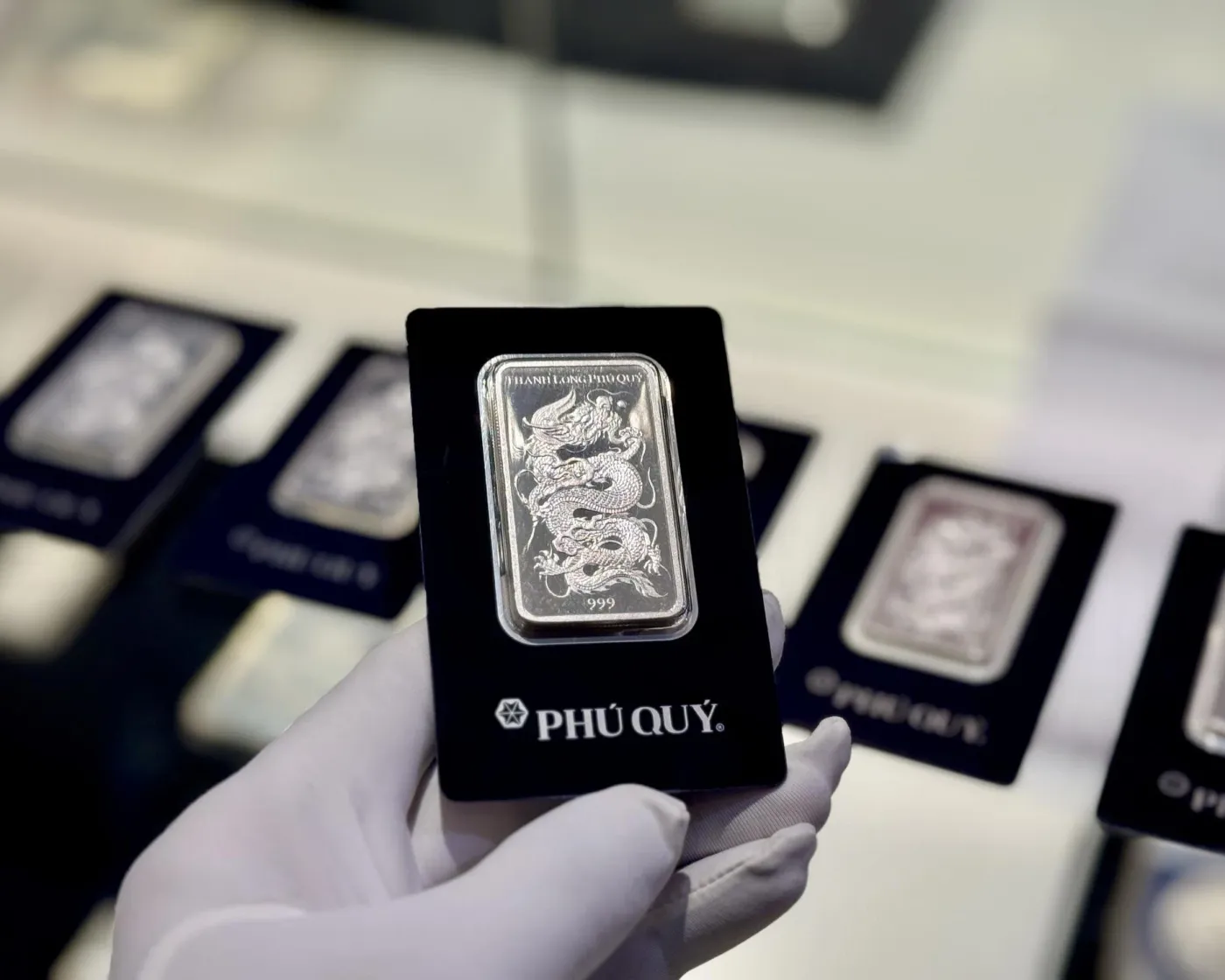
The more important story for Vietnamese retail investors is this: as of April 17, 2026, Phu Quy 999 silver bars sold at VND 3.05 million per luong, roughly 22% above the world silver price converted to Vietnamese units. Before thinking about buying silver for storage, we need a clear view of all three stages of the global silver re-pricing and the very real frictions of the domestic market.
Supply-demand picture: structural deficit is not a speculative wave
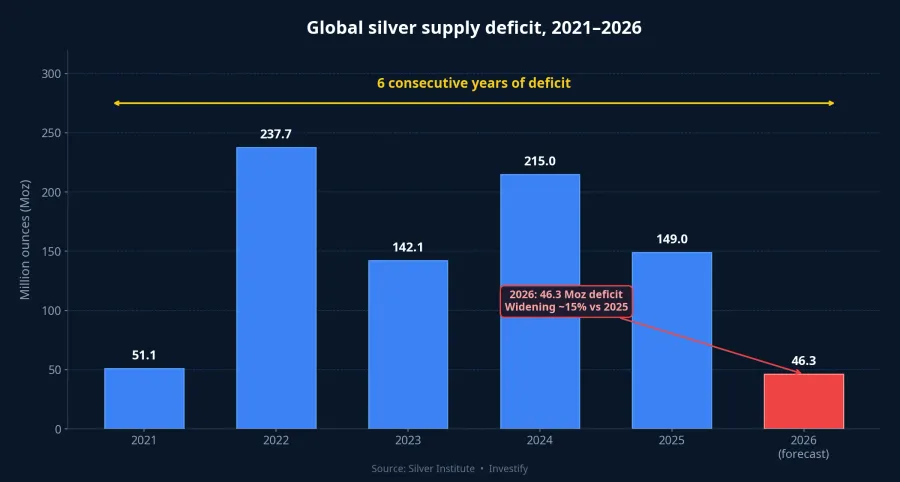
According to data released by the Silver Institute on April 15, the 2026 silver deficit is projected at 46.3 million ounces, widening by roughly 15% from 2025.Mining.com Global silver supply in 2026 is expected to fall by about 2% as producer hedging activity normalizes. More importantly, since 2021, approximately 762 million ounces of silver have been drawn from global stockpiles to bridge the gap between supply and demand.
The key distinction: a six-year recurring deficit is fundamentally different from a speculative price spike. Speculative waves typically reverse once hot money withdraws. But physical deficit forces the market to keep drawing from inventory — and each year, the remaining cushion grows thinner. This very structure explains why silver prices have not returned to their old range after surging, instead of creating a peak and crashing like ordinary speculative cycles.
Stage 1 (2021-2023): Solar ignites demand, price stays flat
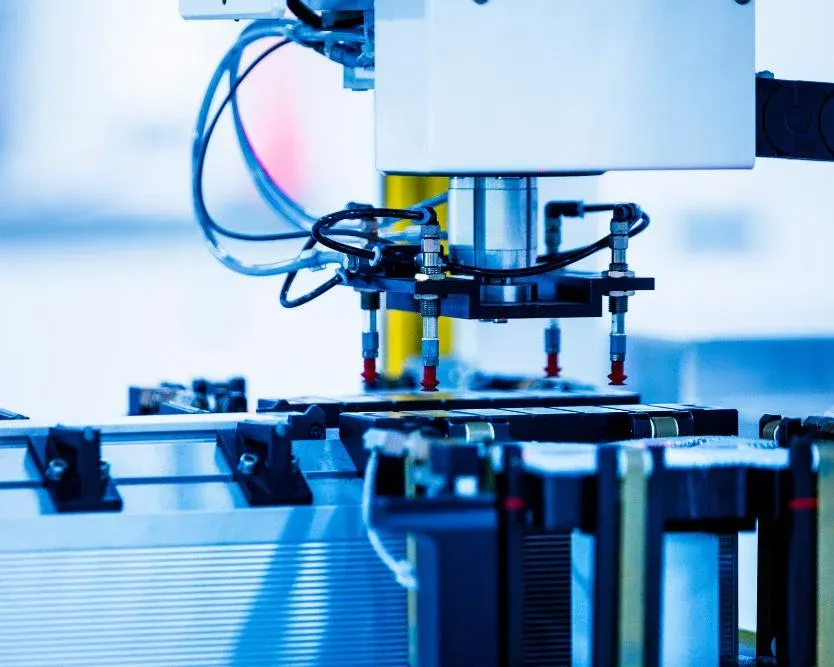
The 2021-2023 period was the first stage. Spot silver prices traded in the $20-25/oz range, with no clear breakout. But behind that stable price line, the supply-demand structure was quietly shifting. Industrial demand surged thanks to solar panels — each PERC/TOPCon cell consumes a meaningful amount of silver paste for conductivity, and global solar installation capacity roughly doubled during this period.
At the same time, mine production from primary silver mines and base-metal mines (where silver is a by-product) did not expand proportionally. Deficits began recurring instead of the surpluses seen before 2020. So why did prices not respond? Because Western physical investment flows were still unwinding, creating a "counter-balancing" sell pressure against rising industrial demand. This was the stage where long-term buyers quietly accumulated while financial markets were not paying attention.
Stage 2 (2024-2025): Investment flows return, price breaks to ~$71
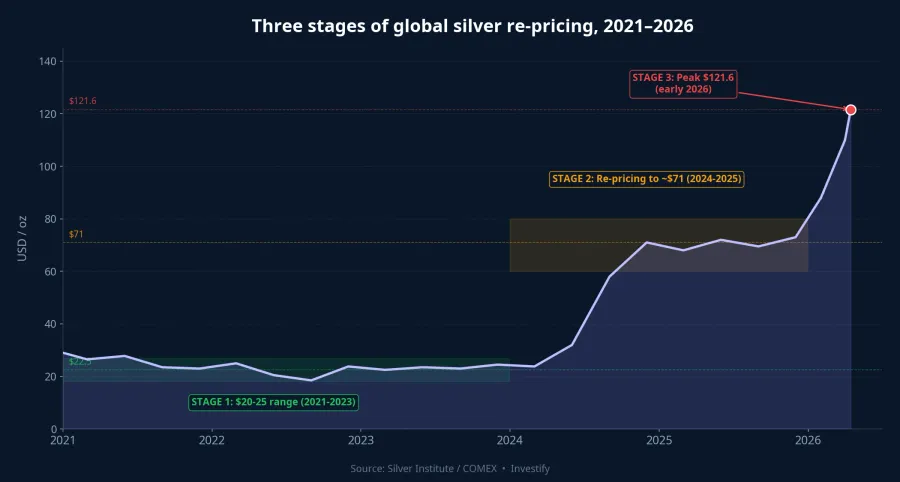
This was the breakout stage for price. Silver closed 2025 at around $71.26/oz, up ~147% from 2024. Industrial demand in 2025 slipped by about 3% to 657.4 million ounces as high prices began to erode usage efficiency, but physical investment demand (coin + bar) surged to offset that drop. The 2025 deficit landed at 40.3 million ounces.
The decisive variable of Stage 2 was the return of Western physical investment flows after years of outflows. When both the base (industry) and the margin (investment) push demand simultaneously, price loses its resistance. Early 2026 saw silver set an all-time high at $121.6/oz in January, followed by a sharp correction.
Internal data shows silver hit a local peak of $88.25/oz on March 10, 2026, then fell sharply to $67.60/oz on March 20, 2026 (about -24% in 10 days), before recovering to $78.64/oz on April 17, 2026. A ±20% swing within a few sessions says one thing: the market is in a state of "physical tightness but highly sensitive to monetary policy expectations". Structural deficit is the foundation, but Fed rate expectations and the US dollar remain the short-term switches.
Stage 3 (2026 onwards): High expectations, non-trivial risks
The third stage is being set up this year. JP Morgan has raised its 2026 average silver forecast from $56.3/oz to $81/oz — more than double the 2025 average — with Q4 projected to hit $85/oz.Kitco The Silver Institute forecasts 2026 physical investment at 227 million ounces, up ~20% from 2025 and the highest in three years.
But this is far from a guarantee. JP Morgan itself notes: high prices may push solar panel manufacturers to reduce silver content or switch to substitute materials like copper plating. If this happens at scale, industrial demand — the backbone of the deficit story — would erode over the medium term. In addition, silver historically moves 2-3 times as much as gold; a reversal in Fed rate expectations or a strengthening US dollar can still produce 20-30% drawdown sessions, as seen in late January and early February 2026.
Vietnamese silver bars: small tickets but real transaction costs
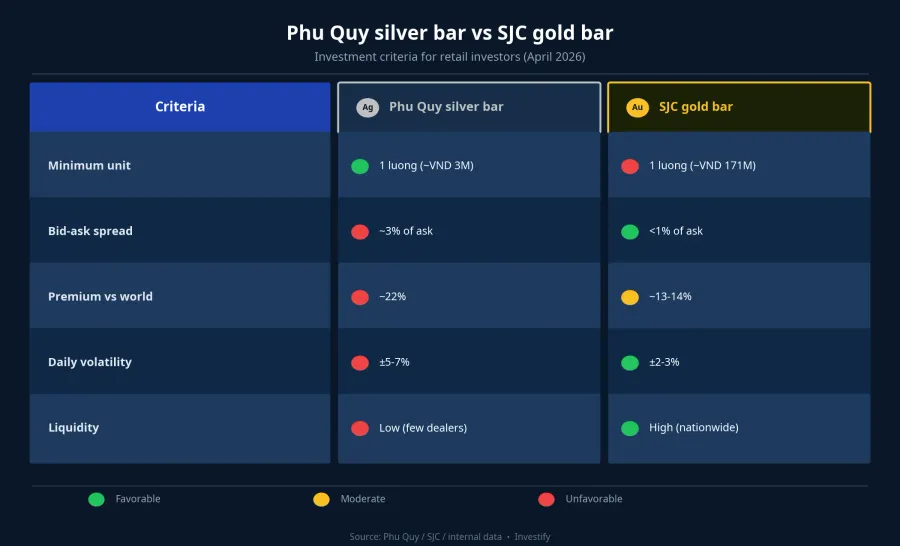
According to internal data, spot silver on April 17, 2026 was $78.64/oz with USD/VND at 26,328. Converted to the local unit (luong = 37.5 grams), world silver equals roughly VND 2.50 million per luong. Phu Quy 999 silver bars on the same day: VND 2.96 million/luong bid and VND 3.05 million/luong ask.Phu Quy
Two numbers matter. First, the ask-side premium over world price is ~22% — notably higher than the ~13-14% premium on SJC gold at recent levels. Second, the bid-ask spread at Phu Quy is about VND 90,000/luong, equivalent to ~3% of the ask price. Just a week earlier (April 14), Phu Quy was at VND 2.848M bid / 2.936M ask; the price rose ~4% in three sessions.Vietnam.vn
In other words, Vietnamese silver bars have a far lower capital barrier than SJC gold — VND 3 million/luong versus VND 171 million/luong — but in exchange, transaction costs are higher and liquidity is thinner. For buy-and-hold investors over a medium horizon, a 3% spread is a real but acceptable cost. For those wanting to trade in and out frequently, this cost erodes profit very quickly.
How this affects your wallet
The data raises three practical questions for retail investors.
First, can silver replace gold as a store of value? Short answer: no. Silver moves 2-3x more than gold and carries dual exposure to industrial cycles (solar, electronics) and precious-metal investment flows. These characteristics make silver a supplement to gold within a small allocation, not a replacement.
Second, is the 22% premium sustainable? The high spread reflects three factors: (a) domestic retail demand is rising faster than silver-bar supply, (b) processing, assay, and small-lot distribution costs in Vietnam, and (c) price expectations spilling over from the world market. If the domestic market expands with more dealers and competing brands, the premium may compress — similar to what is unfolding in the SJC gold market after the State Bank of Vietnam received 11 production licensing applications.
Third, does structural deficit guarantee continued price gains? No guarantee exists. The deficit is a supportive condition, but silver prices still react very strongly to Fed rate expectations, DXY moves, and solar-cell technology changes. JP Morgan's $81/oz forecast is a base case, not a promise — and the 20-24% drawdowns from January through March 2026 are a visual reminder of near-term volatility risk.
Three signals worth monitoring over the next 2-3 quarters: physical investment figures and COMEX/LBMA inventory, the pace of silver-content reduction in solar panels from Chinese manufacturers, and the evolution of domestic silver-bar premiums as retail supply expands.