


A chronically unprofitable shoe company sold its entire footwear brand for 39 million USD, then renamed itself NewBird AI. The result: BIRD stock surged over 580% in a single trading session on April 15. This story is disturbingly familiar, because Long Blockchain (2017) and KodakCoin (2018) opened with the exact same script and ended with delisting or project cancellation.
What the financial reports don't tell you: every time history repeats, FOMO capital arrives first and retail investors pay the price later.
What Just Happened with Allbirds?
On April 15, 2026, Allbirds (ticker: BIRD) officially announced its rebrand to NewBird AI and a complete pivot to AI compute infrastructure. This is a company that was once valued at over 4 billion USD at IPO, but subsequently suffered continuous revenue declines, shuttered most of its US stores, and faced "going concern" warnings about its ability to continue operations.TechCrunch
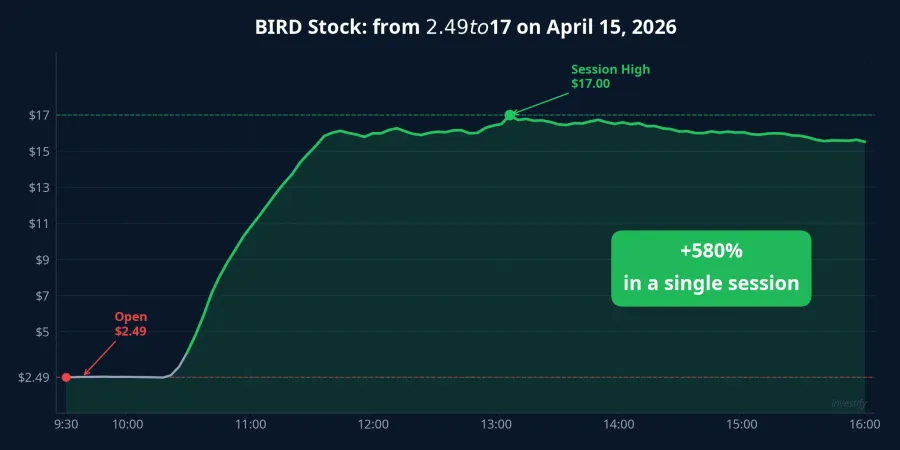
BIRD stock surged over 580% in the session, from a prior close of approximately 2.49 USD to the 17 USD range, even touching an intraday high of 24.31 USD.Yahoo Finance The specifics: in late March 2026, Allbirds sold its entire footwear brand and assets to American Exchange Group (AXNY) for 39 million USD.CNBC Simultaneously, the company signed an agreement to raise 50 million USD through a convertible loan from an institutional investor, with the stated purpose of purchasing GPUs and building "GPU-as-a-Service" capabilities.GlobeNewsWire
In other words, the entire "AI story" at the time of announcement consisted of: an undisbursed 50 million USD financing agreement, an unexecuted GPU purchase plan, and a new name. No AI revenue, no AI customers, no AI engineering team.
History of "Wave-Riding Renames" and Their Outcomes
This is not the first time markets have seen companies rename themselves to latch onto a technology trend. Every major tech cycle produces a generation of "renamed companies," and the outcome is almost always the same.

Long Island Iced Tea → Long Blockchain Corp (Dec 2017). In December 2017, this beverage company renamed itself Long Blockchain Corp. The stock immediately surged 380%, with trading volume spiking 1,000%.CNBC The outcome: in April 2018, NASDAQ sent a delisting warning. In July 2021, the SEC charged 3 individuals with insider trading — a major shareholder had tipped information before the rename.CoinDesk The company never deployed a single blockchain project.
Kodak → KodakCoin (Jan 2018). At CES Las Vegas, Kodak announced KodakCoin — a photo rights tokenization project. The stock surged over 300% in 2 days, with market cap jumping to 565 million USD.Wikipedia The planned ICO on January 31, 2018 was postponed indefinitely due to compliance issues. The project was eventually shut down entirely, with all mentions of KodakCoin removed from Kodak's official website.SmartMoneyMindset
The Dot-com Era (late 1990s). Numerous traditional companies added ".com" to their names. According to Purdue University research, these renamed companies saw an average 74% increase within 10 days of renaming, but most returned to original prices or went bankrupt within 12-18 months when the bubble burst in 2000.Wikipedia
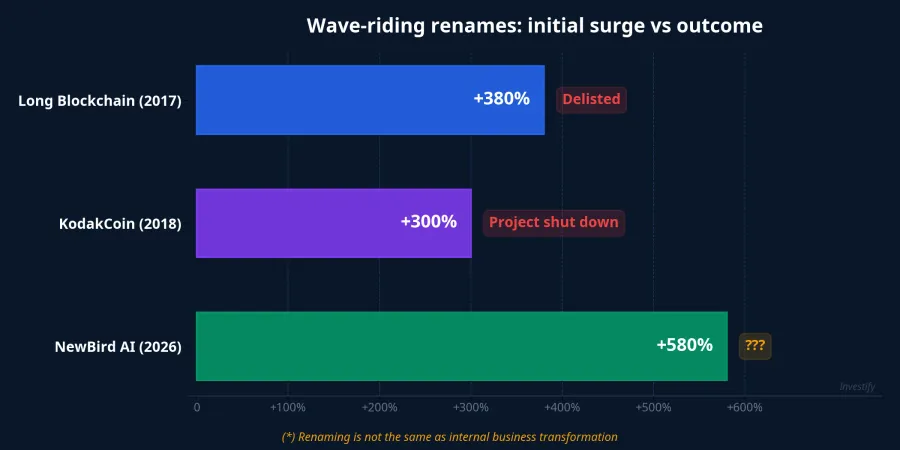
The common pattern is clear: in the first 0-60 days, prices surge on media coverage and FOMO; within 3-6 months, the lack of capability becomes evident and hype fades; within 6-12 months, prices return to pre-rename levels or lower.
Five Criteria to Distinguish Real AI from AI-in-Name-Only
Instead of believing "every AI stock is worth buying," investors need a concrete filter. Here is a 5-criteria framework:
Criterion 1: AI Revenue. Real AI companies have measurable AI revenue streams. FPT reports AI revenue in the tens of millions of USD per year, growing rapidly.FPT Software NewBird AI at the time of renaming: AI revenue is zero.
Criterion 2: Paying Customers. Strong signals include OEM contracts and enterprise customers actively using AI products. Warning signs: only "pilots," "PoCs," or "testing" — or in NewBird AI's case, nothing at all.
Criterion 3: GPU/Datacenter Infrastructure. FPT has built AI Factories in Vietnam and Japan, ranked Top 36 and Top 38 among the world's fastest supercomputers, using NVIDIA H100 and H200 GPUs.FPT Smart Cloud NewBird AI: plans to buy GPUs with 50 million USD in undisbursed convertible financing.
Criterion 4: AI Engineering Team. FPT has over 600 AI specialists and a comprehensive strategic partnership with NVIDIA. NewBird AI has no public information about AI personnel.
Criterion 5: Intellectual Property. Real AI companies own patents, proprietary trained models, and commercialized products. "Renamed" companies only have press releases.
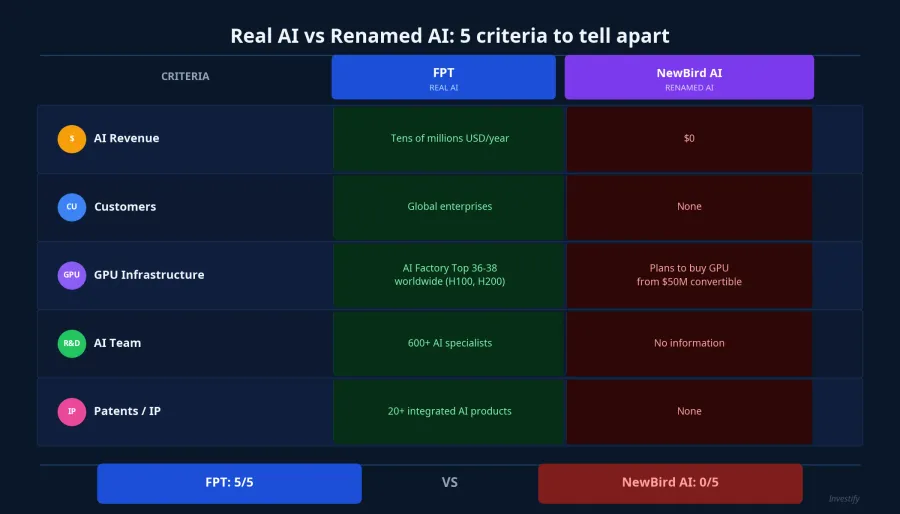
The result: FPT scores 5/5, NewBird AI scores 0/5. The gap speaks for itself.
The Bigger Picture: The Gap Between Expectations and Reality
The NewBird AI story is not isolated. According to a National Bureau of Economic Research (NBER) study published in February 2026, 90% of US businesses report that AI has not significantly impacted productivity — while executives at these same companies still project AI will increase productivity by 1.4% and output by 0.8%.Motley Fool The gap between expectations and reality is widening.
Total AI capital expenditure in the US is projected to exceed 500 billion USD per year in 2026-2027 — roughly equivalent to Singapore's GDP. Meanwhile, American consumers spend only approximately 12 billion USD per year on AI services.Nadcab The AI capex-to-revenue ratio is at levels not seen since the dot-com era.
This does not mean AI is fake. AI technology is real and transforming many industries. But there is a vast difference between AI as a foundational technology and AI as a marketing label on stocks. The dot-com era was built on real technology too, yet 80% of companies that slapped ".com" on their names still went bankrupt when the bubble burst.
What Should Vietnamese Investors Watch For?
In Vietnam, FPT is the company with the most complete AI ecosystem, trading at 75,100 VND per share with a P/E of approximately 15.4x — a reasonable valuation by regional standards. Beyond FPT, several other companies have announced AI strategies, but the depth of actual deployment varies significantly.
Vietnamese retail investors should stay vigilant against similar "AI labeling" — when a company suddenly announces an "AI strategy" without accompanying revenue, customers, or specific technical capabilities. The 5-criteria framework above applies to any market, in any language. The first question is always: where is the AI revenue?
Where Does the Real Risk Lie?
The NewBird AI story matches the historical pattern of wave-riding renames precisely. All three core elements are present: a loss-making company needing a new narrative, a hot technology trend to latch onto, and FOMO capital ready to chase prices higher.
History shows: Long Blockchain lost 100% of its value and faced SEC prosecution, KodakCoin was scrapped, and hundreds of ".com" companies went bankrupt. At the same time, Amazon, Google, and other genuine Internet businesses survived and thrived after the dot-com bubble. Real AI — with revenue, customers, and infrastructure — will survive the shakeout. AI that exists only in a name will not.
Three signals to monitor over the next 3-6 months: (1) whether NewBird AI actually disburses the 50 million USD and acquires GPUs; (2) whether it signs a first paying customer; (3) the outcome of the shareholder vote on May 18 regarding the shoe business sale. If all three answers are "no" or "not yet," the Long Blockchain scenario will no longer be just a metaphor.