


The big picture reveals an entirely new level of confrontation at Hormuz. After 21 hours of marathon negotiations in Islamabad, the US and Iranian delegations failed to reach any agreement. President Trump immediately declared a US naval blockade of the Strait of Hormuz, turning the shipping route that handles 20% of global oil and gas supply into a two-way exclusion zone. Brent crude closed at $95.35/barrel on Friday April 10, but Sunday night futures surged approximately 6-7%, pushing prices toward the $101-102 range. Monday April 14 will be the first session for Vietnam's market to absorb this shock.
1. Two-way blockade: an unprecedented situation
Previously, only Iran had closed the Strait of Hormuz and required commercial vessels to request permission to pass. This time, the US declared a blockade from the outside, meaning the strait is now sealed from both directions. This situation has never occurred in Hormuz's modern history.
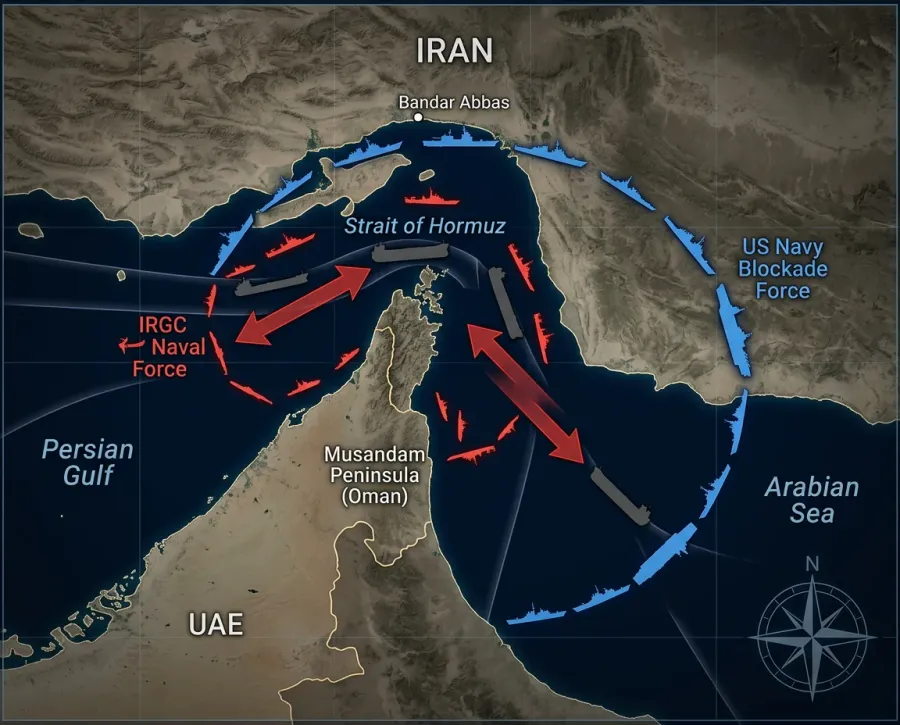
Hormuz handles approximately 20% of global oil and gas traffic.Fortune The near-complete closure has created a supply shortfall estimated at 4.5-5 million barrels per day, temporarily offset by coordinated strategic reserve releases by the IEA.CoinDesk However, strategic reserves are approaching their limits by mid-April.
The critical difference: the US blockade represents a direct military confrontation, affecting not just Iran but all commercial shipping through the strait. CENTCOM confirmed the blockade takes effect Monday April 13 at 10:00 AM ET (9:00 PM Vietnam time).NPR
2. Oil back above $100: comparison with the March episode
The last time Brent exceeded $100/barrel was during March 16 to April 2, when prices ranged between $100-113. During that period, the VN-Index dropped 12.5% from its peak of 1,818 points (March 4) to a trough of 1,591 points (March 23).
| Factor | March episode | Current (Apr 14) |
|---|---|---|
| Cause | Iran closed Hormuz, military escalation | Talks collapsed + US two-way blockade |
| Brent peak | $112.57 (Mar 27) | Expected above $100 |
| VN-Index pre-shock | 1,818 points | 1,750 points |
| VN-Index decline | -12.5% over 13 sessions | Unknown |
| Policy support | Stabilization fund + env. tax cut | Stabilization fund + 3 tax exemptions from Apr 16 |
| IEA strategic reserves | Just started releasing | Near depletion |
Three factors worth noting. First, the market has built partial immunity: the VN-Index already endured a 12.5% decline in March and recovered 10% from its trough of 1,591 to 1,750 points. Many investors have already reduced positions or set stop-losses.
Second, supply-side risk is more severe this time: a two-way blockade combined with depleting IEA reserves creates greater supply pressure. Goldman Sachs warned that Brent could remain above $100 throughout 2026 if Hormuz stays closed for another month.OilPrice
Third, initial session reactions tend to be exaggerated. The March 9 session saw the VN-Index drop 6.5% in a single day but recover strongly in subsequent sessions.
3. Winners and losers on the Vietnamese exchange
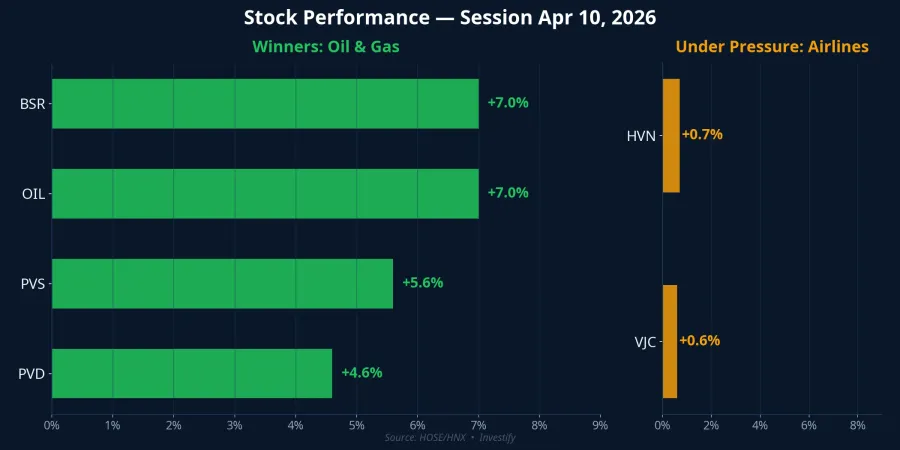
Upstream oil & gas and services are the most direct beneficiaries. PVS (PV Technical Services) closed at VND 39,600, up 5.60% on April 10, with net foreign buying. PVD (PV Drilling) reached VND 33,900, up 4.63%. PVT (PV Transport) hit VND 22,500, up 3.69%, benefiting indirectly as shipping routes are forced to take longer detours. However, all these stocks remain in a medium-term downtrend since early March; the April 10 bounce is insufficient to confirm a reversal.
Downstream (refining) is more complex. BSR (Binh Son Refining) rose 7.00% to VND 26,750, but surging input costs could squeeze refining margins (crack spread) if retail prices remain controlled. OIL (PetroVietnam Oil) gained 7.04% to VND 15,200, but with low liquidity and high volatility risk.
Airlines face the clearest pressure. HVN (Vietnam Airlines) rose only 0.67% to VND 22,500, barely responding to the broader market momentum. VJC (Vietjet Air) gained just 0.60% to VND 167,000. Fuel accounts for 30-40% of airline operating costs; every additional $10/barrel directly impacts Q2 profit margins.
Transport and logistics face similar pressure as fuel cost increases directly erode margins, especially for companies without fuel hedging contracts. Consumer and retail stocks are also indirectly affected as fuel prices push up shipping costs, adding inflationary pressure.
4. Policy cushion: stabilization fund and tax exemptions from April 16
The government has proactively built multiple layers of protection. After heavy spending in March with disbursements of VND 4,000-5,000 per liter of fuel, the government injected VND 8,000 billion from the central budget into the stabilization fund.CafeF Notably, in the April 9 pricing session, the inter-ministry committee switched to fund accumulation mode (VND 800/liter for gasoline, VND 1,000/liter for diesel), signaling the fund is being replenished after the heavy drawdown period.VnExpress
Domestic fuel prices in the April 9 session dropped significantly: E5 RON 92 gasoline fell to VND 22,340/liter (down VND 2,390, or 9.7% from the previous period), while diesel dropped sharply to VND 33,730/liter (down VND 9,510, or 22.0%).
The next layer of protection is the exemption of three fuel taxes from April 16. The National Assembly approved with 460 out of 500 votes, simultaneously exempting the environmental protection tax, special consumption tax, and suspending VAT on fuel, effective from April 16 through June 30, 2026.PetroTimes
However, the policy buffer has limits. If global oil prices remain above $100/barrel for weeks, tax measures and the stabilization fund will cushion the shock but not eliminate it entirely. The next pricing session (expected April 14 or 16) will more clearly reflect the weekend oil price surge.
5. What to watch during Monday's session

Investors may consider:
Reassessing exposure to oil-sensitive stocks. Airlines (HVN, VJC) face Jet A1 cost pressure that will be clearly reflected in Q2. Oil stocks (BSR, OIL, PVD, PVS) require caution when gap-chasing: March taught us that oil prices can reverse quickly on positive diplomatic signals — Brent dropped 13.3% in a single session (from $109.27 to $94.75) on April 7-8 following ceasefire news.
Tightening stop-loss discipline beyond normal levels. In a high-volatility environment, reasonable short-term stop-losses are 5-7% from session opening prices. Avoid "bottom-fishing" during the first 30 minutes of the morning session; wait for the market to absorb the news.
Key signals to monitor during the session: the opening range at 9:00-9:30 (if the gap down exceeds 2%, a technical bounce during the session is likely); foreign fund flows (heavy net selling is a warning signal); and Brent prices during the Asian session Monday morning, which will set the tone for the entire session.
Three common mistakes to avoid: panic-selling the entire portfolio (the March 9 session dropped 6.5% but recovered strongly afterward); going all-in on oil stocks because "oil goes up, oil stocks go up" (the correlation isn't always linear); and ignoring the diplomatic factor, because a single announcement about resumed talks could reverse oil prices 10-15% within hours.
Conclusion
Monday's session will face downward pressure, but Vietnam's market already endured a 12.5% decline in March and demonstrated the ability to recover quickly when tensions eased. The decisive factor is not the morning gap down, but the actual developments around the Hormuz blockade over the next 48-72 hours and the possibility of both sides returning to the negotiating table.
Three factors to watch this week: CENTCOM's actions when the blockade takes effect at 9:00 PM Vietnam time on Sunday April 13; Brent prices during the Asian session Monday morning; and any diplomatic signals about the possibility of resumed negotiations. If no de-escalation signals emerge within 48 hours, the scenario of Brent remaining above $100 becomes increasingly clear, and pressure on the stock market will persist rather than being just a single-session shock.