


On April 10, 2026, Vietnam's digital asset market recorded its largest investment deal to date. OKX Ventures and HashKey Capital signed a strategic partnership agreement with Vietnam Prosperity Crypto Asset Exchange (CAEX), raising the company's charter capital to VND 10,000 billion (approximately USD 380 million).Tuổi Trẻ This marks the first time a domestic banking group has joined forces with two global crypto heavyweights to build a legally licensed exchange on Vietnamese soil.
Under the roadmap, OKX Ventures, HashKey Capital and founding shareholders VPBankS and LynkiD will complete their capital contributions within April 2026, meeting the minimum VND 10,000 billion requirement under the pilot program established by Resolution 05/2025/NQ-CP.VnExpress
CAEX: From a VND 25 Billion Startup to a VND 10,000 Billion Exchange
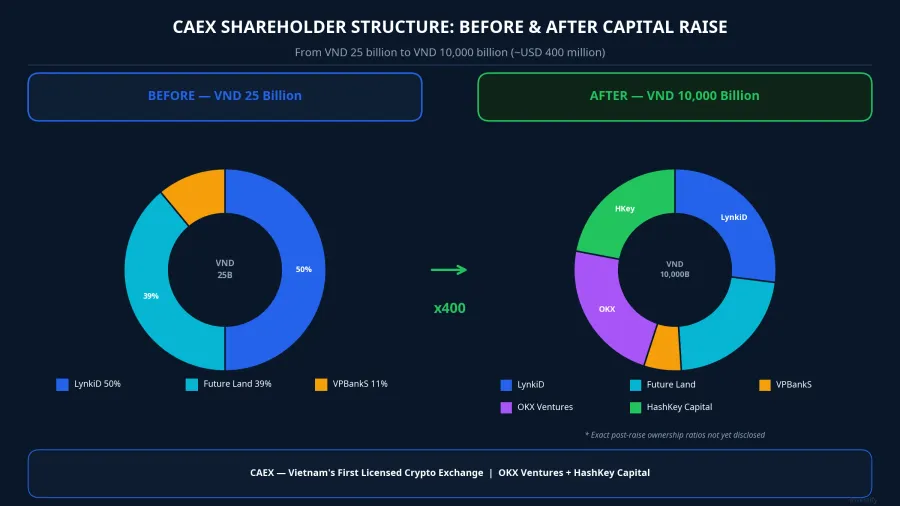
CAEX was established within VPBank's financial ecosystem with an initial charter capital of just VND 25 billion, held by three founding shareholder groups: LynkiD at 50%, Future Land at 39%, and VPBankS (VPBank Securities, ticker VPX) at 11%.VnEconomy

To leap from VND 25 billion to VND 10,000 billion, CAEX needed to raise nearly VND 9,975 billion. OKX Ventures and HashKey Capital are not only contributing capital but have also committed to supporting CAEX with technical infrastructure, security systems, regulatory compliance, risk management, and international liquidity connections.CoinDesk
What Do These Two Crypto Giants Bring to Vietnam?
OKX: A World-Leading Web3 Exchange
OKX is one of the largest crypto exchanges globally. OKX Ventures, the group's investment arm, specializes in funding Web3 projects, blockchain infrastructure, and decentralized finance. In terms of regulatory credentials, OKX was the first exchange in the world to receive MiCA (Markets in Crypto-Assets Regulation) authorization from the Malta Financial Services Authority in January 2025.OKX Additionally, OKX holds a MiFID II license for derivative products and a PI license for stablecoin payments in Europe.StockBiz
Star Xu, OKX's founder and CEO, personally announced the investment and emphasized that the company's MiCA compliance experience in Europe and money services licensing in the US would be directly applied to the Vietnamese market.OKX

HashKey Capital: Asia's Compliance Gatekeeper
HashKey Capital is one of the largest blockchain asset managers in Asia, managing over USD 1 billion and having invested in more than 200 projects.CoinPhoton Their licensing system in Hong Kong is among the most comprehensive in the industry: a Type 1 license (dealing in securities) enabling virtual asset brokerage services to both retail and institutional investorsHashKey Group; and Type 4 (advising on securities) plus Type 9 (asset management) licenses allowing full crypto portfolio management.CoinDesk
HashKey Capital also co-manages the first SFC-approved spot Bitcoin and Ether ETFs in Hong Kong, alongside Bosera Asset Management.BraveNewCoin In Singapore, HashKey has received in-principle approval for a CMS license from MAS.CoinPhoton
The combination of OKX (global exchange operations, European MiCA compliance) and HashKey (asset management expertise, dual SFC + MAS licensing in Asia) creates a rare duo in the crypto industry.
Resolution 05 and the Digital Technology Law: The Legal Foundation
CAEX did not emerge in a regulatory vacuum. The exchange launched precisely when Vietnam first established a formal legal framework for crypto assets.
Resolution 05/2025/NQ-CP, issued by the Government in September 2025, authorizes a 5-year pilot program for crypto asset trading.Government Portal Key requirements include: minimum charter capital of VND 10,000 billion; at least 65% of capital from institutional investors, with over 35% from banks, securities firms, fund managers, or tech companies; and a maximum of 5 organizations granted pilot licenses.
The Digital Technology Industry Law 2025 (effective January 1, 2026) defines crypto assets as "digital assets using cryptographic or equivalent technology to verify the creation, issuance, storage, and transfer process," while explicitly excluding securities and fiat digital currencies. This draws a clear boundary between crypto and traditional securities markets.
The Race for 5 Pilot Licenses
The Ministry of Finance received 7 applications and determined 5 to be complete and eligible.Vietnamnet Among the 5 candidates, CAEX stands out with its target capital of VND 10,000 billion, ten times larger than the nearest competitor (VIXEX at VND 1,000 billion), backed by both a domestic banking ecosystem and top-tier international partners.Thanh Niên
Why Vietnam, Why Now?
Vietnam ranks among the countries with the highest crypto adoption rates in the world. According to the Chainalysis 2025 Global Crypto Adoption Index, Vietnam ranks 4th globally, behind only India, the US, and Pakistan, with approximately 21% of the population owning or using crypto assets.VnEconomy
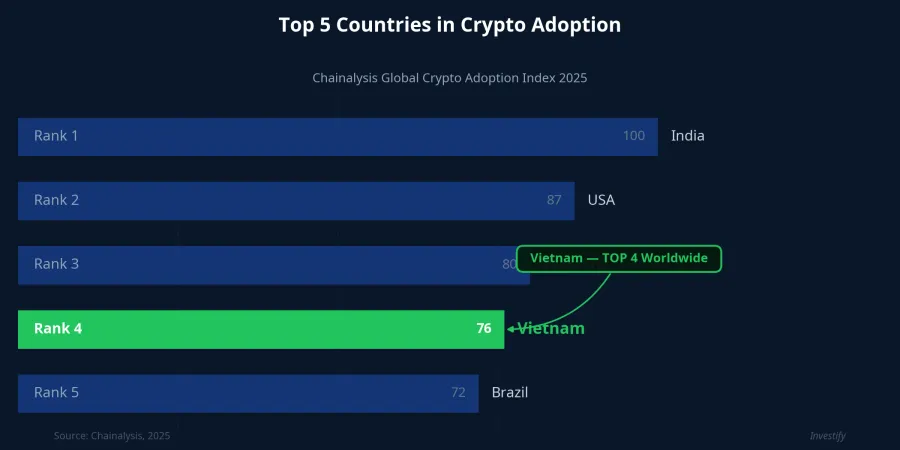
The total value of crypto assets received by Vietnamese users between July 2024 and June 2025 was estimated at approximately USD 220 billion, averaging over USD 600 million per day.CafeF However, all of this trading activity occurs on international exchanges without licenses in Vietnam: Binance, OKX, Bybit, and many smaller platforms. Users are not protected by Vietnamese law and have no compensation mechanism if assets are lost.
The government has recognized this paradox: a market worth hundreds of billions of dollars operating entirely outside regulatory control. Resolution 05 and the Digital Technology Law represent the effort to bring this activity "home," legalizing, regulating, and taxing it. The regulatory direction is to block unlicensed international exchanges and redirect all trading to domestic platforms.CafeF
Risks to Watch
Despite the groundbreaking nature of this deal, investors should remain clear-eyed about several risks.
First, the post-raise ownership structure remains unclear. CAEX has not disclosed specific ownership percentages after raising capital from VND 25 billion to VND 10,000 billion. Resolution 05 requires at least 35% of capital to come from domestic financial or technology institutions, so foreign ownership may be capped. The control mechanisms and authority distribution between domestic and foreign shareholders remain unknown.
Second, tradable products will be limited. The pilot phase prioritizes spot trading (direct buy/sell). Derivatives, leverage, and stablecoin products lack specific guidelines. For many Vietnamese traders accustomed to futures margin trading on Binance or OKX, the domestic exchange may initially lack appeal.
Third, the challenge of bringing users "home" is considerable. Convincing millions to leave international exchanges (which offer hundreds of trading pairs, deep liquidity, and low fees) for a new domestic platform will require time, reasonable tax policies, and competitive products.
Finally, the legal framework is still taking shape. Three crucial circulars on crypto assets were expected in Q1 2026 but remain incomplete as of today.VnEconomy The regulatory framework is being built in a "learn as you go" fashion, creating uncertainty for both operators and investors.
Benchmarking Against Hong Kong and Singapore
Comparing Vietnam with Asia's two largest crypto hubs reveals notable parallels. Hong Kong (SFC) requires virtual asset exchanges to meet supervisory standards equivalent to traditional stock exchanges, permitting only spot trading with strict limits on derivatives. Singapore (MAS) mandates client asset segregation, rigorous KYC/AML, and permits stablecoins under high reserve transparency standards.
Vietnam's Resolution 05 mirrors elements of both models: high entry barriers (large capital requirements like Hong Kong), financial-grade AML/KYC (like Singapore), and a phased roadmap expanding from spot to derivatives. The minimum capital requirement of VND 10,000 billion (~USD 380 million) is among the highest in the region, signaling the government's intent to admit only serious players.
What to Watch Next
The CAEX deal marks the moment crypto officially enters the regulated financial orbit in Vietnam. Over the coming 3-5 years, key milestones to watch include: whether CAEX can complete the VND 10,000 billion capital raise in April as pledged; how many of the 5 candidates the Ministry of Finance will license, and whether CAEX will be in the first batch; what tax rates on crypto transactions and income will look like; which tokens will be permitted on the pilot exchange; and the timeline for blocking unlicensed international exchanges.
With a market worth hundreds of billions of dollars and over 20 million potential users, Vietnam's legal crypto era is just beginning. CAEX, backed by VPBank, OKX, and HashKey, holds the best starting position; but the race ahead is long, and policy will ultimately determine who crosses the finish line.