


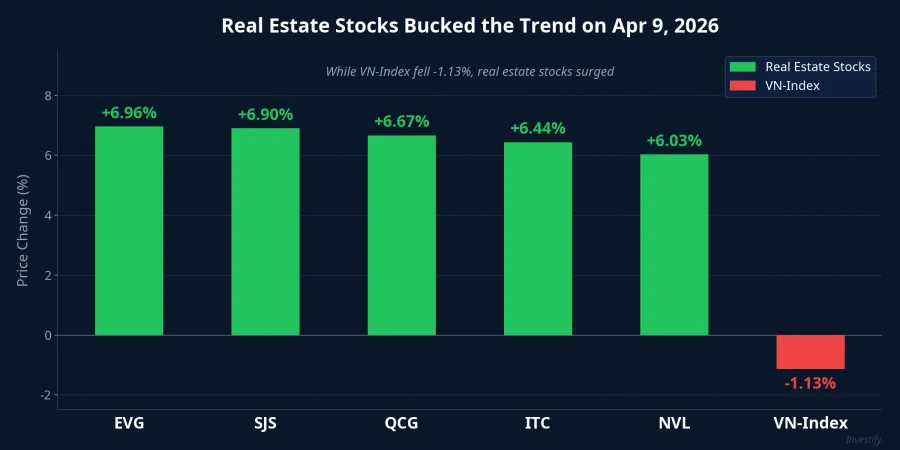
The big picture reveals an anomaly: VN-Index dropped 19.87 points (-1.13%) to 1,736.68 on April 9, yet real estate stocks surged in the opposite direction with 5 stocks hitting ceiling prices and 43 out of 78 sector stocks closing in the green.VnEconomy
Capital is shifting. Just one day after the historic 79-point rally driven by the FTSE upgrade confirmation, blue-chips corrected across the board while real estate stocks exploded. This was no coincidence. Here are 5 key factors investors need to understand before making their next move.
Real Estate Trading Volume Surged 1.83x
The most important signal is not the price increase but the volume. On April 9, the entire real estate sector recorded nearly 273 million shares traded, compared to a 20-session average of approximately 149.57 million shares — a 1.83x increase.
NVL alone accounted for nearly 30% of the sector's total volume with 81.7 million shares changing hands, 2.7 times the previous session (30.28 million on April 8).Dân Việt Other stocks like DXG, PDR, CEO, and DIG also saw significant volume increases.
When volume surges alongside rising prices, it signals active capital rotation. If prices rise on thin liquidity, it's typically a short-term technical wave that reverses easily. Here, the volume signal confirms real money is flowing into the real estate sector.
| Ticker | Closing Price | Change | Volume |
|---|---|---|---|
| EVG | VND 7,070 | +6.96% | 2.86M |
| SJS | VND 52,700 | +6.90% | 115,700 |
| QCG | VND 14,400 | +6.67% | 1.68M |
| NVL | VND 16,700 | +6.03% | 81.79M |
| ITC | VND 12,400 | +6.44% | 353,500 |
Foreign Investors Net Bought VND 62 Billion, Focused on NVL
On April 9, foreign investors net bought over VND 62 billion in real estate stocks. NVL captured nearly all foreign capital flowing into the sector, while QCG and EVG saw modest net buying. ITC and SJS experienced minor net selling, which had no significant impact on the overall picture.
The reason foreign investors concentrated on NVL is clear: it is one of 32 stocks expected to be included in the FTSE Global All Cap index when Vietnam officially upgrades to Secondary Emerging Market status in September 2026.Tuổi Trẻ Among the 32 stocks, real estate names include NVL, VHM, VIC, VRE, KDH, DXG, PDR, DIG, and KBC — a significant weighting. This explains why foreign capital is concentrated rather than spread thin, targeting stocks with a "ticket" into the FTSE basket.

NVL: Three Catalysts Converging
NVL was the session's focal point with three supporting factors converging simultaneously.
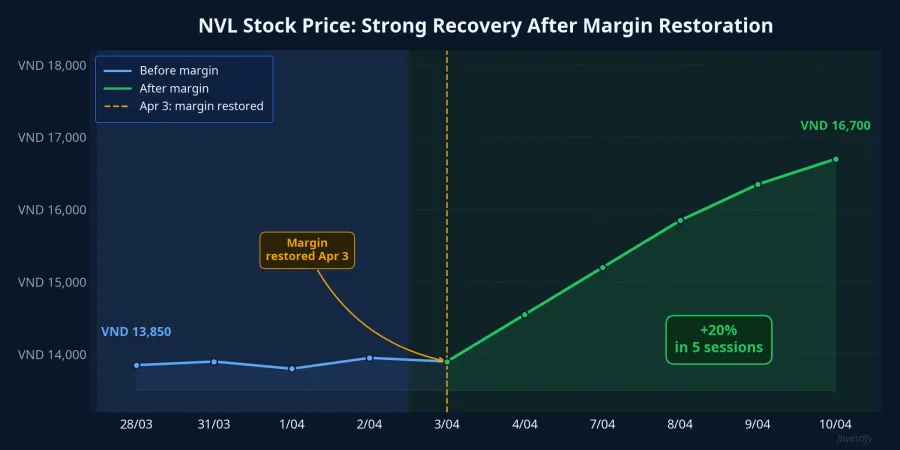
Margin trading restored from April 3, 2026. HoSE published the list of securities ineligible for margin trading in Q2/2026, and NVL was officially removed from the restricted list after its 2025 audited financials showed net revenue of VND 6,966 billion and after-tax profit of VND 1,861 billion.CafeF From VND 13,900 when margin was restored (April 2) to VND 16,700 on April 9, NVL surged over 20% in just 5 trading sessions.
Included in the FTSE 32-stock basket. FTSE Russell officially confirmed Vietnam's upgrade roadmap from Frontier Market to Secondary Emerging Market status, beginning September 21, 2026 and completing by September 2027, with an estimated USD 1.7 billion in passive capital inflows.Báo Chính phủVnEconomy
2026 revenue target 3.26x higher. According to AGM documents, Novaland set a 2026 net revenue target of VND 22,715 billion, 3.26 times its 2025 results, planning to hand over more than 5,200 units at Aqua City, NovaWorld Phan Thiet, and NovaWorld Ho Tram.Thời báo Tài chính
However, investors should note that NVL has no dividend plan for 2026 and its profit target of VND 1,852 billion is essentially flat compared to 2025. Revenue surging while profits stagnate reveals that restructuring costs and interest expenses remain a heavy burden. Record revenue does not automatically translate into higher earnings per share or dividends.
Distinguishing Fundamentally Backed Stocks from Momentum Plays
Not every rising real estate stock has a genuine story behind it. Investors need to clearly distinguish between two groups.
Stocks with clear support include NVL (market cap VND 37,300 billion, highest sector liquidity, both margin and FTSE eligible), DXG (in the FTSE 32-stock list, benefiting from passive capital flows), and KBC (industrial real estate, dual benefits from FTSE and FDI capital inflows). These stocks have real "stories" backed by actual trading volume.
Stocks requiring caution include EVG (market cap only VND 1,500 billion, volume of 2.86 million shares, large price swings creating liquidity traps), SJS (up 6.9% but volume only 115,700 shares — price moves on thin liquidity create false signals), QCG (legal recovery story needs further confirmation), and ITC (small market cap of VND 1,200 billion, suitable for short-term trading but high risk of getting stuck if capital flows reverse).
A simple rule: prioritize stocks that are both in the FTSE 32-stock list and had April 9 trading volume at least 2x their 20-session average. Currently, NVL and DXG meet both criteria.
Capital Rotation Lessons from Past Upgrades
Experience from other emerging markets following FTSE upgrades shows that capital typically moves through three phases. Phase 1 happens immediately after the announcement: capital concentrates on blue-chips, banks, and large caps — this was the April 8 session when VN-Index surged 79 points. Phase 2, roughly 1-2 weeks later, sees capital spreading to midcaps and indirectly benefiting sectors like real estate, securities, and tech. The April 9 session suggests this phase is underway. Phase 3, from September 2026 onward, is when actual passive capital flows in following the 4-stage roadmap through September 2027.
The most common mistake is FOMO buying right after the explosive session, when prices already reflect most short-term expectations. With NVL having gained 20% in 5 sessions, the probability of a technical correction within the next 1-2 sessions is high. Long-term investors should focus on Phase 3, when passive capital actually flows in, rather than chasing short-term waves.
April 10 Session: Four Signals to Watch
Today's session will be a critical test for real estate stocks. Four signals demand close attention.
First, NVL liquidity: if volume stays above 50 million shares and the price holds above VND 16,000, capital flow remains supportive; if volume drops sharply below 30 million and the opening price gaps down, profit-taking has begun.
Second, foreign capital flows: consecutive 2-3 sessions of net buying will confirm the sector rotation trend. A single session of net buying alone is insufficient to draw conclusions.
Third, VN-Index direction: if VN-Index continues declining while real estate stocks hold green, that clearly confirms sector rotation. Conversely, if real estate stocks reverse together, the April 9 rally was merely a short-term reaction.
Fourth, NVL technical levels: psychological resistance at VND 17,000 (round number), nearest support around VND 15,750 (April 8 closing price).
Conclusion
The April 9 session showed clear signals of capital rotation from blue-chips to recovering real estate stocks, driven by FTSE upgrade expectations, NVL's margin restoration and FTSE basket inclusion, and concentrated foreign net buying. However, investors must clearly distinguish fundamentally backed stocks (NVL, DXG, KBC) from short-term momentum plays (EVG, QCG, SJS, ITC) to avoid liquidity traps. Capital is shifting, but disciplined risk management is what ultimately determines returns.